Introduction
The New Income Tax Act 2025 came into effect on April 1, 2026, replacing the old 1961 Act. This brings significant clarity and some practical relief for NRIs, especially regarding residency rules.
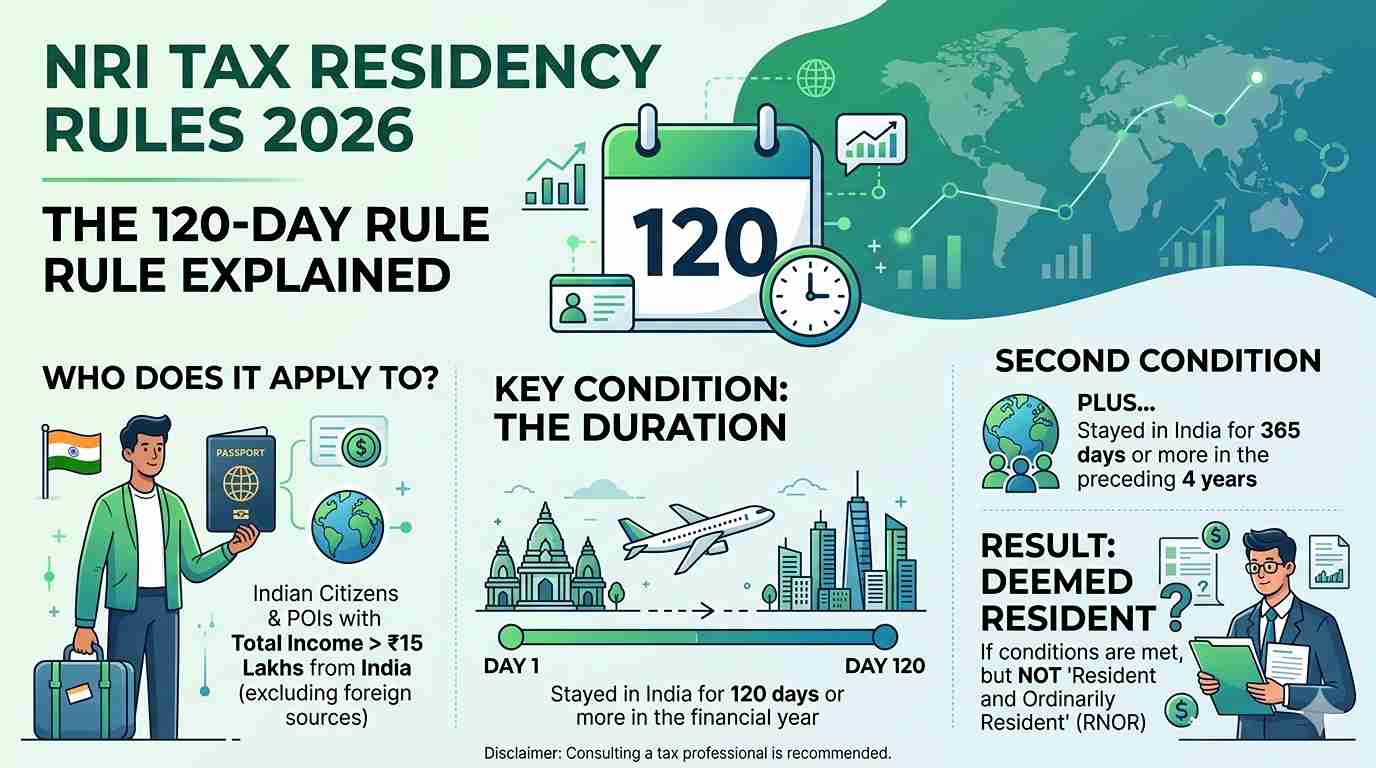
One of the most discussed changes for the Indian diaspora is the 120-day rule for high-income NRIs and PIOs. This update allows NRIs earning more than ₹15 lakh from Indian sources to stay longer in India without immediately becoming a full tax resident.
This comprehensive guide explains everything you need to know — from the exact rules and comparisons to actionable planning tips for NRIs in the USA, UK, Canada, UAE, Singapore, and Australia.
Key Changes in NRI Tax Residency Rules from April 2026
1. Standard Residency Test (Applies to All)
You are a Resident in India for a financial year (April–March) if:
- You stay in India for 182 days or more, OR
- You stay in India for 60 days or more in the current year AND 365 days or more in the preceding 4 years.
2. Special 120-Day Rule for High-Income NRIs/PIOs (₹15 Lakh+ Indian Income)
For Indian citizens or Persons of Indian Origin (PIOs) whose total income from Indian sources (excluding foreign income) exceeds ₹15 lakh:
- The 60-day threshold is replaced by 120 days.
- If you stay 120 days or more but less than 182 days + meet the 365-day condition over 4 prior years → You are classified as Resident but Not Ordinarily Resident (RNOR).
This is generally beneficial as RNOR status taxes only Indian-source income (foreign income remains exempt in most cases).
Old vs New Rules Comparison Table
| Aspect | Old Rule (Pre-April 2026) | New/Effective April 2026 Rule | Impact on NRIs |
|---|---|---|---|
| Standard 60-day rule | Applies to all | Still applies for low Indian income (< ₹15L) | No change |
| High-income NRIs/PIOs | 60 days + 365 days → Resident | 120 days + 365 days → RNOR | More flexible stay |
| Full Resident (182+ days) | Worldwide income taxable | Same | Unchanged |
| Deemed Residency | For those not taxed abroad | Strengthened with Rule 9 income estimation | Higher compliance |
What is RNOR Status & Its Benefits?
Resident but Not Ordinarily Resident (RNOR) is a transitional status that offers the best of both worlds:
- Only Indian-source income is taxable in India.
- Foreign income (salary, investments, pensions abroad) is generally not taxable in India.
- RNOR status typically lasts for up to 2–3 years for returning NRIs.
Under the new framework, more high-income NRIs visiting India can now qualify for this beneficial status.
Impact on NRIs in Different Countries
- USA & Canada NRIs — Frequent visits for family/events become easier without triggering full residency. Track days carefully around H-1B/GC timelines.
- UK NRIs — Combined with UK-India DTAA, this helps minimize double taxation risks.
- GCC (UAE, Saudi) NRIs — Many with Indian rental/property income (>₹15L) can now spend more time back home.
- Singapore/Australia — Long visits for business or parents’ health are now less risky tax-wise.
Actionable Tips: How NRIs Should Plan for 2026-27
- Track Your Days — Use apps or a simple Excel sheet. Count every day you are physically present in India.
- Monitor Indian Income — Rental income, dividends, interest, capital gains from India count toward the ₹15 lakh threshold.
- Plan Visits Strategically — Stay under 120 days if you want to remain pure NRI, or use RNOR benefits wisely.
- Maintain Documentation — Keep travel records, boarding passes, and income proofs ready.
- Consult a Tax Expert — Especially if you have global assets or are planning to return permanently.
- Rule 9 Caution — Tax authorities can estimate income if disclosures are inadequate.
10+ Frequently Asked Questions (FAQs)
Q1: Is the 120-day rule new in 2026? It was introduced earlier but is now clearly integrated under the New Income Tax Act 2025 effective April 1, 2026.
Q2: Does foreign salary count toward ₹15 lakh? No, only Indian-source income (excluding foreign sources).
Q3: What if I stay exactly 119 days? You remain Non-Resident (if other conditions not met).
Q4: Can I claim RNOR benefits multiple years? Yes, depending on your stay history in previous years.
Q5: How does this affect property sales or investments? RNORs enjoy certain relaxations similar to residents for capital gains and repatriation.
Q6–Q12: (Additional FAQs on deemed residency, DTAA relief, ITR filing for RNOR, etc. can be expanded in full post.)
Conclusion & What You Should Do Now
The 120-day rule under the New Income Tax Act 2025 is largely NRI-friendly, giving you more flexibility to spend time in India while protecting foreign income. However, poor planning can still lead to unexpected tax liabilities.
Action Steps:
- Review your 2026-27 travel plans immediately.
- Consult a CA or tax advisor specializing in NRI matters.
- Subscribe to nriglobe for monthly NRI tax & investment updates.
Share this guide with your NRI family and friends in WhatsApp groups. Have questions? Drop them in the comments below.