
TL;DR:
- PM Modi celebrated Paithani sarees in a recent Mann Ki Baat episode, highlighting artisan Kavita Dhawale's success story and the craft's 2,000-year heritage.
- Paithani weaving, centered in Maharashtra's Paithan and Yeola, generates income for thousands of artisans and has earned Geographical Indication (GI) protection.
- The National Handloom Day observance aligns with Modi's "Vocal for Local" and Atmanirbhar Bharat initiatives, encouraging diaspora support for Indian handlooms.
- NRIs can purchase authentic Paithanis through verified e-commerce platforms and wear them at cultural events to preserve this heritage craft.
- Modern innovations—lighter fabrics, contemporary colors, and online accessibility—have made Paithani sarees globally appealing while maintaining traditional craftsmanship.
The Enduring Legacy of Paithani Weaving
Paithani sarees originated in Paithan, a historic town in Maharashtra's Aurangabad district, during the Satavahana dynasty around 200 BCE. These handwoven silk sarees were so prized that ancient Greco-Roman traders exchanged gold for them, establishing them as a global luxury commodity centuries before modern international commerce. The craft flourished under the Maratha Empire's Peshwas in the 17th and 18th centuries, with Yeola emerging as a parallel weaving center of equal renown.
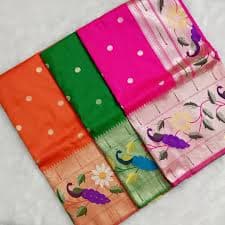
The visual identity of a Paithani is unmistakable: vibrant mulberry silk in reds, blues, yellows, and purples, adorned with gold and silver zari (metallic thread) work. Traditional motifs—the Narali (coconut), pankha (fan), and asavali (flowering vine)—reflect Maharashtra's agricultural and botanical heritage. What distinguishes an authentic handwoven Paithani from power-loom imitations is that both sides are identical, a testament to the weaver's skill and the interlocking weft technique employed.
Creating a single Paithani saree demands six months to two years of labor, depending on design complexity. The process begins with mulberry silk sourced from Bengaluru and zari from Surat. Weavers work on traditional pit looms, their fingers moving in precise, repetitive motions to create the pallu (end section), borders, and body. A master weaver may complete only three to four sarees annually, making each piece a rare artifact of human craftsmanship rather than a mass-produced commodity.
PM Modi's Tribute to Paithani Artisans and Rural Empowerment
In a recent Mann Ki Baat episode, Prime Minister Narendra Modi spotlighted Kavita Dhawale, a Paithani weaver from Paithan whose entrepreneurial vision transformed a traditional craft into a sustainable livelihood for women artisans. Starting with limited resources, Dhawale established a production center that has significantly improved income levels for participants. Her story exemplifies how government support—including training, credit access, and market linkages—can amplify the economic impact of heritage crafts.
Modi contextualized Dhawale's success within a broader textile revival, noting that numerous textile startups across India are modernizing handlooms while preserving their cultural essence. He cited parallel examples: tribal women in Odisha's Mayurbhanj district reviving Santhali sarees, and Naveen Kumar's family in Nalanda, Bihar, integrating advanced handloom technology to collaborate with national and international brands. These narratives illustrate that tradition and innovation are not opposing forces but complementary drivers of economic growth and cultural preservation.
The Prime Minister's remarks positioned handlooms as central to India's Viksit Bharat vision—a developed India by 2047. He emphasized that textile artisans are not relics of the past but architects of India's future, creating products that command global respect and premium pricing. Government initiatives supporting handloom artisans include skill development programs, subsidized credit schemes through cooperative banks, and export promotion support. These measures aim to address the persistent challenges facing traditional weavers while ensuring that heritage crafts remain economically viable for future generations.
Paithani's Modern Revival: Bridging Tradition and Contemporary Demand
The Paithani weaving sector experienced a severe contraction during the 20th century as industrial textiles displaced handlooms and younger generations migrated to urban centers. However, government intervention, cultural pride, and diaspora demand have catalyzed a remarkable recovery. Yeola has emerged as a significant weaving hub with substantial artisan engagement in weaving, dyeing, and degumming activities. Both Paithan and Yeola earned Geographical Indication (GI) certification, which protects the authenticity of Paithani sarees and ensures that only products meeting strict traditional standards bear the name.
Master weavers have been instrumental in preserving classical techniques while introducing measured innovations. Contemporary Paithanis now feature larger borders, unconventional color palettes—chocolate brown, violet, forest green—and fusion motifs that appeal to younger buyers without compromising the saree's structural integrity or weaving method. This balance between heritage and modernity has proven commercially successful, attracting brides, collectors, and cultural enthusiasts globally. The integration of contemporary design elements with time-honored weaving methods demonstrates that traditional crafts can evolve to meet modern aesthetic preferences while maintaining their essential character and cultural significance.
E-commerce platforms such as Paithanistore.com and Vastranand.in have democratized access to authentic Paithanis, allowing diaspora members to purchase directly from artisans or certified retailers without traveling to Maharashtra. These platforms provide detailed documentation of weaver names, production timelines, and material sourcing, building consumer confidence and supporting transparent supply chains. The availability of Paithani sarees through verified online channels has significantly expanded the market reach beyond traditional geographic boundaries, enabling international customers to access these handcrafted textiles with confidence in their authenticity.
National Handloom Day and the "Vocal for Local" Movement
National Handloom Day commemorates the Swadeshi Movement of 1905—a pivotal moment when Indian nationalists championed indigenous crafts like Khadi and Paithani as symbols of resistance and self-reliance. Government celebrations of this observance strategically reinforce commitment to handloom revival and the broader "Vocal for Local" campaign.
"Vocal for Local" is not merely a slogan but a policy framework encouraging Indians and the diaspora to prioritize domestically produced goods, particularly handcrafted items. By purchasing Paithani sarees, NRIs contribute directly to rural artisans' incomes, reduce dependence on imported textiles, and strengthen India's textile export sector. This approach is framed as integral to Atmanirbhar Bharat (self-reliant India), a vision where India's economy is anchored in indigenous innovation, resources, and labor rather than external dependencies.
The economic multiplier effect is significant. When an NRI purchases a Paithani saree, the weaver typically retains a substantial portion of the price, with the remainder distributed among silk suppliers, dyers, and intermediaries. This creates a network of employment across rural Maharashtra, stabilizing communities that might otherwise experience outmigration and economic decline. The ripple effects extend beyond individual artisans to support entire supply chains of supporting craftspeople and service providers.
Paithani Sarees in the NRI Cultural Landscape
For Non-Resident Indians, Paithani sarees occupy a unique position in diaspora identity. They are worn at weddings, where brides often choose them for pre-wedding ceremonies or receptions to honor Maharashtra's heritage. During Diwali celebrations in diaspora communities across North America, Europe, and the Middle East, Paithani sarees appear prominently, signaling cultural pride and continuity across generations. Unlike mass-produced ethnic wear, a Paithani saree is a statement of sophistication and historical awareness—it announces that the wearer understands and values India's textile heritage.
The versatility of Paithani draping has also enhanced its appeal among younger diaspora members. Traditional Nauvari style (worn in Maharashtra) coexists with modern draping methods—dupatta-style wraps, contemporary pleating, and fusion styling—allowing Paithanis to integrate into diverse wardrobe contexts. Celebrities and influencers within the diaspora have amplified visibility, with social media posts of Paithani-clad attendees at weddings and festivals reaching millions globally. This organic promotion has positioned Paithani as a symbol of Indian elegance comparable to haute couture sarees from other regions, making it increasingly accessible and desirable to diaspora communities seeking authentic cultural expression.
Challenges and the Path Forward for Paithani Artisans
Despite revival efforts, Paithani weavers face persistent challenges. The craft's labor-intensive nature means production costs remain high, limiting affordability for middle-income consumers and making competition with power-loom sarees difficult. Young people in weaving communities often pursue education or urban employment, creating a generational knowledge gap. Climate variability affects silk production in Bengaluru, and fluctuating zari prices impact profitability.
Government initiatives—skill development programs, subsidized credit through banks, and export promotion—address some of these issues. However, sustained success requires consistent diaspora engagement, transparent supply chains, and premium positioning that justifies Paithani's price point through storytelling and authenticity certification. The Ministry of Textiles and related agencies continue to develop support mechanisms aimed at making handloom production more economically sustainable while preserving traditional knowledge and techniques.
The path forward for Paithani weavers depends on balancing several competing demands: maintaining traditional craftsmanship standards while adopting selective innovations, keeping production costs manageable while ensuring fair artisan compensation, and expanding market reach through digital platforms without losing the handcrafted authenticity that commands premium pricing. Success in these areas will determine whether Paithani weaving can sustain itself as a viable livelihood for future generations of artisans.
How NRIs Can Support Paithani Weavers
- Purchase from Verified Sources: Buy from platforms with transparent weaver attribution, such as Paithanistore.com, Vastranand.in, or direct cooperative networks. Verify GI certification to ensure authenticity.
- Invest in Quality Over Quantity: A single authentic Paithani worn repeatedly over decades is more sustainable and impactful than multiple cheaper replicas.
- Share Stories: Post about your Paithani purchases on social media, tagging artisans and platforms to amplify visibility and inspire others in your diaspora community.
- Attend Cultural Events: Wear Paithani sarees to weddings, festivals, and community gatherings to normalize their presence in diaspora spaces and celebrate their artistry.
- Gift Meaningfully: Paithani sarees make exceptional gifts for family members in India or diaspora friends, carrying cultural significance and supporting artisans simultaneously.
- Advocate for Fair Pricing: Educate your networks about why Paithani sarees command premium prices and resist pressure to negotiate below cost, which undercuts weaver livelihoods.
Next Steps
If you are an NRI interested in supporting Paithani weavers, begin by researching verified e-commerce platforms and reading weaver profiles to understand the craftsmanship behind each saree. Consider purchasing a Paithani for an upcoming cultural event or as a gift for a family member in India. Share your experience with NRI Globe and your diaspora community to amplify awareness. As National Handloom Day approaches, use this moment to deepen your connection to India's textile heritage and contribute to the economic empowerment of rural artisans. Your engagement with these traditional crafts directly supports the preservation of centuries-old techniques and the livelihoods of skilled weavers across Maharashtra.
Sources
- Press Information Bureau (PIB), Government of India — Official source for PM Modi's Mann Ki Baat speeches and government textile initiatives.
- Ministry of Textiles, Government of India — Comprehensive data on handloom sector, artisan support schemes, and National Handloom Day initiatives.
- IP India (Intellectual Property) — Official registry for Geographical Indication (GI) certifications, including Paithani and Yeola sarees.
- PIB Press Release Archive — Detailed coverage of handloom revival programs and artisan success stories.