
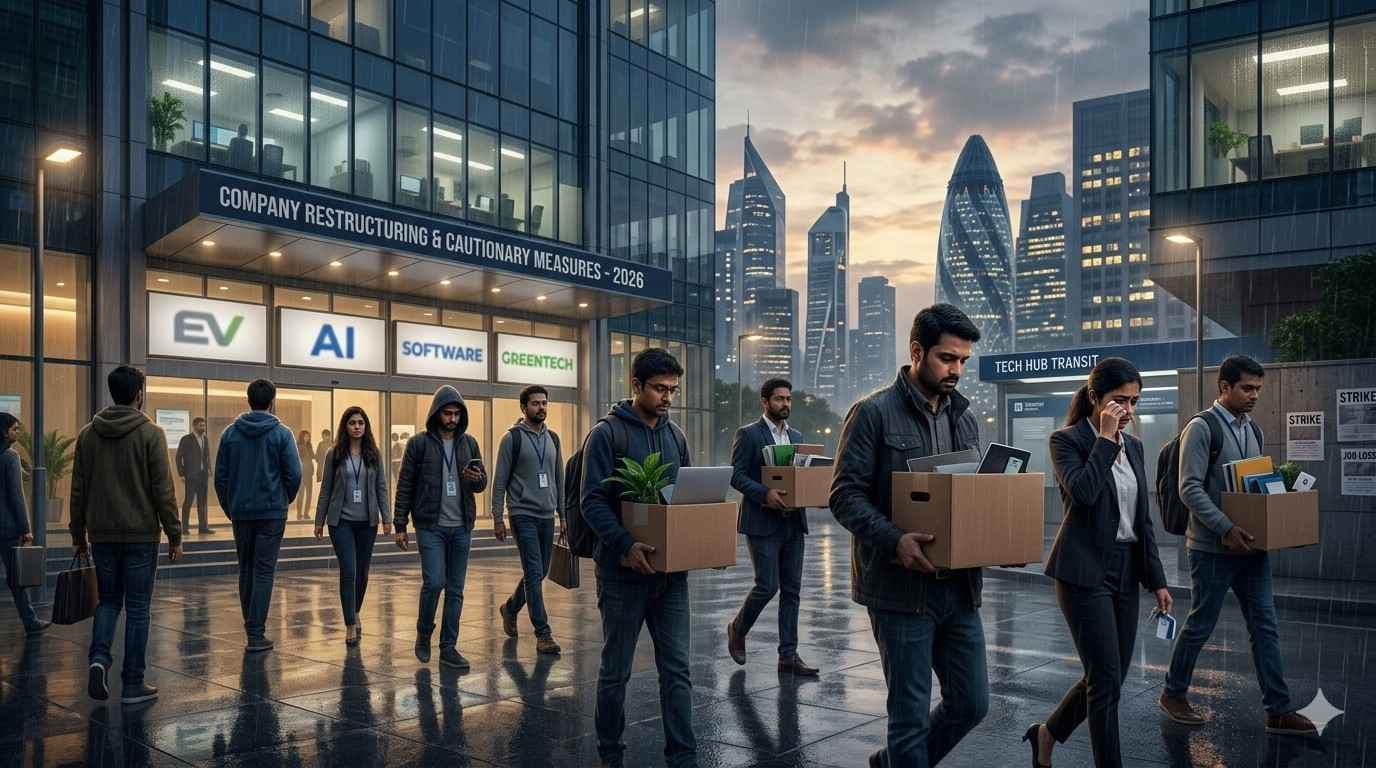
For NRI tech professionals working at Indian IT services majors (Infosys, TCS, Wipro, HCL, Tech Mahindra, LTIMindtree), at Global Capability Centres (GCCs) of US/EU enterprises in India, or at Indian product companies, the central 2026 question is how generative AI is reshaping the industry's growth trajectory + employment patterns. This analysis covers the augmentation-not-replacement thesis publicly articulated by industry leaders including Narayana Murthy (Infosys founder + chairman emeritus), the new service-line opportunities that AI creates, the reskilling framework for NRI IT professionals, and what the broader Indian tech industry landscape looks like through this transition.
The augmentation-not-replacement thesis
The publicly stated industry position
Narayana Murthy — Infosys founder + chairman emeritus + foundational figure in Indian IT services — has consistently articulated the position over multiple public appearances that AI represents augmentation rather than replacement for Indian IT services firms. The framing follows from a structural argument:
- AI handles routine + repetitive tasks (basic coding, testing, support tickets, documentation generation) — freeing human engineers for higher-value work.
- AI implementation creates substantial new services demand — large enterprises need help integrating AI into their workflows, data preparation, model training, governance, security, and ongoing operations.
- Indian IT services firms have structural scale advantages for AI implementation — established client relationships + delivery capability + cost structure.
- Historical precedent — previous major technology shifts (mainframe → client-server, on-premise → cloud, monolith → microservices) ultimately expanded the services market rather than shrinking it.
This framing has been publicly articulated by Murthy across multiple forums + interviews + industry events; similar positions have been taken by other senior Indian IT industry leaders (TCS, Wipro, HCL, Tech Mahindra leadership).
Why the augmentation thesis matters
- Enterprise AI deployment is structurally complex — data quality, integration with legacy systems, change management, governance, security, monitoring.
- Indian IT services firms have decades of experience handling exactly this kind of complex enterprise delivery at scale.
- The same Indian engineering talent + project management infrastructure that delivered enterprise IT modernization can deliver enterprise AI transformation.
The actual employment landscape in 2026
What's happening at Indian IT services majors
- Slower headcount growth at entry-level — major Indian IT firms have publicly reduced fresher hiring numbers compared to 2021-2023 peak years. Fewer hires per quarter than the broader hiring patterns suggested historically.
- Increased focus on reskilling existing employees — substantial internal programs at TCS, Infosys, Wipro, HCL covering AI/ML, cloud, data engineering, cybersecurity skills.
- Shift toward higher-value services — strategy consulting, AI transformation programs, cloud migration deals, custom AI implementation. Average revenue per employee trending up.
- Margin pressure on commoditized services — basic application maintenance + testing automation impacting traditional services margins.
What's happening at GCCs (Global Capability Centres)
- GCC growth continues — major US/EU enterprises (Microsoft India, Google India, Amazon India, Walmart Global Tech India, JP Morgan India, Wells Fargo India, Cisco India, Salesforce India) continue substantial hiring across senior IC + engineering management levels.
- GCC AI roles particularly competitive — substantial demand for ML/AI engineers + applied scientists + data engineers.
- Salary structure at GCCs closer to US-equivalent comp than traditional Indian IT services — substantial pull for NRI returnees with US experience.
What's happening at Indian product companies
- Aggressive AI investment across Flipkart, Razorpay, CRED, PhonePe, Paytm, Freshworks, Zoho, Tata Digital, Reliance Jio Platforms.
- Senior IC + EM hiring particularly competitive for AI/ML + data engineering specialties.
- Compensation often comparable to GCCs at senior levels with equity upside.
New service lines that AI creates
AI implementation + system integration
- Enterprise data preparation + cleansing for ML model training.
- Foundation model selection + fine-tuning for enterprise use cases.
- Vector database deployment + retrieval-augmented generation (RAG) pipelines.
- Integration with legacy enterprise systems (SAP, Oracle, Salesforce, etc.).
MLOps + platform engineering
- ML model deployment + monitoring infrastructure.
- Cost optimization for AI workloads.
- Multi-region ML platform deployment.
- A/B testing infrastructure for AI features.
AI governance + compliance
- Responsible AI frameworks for enterprises.
- AI ethics + bias monitoring.
- Regulatory compliance (EU AI Act, sectoral US regulations, India digital frameworks).
- AI audit + explainability programs.
AI security
- Adversarial input protection.
- Model leakage + prompt injection defense.
- Supply chain security for AI components.
- Privacy-preserving ML techniques.
Domain-specific AI applications
- Healthcare AI (regulatory + workflow integration).
- Financial services AI (fraud + risk + customer service).
- Manufacturing AI (predictive maintenance + quality).
- Retail AI (personalization + supply chain).
Reskilling framework for NRI IT professionals
For NRI engineers working at Indian IT services majors
- Build deep specialty in one of the 5 resilient clusters — AI/ML, Cloud, Cybersecurity, Data Engineering, DevOps/SRE.
- Pursue cloud certifications — AWS Solutions Architect / DevOps, Azure equivalents.
- Pursue ML/AI certifications — Google Cloud ML Engineer, AWS ML Specialty, Azure AI Engineer.
- Build portfolio — GitHub projects demonstrating AI + cloud + data implementation work.
- Track internal mobility opportunities — most major Indian IT firms have AI transformation practice groups actively hiring internally.
For NRI engineers at GCCs
- Lean into US-domain + India-context bridge roles — engineering management + senior IC positions span US/India teams.
- AI/ML specialty particularly valued at GCCs.
- Cross-border collaboration skills — team management + asynchronous workflow design.
For NRI engineers at Indian product companies
- Equity compensation meaningful — evaluate total compensation including stock vesting.
- Senior IC + EM roles particularly competitive for AI/ML specialties.
- Customer-facing engineering + product-engineering bridges in demand.
For NRI tech professionals abroad (US/UK/Canada/Australia)
Compatibility of skills with Indian IT services landscape
- US-trained AI/ML engineers are highly valued by Indian IT services majors + GCCs + product companies if returning to India.
- Returnees with US enterprise transformation experience command substantial premium at senior IC + EM levels.
- Cross-cultural collaboration capability — substantial value for NRI returnees who can manage cross-border programs.
What return-pathway options look like
- Direct hire by Indian IT services majors — senior roles via internal referrals + direct application.
- GCC employment at the India-side subsidiary of US/EU enterprises — closest comp pattern to US.
- Indian product companies — competitive comp + equity for AI/ML specialties.
- Consulting + advisory roles — senior advisory positions at AI transformation practice groups.
NRI Globe's NRIs returning to India 2026 guide covers the broader returnee framework + city-by-city salary realities.
The honest balance — challenges that remain
- Short-term disruption for highly-repetitive roles is real — basic coding + testing + support work most affected.
- Companies that fail to reskill rapidly face margin pressure + competitive disadvantage.
- Competition from global hyperscalers + AI-native startups intensifying — Indian IT services firms can't compete purely on cost arbitrage.
- Need to demonstrate strategic value beyond commoditized services — Indian IT firms increasingly position as transformation partners not just delivery vendors.
What previous technology waves teach us
- Personal computers (1980s-1990s): Initial fears of job losses → ultimately expanded technology workforce dramatically.
- Internet (1990s-2000s): Initial concerns about traditional industries → spawned entirely new technology ecosystem + Indian IT services boom.
- Cloud computing (2010s-2020s): Initial fears of traditional IT job losses → expanded both cloud-native + traditional IT roles.
- Generative AI (2023-2026): Pattern emerging similarly — augmentation of existing roles + creation of new specialties + expansion of overall services demand.
The historical pattern consistently shows: technology waves create more opportunities than they eliminate, but the transition periods reward those who adapt faster.
Implications for NRI tech professionals — practical framework
- Lean into AI specialty — particularly applied ML + foundation model integration + AI implementation.
- Maintain breadth across the 5 resilient clusters — depth in one + breadth across — beats depth in only one as the landscape evolves.
- Build personal brand — substantive technical posts on LinkedIn + GitHub portfolio drive inbound recruiter conversations.
- Engage with industry communities — Indian tech communities in Bay Area / NY / Houston / Toronto / Mississauga / London — knowledge sharing + opportunity flow.
- Consider hybrid models — some NRIs maintain US-based roles + India-based remote work arrangements at GCCs or Indian companies; this hybrid is increasingly viable.
- Plan reversibility — don't liquidate US ties prematurely; the option value of multiple geographic pathways matters.
Final thoughts
The augmentation-not-replacement thesis articulated publicly by Narayana Murthy + other senior Indian IT industry leaders reflects a structural argument about how previous technology waves have expanded the services market — and applies plausibly to the current AI wave. The transition is not without disruption — entry-level + highly-repetitive roles face real pressure — but the broader landscape continues to create substantial opportunities for NRI tech professionals who adapt their skills toward AI implementation, MLOps, data engineering, AI governance, AI security, and domain-specific AI applications. The Indian IT services majors + GCCs + Indian product companies all show substantial appetite for senior IC + EM talent with these specialties. For NRI tech professionals navigating this period, the consistent strategic answer is: lean into AI specialty + maintain skill breadth + build substantive personal brand + plan multiple-geography optionality.
For broader NRI tech career framework, NRI Globe's Tech Careers for NRIs in USA 2026 guide covers the in-demand skill clusters + salary ranges + positioning playbook. The US tech layoffs guide covers downside recovery framework. The NRIs returning to India 2026 guide covers the returnee city + salary framework.
Informational only — industry employment patterns + company specifics change. The analysis reflects publicly articulated industry positions + general patterns; verify current information at the specific employer's announcements + reputable industry sources before specific career decisions. Not investment advice.