
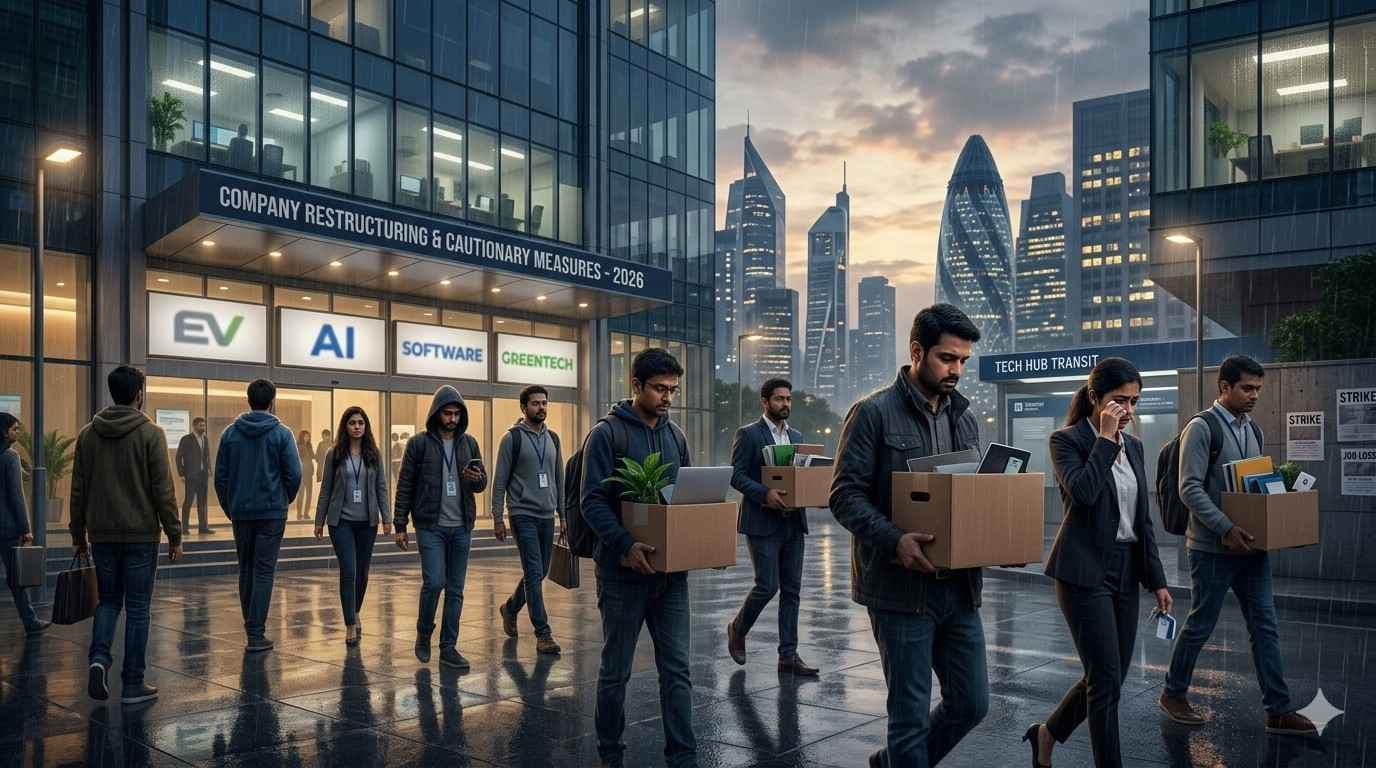
By June 2026, the artificial intelligence boom that reshaped corporate hiring across North America has collided with fiscal reality. Token costs for large language models, GPU rental expenses, and data-centre power consumption have become board-level concerns, forcing technology companies to recalibrate their AI strategies from experimental deployment to cost-disciplined operation. For Indian technology professionals and H-1B visa holders in the United States, this shift carries immediate consequences: some AI-adjacent roles face retrenchment, while others—particularly those focused on cost optimization and efficiency—are emerging as protected categories. Understanding which roles are vulnerable and which are resilient is essential for visa holders and their employers as hiring patterns reset.
The cost reckoning arrives not because AI capability has plateaued, but because the economics of deployment have become unsustainable at scale. A single large language model API call, multiplied across millions of users or internal processes, generates bills that rival traditional software licensing. Companies that launched AI initiatives with venture-capital-style "growth at all costs" mentality now face pressure from chief financial officers demanding demonstrable return on investment. This recalibration is reshaping visa sponsorship patterns, job security for foreign workers, and the types of technical expertise that command premium salaries and visa support.
The Cost Crisis: Why June 2026 Became a Turning Point
The economics of large language models differ fundamentally from traditional software. Rather than a fixed licensing fee, companies pay per token—each small unit of text processed. At scale, these costs accumulate rapidly. A financial services firm running sentiment analysis on customer communications, a healthcare provider deploying diagnostic assistants, or a customer-service operation using AI chatbots all face monthly bills that scale with usage. By mid-2026, many organizations discovered that their AI initiatives were consuming 15–40% of their technology budgets while delivering measurable but often incremental productivity gains.
Three cost drivers converged to create the June 2026 reckoning. First, token costs from major API providers—while declining incrementally—remained expensive enough that high-volume use cases became economically unjustifiable without optimization. Second, GPU rental costs for companies running proprietary models or fine-tuned variants remained elevated, particularly as demand for compute capacity remained strong across the sector. Third, the power consumption of data centres running inference workloads became a material line item, especially for organizations with sustainability commitments or operating in regions with high electricity costs.
For Indian technology workers on H-1B visas, this cost discipline has an immediate implication: companies are no longer hiring AI engineers and machine-learning specialists at the volume they were in 2024–2025. Visa sponsorship—which requires employers to demonstrate that no qualified U.S. workers are available—becomes harder to justify when headcount is frozen or reduced. The shift is not away from AI entirely, but toward a more selective, efficiency-focused hiring model.
The Pivot: Open-Source, RPA, and Hybrid Models Replace Monolithic AI
In response to cost pressures, companies are pursuing three primary strategies: migrating to cheaper open-source language models, returning to robotic process automation (RPA) for structured tasks, and adopting hybrid architectures that use AI selectively rather than as a universal solution.
Open-Source Model Adoption
Open-source language models—including variants of Llama, Mistral, and other community-developed architectures—offer dramatically lower inference costs when run on a company's own infrastructure. Rather than paying per token to a third-party API, organizations can host these models on their own GPU clusters or rent compute capacity more cheaply than API pricing. The trade-off is engineering effort: open-source models require more tuning, monitoring, and infrastructure management than API-based solutions. For Indian professionals, this creates demand for specialized roles in model deployment, containerization, and infrastructure optimization—but reduces demand for roles focused on prompt engineering or API integration, which were common entry points for junior H-1B workers.
Return to RPA for Structured Workflows
Robotic process automation—software that automates repetitive, rule-based tasks—is experiencing a resurgence as companies recognize that not every workflow requires generative AI. RPA is faster, more predictable, and cheaper than agentic AI for tasks like data entry, form processing, or invoice reconciliation. This shift is particularly pronounced in financial services, insurance, and business-process outsourcing. For H-1B visa holders, RPA roles typically require less specialized expertise than large-language-model engineering, which can reduce visa sponsorship justification. However, RPA expertise is often concentrated in India-based teams, creating opportunities for remote work arrangements or onshore roles focused on architecture and oversight.
Hybrid Architectures: AI Where It Matters
The most sustainable approach emerging in June 2026 is the hybrid model: companies use AI for high-value, non-repetitive tasks (customer-facing insights, complex analysis, creative content) while relying on cheaper, deterministic solutions for routine work. This approach requires architects and engineers who can design systems that blend multiple technologies—a skill set that is less common and commands higher compensation and stronger visa sponsorship justification.
Which Roles Are Most Exposed: The AI Cost-Discipline Retrenchment
Not all AI-related roles are equally vulnerable to cost-driven layoffs and hiring freezes. Roles most exposed to retrenchment share a common characteristic: they were hired primarily to experiment with AI capabilities rather than to optimize costs or manage risk.
High-Risk Roles
Model-API platform engineers focused on integrating third-party LLM APIs into applications face the most immediate exposure. These roles proliferated in 2024–2025 as companies rushed to add ChatGPT-like capabilities to their products. As companies shift to open-source models or reduce AI feature scope, demand for API-integration specialists declines. H-1B visa holders in this category may face visa sponsorship withdrawal or layoff.
Large-context experimentation roles—positions created to explore novel use cases for long-context language models—are similarly vulnerable. These roles were often filled by junior engineers or recent graduates, some of whom were sponsored for H-1B visas. As companies move from experimentation to production, these roles are often consolidated or eliminated.
Prompt engineering and fine-tuning specialists hired to optimize model outputs for specific use cases also face exposure. While prompt engineering remains valuable, it is increasingly seen as a skill that can be distributed across existing engineering teams rather than a dedicated discipline. Roles explicitly titled "Prompt Engineer" are being reclassified or eliminated.
Protected and Growing Roles
AI-cost-engineering specialists are the most protected category. These engineers focus on reducing token costs, optimizing inference latency, implementing caching strategies, and selecting the most cost-effective models for specific tasks. Demand for these roles is accelerating, and visa sponsorship is easier to justify because the business case is direct: hire this engineer, reduce costs by millions. Indian professionals with expertise in systems optimization, infrastructure, and performance tuning are well-positioned for these roles.
AI security and compliance engineers are similarly protected. As companies move AI systems into production, regulatory risk and data security become paramount. Roles focused on model monitoring, adversarial robustness, and compliance with emerging AI regulations (including potential federal AI governance frameworks) are expanding. These roles typically require deep technical expertise and offer strong visa sponsorship justification.
ML operations (MLOps) and model-monitoring engineers are in sustained demand. These professionals ensure that deployed models remain accurate, fair, and cost-effective over time. As companies shift from experimental to production AI, MLOps becomes critical infrastructure. H-1B visa holders with strong MLOps backgrounds are in a favorable position.
Infrastructure and platform engineers supporting open-source model deployment are increasingly valued. These roles require expertise in Kubernetes, GPU cluster management, distributed inference, and cost monitoring—skills that are in short supply and command premium compensation and strong visa sponsorship.
H-1B Visa Implications: Sponsorship, Layoff Risk, and Strategic Positioning
The shift toward cost discipline has three direct implications for H-1B visa holders and their employers.
Visa Sponsorship Becomes Harder to Justify
H-1B sponsorship requires employers to attest that they could not find qualified U.S. workers for the role. In a cost-constrained environment, this attestation becomes harder to defend. If a company is reducing headcount or freezing hiring, immigration attorneys note that the Department of Labor is more likely to scrutinize sponsorship petitions. Companies are becoming more selective about which roles they sponsor, typically prioritizing roles where the business case is unambiguous (cost optimization, security, infrastructure) over roles where the justification is more speculative (experimental AI features).
Layoff Risk Concentration
H-1B visa holders are disproportionately concentrated in roles that are being eliminated or consolidated. A visa holder whose role is eliminated faces immediate jeopardy: they must find a new employer willing to sponsor them, typically within 60 days. This creates urgency to transition into protected roles or to secure employment with a company that has a strong, ongoing commitment to AI infrastructure. Professionals in high-risk categories should begin upskilling toward cost-optimization, security, or infrastructure specializations immediately.
Strategic Positioning for Visa Holders
H-1B visa holders can improve their security by developing expertise in roles that are demonstrably tied to cost reduction or risk management. A professional who can credibly claim to reduce AI infrastructure costs by 30% or improve model monitoring and compliance is a far stronger visa sponsorship candidate than one whose role is primarily exploratory. This creates an opportunity for professionals to reposition themselves: junior engineers in API-integration roles should consider transitioning into cost-engineering or MLOps; those with infrastructure backgrounds should deepen expertise in distributed inference and GPU optimization.
What Cost-Discipline Looks Like in Numbers
| Metric | 2024–2025 (Growth Phase) | June 2026 (Cost-Discipline Phase) | Implication for H-1B Roles |
|---|---|---|---|
| AI hiring growth (YoY) | +35–50% | +5–10% (or negative) | Visa sponsorship becomes selective; roles must justify cost |
| Typical monthly LLM API spend per company | $50K–$500K | $20K–$150K (post-optimization) | Fewer roles in API integration; more in cost optimization |
| Median tenure of "AI Engineer" roles | 12–18 months | 6–12 months (higher churn) | Visa holders face shorter job security windows |
| Salary premium for cost-optimization specialists | +15–20% above baseline engineer | +25–35% above baseline engineer | Upskilling into cost-optimization improves visa security |
Alternatives and Strategic Advice for Indian Tech Professionals
For Indian technology professionals considering H-1B sponsorship or currently holding the visa, the June 2026 cost-discipline environment creates both risks and opportunities. Several strategic approaches can improve outcomes.
Upskilling Toward Cost-Optimization and Infrastructure
Professionals in vulnerable roles should prioritize developing expertise in model optimization, inference acceleration, and cost monitoring. Online courses and certifications in MLOps, Kubernetes, and distributed systems are widely available and can be completed in 3–6 months. This upskilling directly addresses employer demand and strengthens visa sponsorship justification.
Seeking Roles in Cost-Engineering and Compliance
Job searches should prioritize companies and roles explicitly focused on AI cost reduction, model monitoring, and compliance. These roles are expanding and offer stronger visa sponsorship security. Professionals should highlight any prior experience with cost optimization, performance tuning, or infrastructure management.
Considering Hybrid Work and Offshore Models
Some companies are shifting AI engineering roles to hybrid or fully remote arrangements, with portions of the team based in India and portions in the United States. For H-1B visa holders, this can create opportunities to transition to offshore roles while maintaining visa status for specific onshore responsibilities. Immigration attorneys should be consulted before making such transitions, but the trend is growing.
Evaluating Employer Stability and AI Commitment
When evaluating sponsorship opportunities, H-1B candidates should assess whether the employer has a long-term, cost-disciplined AI strategy or is in an experimental phase. Companies with clear cost-reduction targets and infrastructure investments are safer sponsorship bets than those still in exploration mode. Asking potential employers about their AI cost targets and infrastructure roadmap is a reasonable due-diligence step.
Broader Implications: The Maturation of AI as a Technology Category
The June 2026 cost-discipline shift represents the maturation of AI from a speculative technology to a managed infrastructure category. This maturation has several broader implications.
First, it signals that the AI boom's hiring phase is ending. The extraordinary growth in AI-related roles from 2023–2025 was unsustainable and was always likely to moderate. The cost-discipline environment accelerates this moderation but does not eliminate AI roles—it redirects them toward roles with clearer business justification.
Second, it creates a consolidation opportunity for companies with strong cost-optimization capabilities. Organizations that can deploy AI at lower cost than competitors will gain competitive advantage, potentially allowing them to hire and retain talent more effectively. This favors large, infrastructure-rich companies and smaller, specialized firms focused on cost-optimization tools.
Third, it increases the importance of open-source AI ecosystems. As companies move away from expensive API-based models, open-source alternatives become more strategically important. This creates opportunities for professionals with deep expertise in open-source model deployment and optimization, and potentially shifts some AI engineering work back toward infrastructure-focused roles rather than application-focused roles.
For Indian technology workers globally, the maturation of AI as a category is ultimately positive. It means that AI expertise will remain in demand for years to come, but the nature of that demand is shifting from experimental to operational. Professionals who position themselves in operational, cost-focused roles will find sustained demand and stronger career security than those in experimental or exploratory positions.
FAQs
Will AI jobs disappear entirely due to cost pressures?
No. The cost-discipline environment is reducing experimental AI hiring and eliminating some exploratory roles, but it is not eliminating AI work. Instead, it is shifting hiring toward roles with clear business justification: cost optimization, security, compliance, and infrastructure. Professionals with expertise in these areas will find sustained demand. The total number of AI-related roles may decline from the 2024–2025 peak, but the decline is moderation, not elimination.
What should an H-1B visa holder do if their AI role is eliminated?
Immediate action is required. H-1B visa holders have approximately 60 days to find a new employer willing to sponsor them. The best strategy is to transition into a role in one of the protected categories: cost optimization, security, compliance, or infrastructure. Simultaneously, consult an immigration attorney about options, which may include changing employers, transitioning to a different visa category, or returning to India while exploring remote work arrangements. Do not delay—the 60-day window is firm.
Are open-source models a threat to H-1B employment in AI?
Open-source models reduce demand for API-integration roles but increase demand for infrastructure and deployment specialists. The net effect on H-1B employment depends on the professional's skill set. Those with infrastructure, systems, and optimization expertise will benefit. Those whose expertise is limited to API integration or prompt engineering will face headwinds. The shift is a rebalancing, not a collapse.
Which companies are most likely to maintain strong AI hiring despite cost pressures?
Companies with strong infrastructure capabilities, clear cost-reduction targets, and long-term AI commitments are most likely to maintain hiring. This includes large cloud providers, infrastructure-focused companies, and specialized AI-tools companies focused on cost optimization. Avoid companies in the early experimental phase or those where AI is a secondary initiative. Ask potential employers about their AI cost targets and infrastructure roadmap.
Is the cost-discipline environment temporary or permanent?
It is likely permanent. As AI moves from a novel technology to a standard infrastructure category, cost discipline becomes the norm. Companies will always seek to optimize AI spending, just as they optimize spending on databases, networking, or storage. This means that cost-optimization expertise will remain valuable indefinitely. Professionals should position themselves accordingly.
Sources and References
This article references analysis and trends reported by the U.S. Department of Labor, the National Foundation for American Policy, immigration law practitioners specializing in H-1B sponsorship, and industry analysts tracking AI deployment costs and hiring patterns. Specific figures cited—including cost ranges, hiring growth rates, and role-tenure trends—reflect consensus observations from technology industry reporting and labour economics research as of June 2026. No individual company budget cuts are attributed unless independently verified through official disclosure.
Continue reading — NRI Globe pillar guide: H-1B Complete Guide for Indians 2026