
TL;DR
- Shiva mantras recited at night support mental calm and inward focus.
- Om Namah Shivaya serves as the core daily practice for most people.
- Mahamrityunjaya Mantra aids healing and reduces fear during late hours.
- Simple setups with dim light and steady breath yield consistent results.
- Consistency over long sessions builds deeper awareness over time.
Why Night Meditation Belongs to Shiva
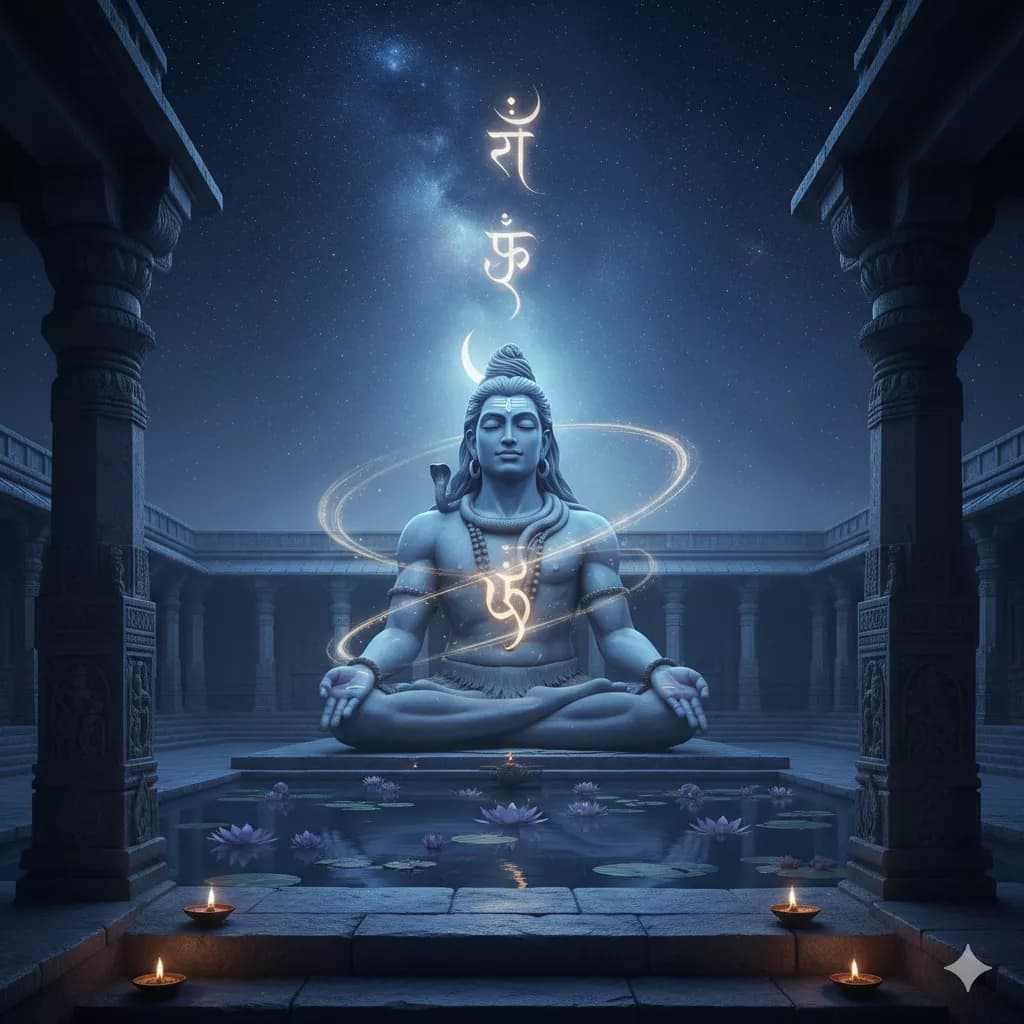
Night brings natural withdrawal of the senses. In many traditions this period aligns with Lord Shiva as the Adiyogi who embodies stillness. Practitioners across regions report that chanting during these hours helps quiet mental activity more readily than daytime sessions.
Within classical Shaiva philosophy, the night is not merely an absence of light but an active state of inward potential. Shiva is often depicted in his Dakshinamurti form — seated in silence beneath a tree, transmitting wisdom without speech. This image captures something that night meditators frequently describe: the sense that stillness itself becomes the teacher. The darkness outside mirrors the inner space that sustained chanting gradually opens. For those new to mantra practice, this framing can make the choice of evening hours feel less like a scheduling convenience and more like an alignment with the tradition's deeper logic.
The philosophical foundations for this alignment run deep in Sanskrit literature. Shiva's association with the night connects to his role as the destroyer of ignorance and the lord of transformation. Unlike deities associated with activity and creation, Shiva represents the principle of dissolution and return to source—qualities that naturally resonate with the inward movement of consciousness during evening hours. Many classical texts describe how the night sky itself reflects Shiva's cosmic form, with stars representing points of consciousness scattered across infinite space. This cosmological understanding adds another layer to why practitioners have historically chosen these hours for their deepest work.
Why Shiva Mantras Work Well After Dark
Reduced external stimuli allow the nervous system to settle. Chanting supports this process by pairing sound with breath. Regular use at night can lower restlessness and prepare the body for rest. Some practitioners note improved dream recall and steadier attention during longer sits.
From a practical standpoint, the repetitive quality of mantra recitation engages the mind just enough to prevent it from cycling through the day's unfinished thoughts, while not stimulating it into alertness. This middle quality — engaged but not aroused — is what distinguishes mantra from other forms of evening activity. Unlike screen-based relaxation, which tends to keep the visual cortex active, soft chanting draws attention inward through the auditory and kinesthetic channels. Over weeks of consistent practice, many people find that the body begins to associate the opening syllables of a chosen mantra with a recognisable shift toward calm, much as a familiar scent can trigger a memory. That conditioned response, built gradually, is part of what makes night practice self-reinforcing over time.
The neurological dimension of this process deserves mention. Repetitive sound patterns, particularly those structured around Sanskrit phonetics, appear to create measurable shifts in brain activity. The vagus nerve—a key component of the parasympathetic nervous system responsible for rest and recovery—responds to sustained vocalization and breath work. When mantra practice combines these elements, the nervous system receives a clear signal that the body is safe and can transition toward rest. This is not mystical but rather a reflection of how sound, breath, and intention interact with the body's regulatory systems. For those skeptical of spiritual frameworks, this physiological understanding can serve as a bridge into the practice itself.
How to Prepare for Night Meditation
A basic setup works better than elaborate arrangements. Choose a clean corner, dim the lights, and face east or north if convenient. Wear loose clothing and silence devices. Ten to fifteen minutes of focused repetition often proves sufficient for beginners.
Preparation also includes a brief mental transition. Spending two or three minutes in slow, deliberate breathing before the first syllable helps signal to the body that the activity mode of the day is ending. Some practitioners light a small lamp or a single candle, not as a ritual requirement but as a visual anchor that marks the boundary between ordinary evening activity and dedicated practice. A light shawl over the shoulders can help maintain warmth without constriction, which matters during longer sits when body temperature tends to drop slightly. These small, repeatable cues accumulate into a reliable pre-sleep routine that the mind begins to anticipate rather than resist.
The physical environment matters more than many assume. Temperature, air quality, and even the texture of the surface you sit upon all influence how easily the body settles. A cushion that supports the spine without forcing an unnaturally rigid posture allows the muscles to relax rather than engage. Adequate ventilation without drafts prevents the distraction of physical discomfort. Some practitioners find that a light blanket nearby—not worn but available—reduces the anxiety of potentially becoming cold, which paradoxically makes it easier to relax. These details may seem minor, but they represent the difference between a session that feels effortful and one that feels naturally supported.
1. Om Namah Shivaya – Core Night Practice
The phrase translates as a bow to the inner self. It remains accessible for daily use. Benefits include steadier emotions and reduced anxiety that can surface before sleep. Chant silently or aloud while tracking breath. One hundred eight repetitions form a traditional round, yet continuous soft repetition also works.
The five syllables Na, Ma, Shi, Va, Ya are sometimes described in classical sources as corresponding to the five elements — earth, water, fire, air, and space — making the mantra a kind of sonic map of embodied existence. For the night practitioner, this correspondence offers a grounding quality: each repetition can be felt as a gentle return to the body and its elemental nature, countering the tendency of a tired mind to drift into anxious abstraction. Beginners who find longer mantras difficult to memorise often start here precisely because the short syllabic structure is easy to hold even when concentration wavers.
The mantra's simplicity also makes it adaptable to various contexts. Whether chanted aloud in a dedicated meditation space, whispered while lying in bed, or repeated silently during a commute, Om Namah Shivaya maintains its efficacy. This flexibility has contributed to its widespread adoption across different lineages and geographic regions. Some practitioners use it as an anchor throughout the day, returning to it during moments of stress or distraction, then deepening their engagement with it during the dedicated evening session. This creates a continuity of practice that extends beyond the formal meditation period.
2. Mahamrityunjaya Mantra – Support During Quiet Hours
The full text begins Om Tryambakam Yajamahe. Across many lineages this mantra is traditionally linked with healing, protection, and the release of fear — qualities that make it especially suited to the quiet of late-night practice. Midnight or the third quarter of the night receives special mention in some traditions. Use it when recovering from illness or when fearful thoughts arise.
The name itself — roughly rendered as the great victory over death — points to a practice that addresses the deeper anxieties the night can surface. Fear of illness, uncertainty about the future, and the vulnerability that comes with physical stillness are all experiences that tend to amplify after dark. Regular recitation of this mantra is understood in the traditions that transmit it as a way of meeting those fears with a sound that carries a quality of protection. For those going through periods of health difficulty or significant life change, incorporating this mantra into a short nightly session — even five or seven repetitions spoken slowly — can provide a sense of grounded continuity when other sources of reassurance feel distant.
The Mahamrityunjaya Mantra also appears in various textual traditions with slightly different phrasings, yet the core intention remains consistent across these variations. This stability across centuries of transmission suggests that the mantra addresses something fundamental in human experience—the confrontation with mortality and the search for transcendence beyond it. Whether understood literally or metaphorically, the practice of reciting this mantra creates a container for processing existential concerns that might otherwise remain unexamined or cause subtle anxiety. Many practitioners report that after several weeks of regular use, a quality of acceptance begins to emerge alongside the protective feeling the mantra generates.
3. Shiva Gayatri Mantra – Clarity for Mind and Study
The verse runs Om Tatpurushaya Vidmahe Mahadevaya Dhimahi. Families and students often prefer it for its measured rhythm. It encourages balanced thinking without overstimulation before rest.
The Gayatri structure, shared across several Vedic mantras, carries an inherent quality of contemplative inquiry — the word Dhimahi itself suggests a meditative dwelling upon. For students preparing for examinations, or professionals who find that analytical thinking persists too long into the evening, this mantra offers a way to redirect mental energy from problem-solving toward open awareness. Its slightly longer form compared to Om Namah Shivaya also means that a single repetition requires a fuller breath cycle, which naturally slows the pace of recitation and encourages a more deliberate engagement with each syllable.
The Gayatri form itself deserves explanation for those unfamiliar with Vedic structures. The traditional Gayatri mantra, dedicated to Savitr (the solar principle), follows a specific metrical pattern that has been preserved across thousands of years. The Shiva Gayatri adapts this structure while redirecting its focus toward Shiva's qualities. This adaptation demonstrates how classical forms remain flexible enough to serve different devotional purposes while maintaining their underlying power. The rhythm of the Gayatri meter, when chanted aloud, naturally creates a cadence that the body finds easy to follow, reducing the mental effort required to maintain focus.
4. Ajapa Style – Breath Synchronized Chanting
Here the syllables align with inhalation and exhalation. Inhale on Om Na, exhale on Mah Shi Va Ya. Advanced practitioners use this method for extended night sits because it reduces verbal effort and deepens absorption.
The term Ajapa — meaning that which is repeated without deliberate effort — points to a stage of practice where the mantra begins to feel less like something the practitioner is doing and more like something the practitioner is receiving. Reaching that stage takes sustained practice over months or years, but even early attempts at breath-synchronised chanting tend to produce a noticeably different quality of attention compared to standard repetition. The breath becomes both the vehicle and the measure of the mantra, and the practitioner's awareness naturally settles at the point where sound and breath meet. For those who find their minds wandering during ordinary repetition, this method provides an additional anchor that is always available.
The integration of breath and mantra represents a sophisticated understanding of how consciousness relates to the body. In classical yoga philosophy, the breath is understood as the bridge between mind and body, between the conscious and unconscious dimensions of experience. By synchronizing the mantra with the breath, the practitioner is not merely adding a technique but rather aligning with a fundamental principle of embodied awareness. Over time, this alignment can lead to experiences of spontaneous mantra repetition—moments when the mantra seems to continue on its own, without conscious effort. These experiences, while not the goal of practice, often signal that a deeper integration is occurring.
5. Shiva Panchakshara Stotram – Devotional Close to Sleep
The stotram praises five elemental aspects of Shiva. Its poetic form suits those who favor bhakti. Many recite it once before lying down to invite emotional ease.
Unlike the shorter seed mantras, the Panchakshara Stotram unfolds as a sequence of verses, each building on the last. This narrative quality gives the mind something to follow without demanding active analysis, making it well suited to the transitional state between wakefulness and sleep. Practitioners with a devotional orientation often describe the stotram as a way of handing over the concerns of the day — placing them, so to speak, at the feet of the deity before rest. Whether understood devotionally or simply as a structured sound sequence, its measured cadence tends to slow the breath naturally by the final verse.
The Panchakshara itself—the five-syllable mantra Na Ma Shi Va Ya that forms the heart of the stotram—represents one of the most ancient and widely recognized invocations in Hindu tradition. The stotram elaborates on this core through poetic language that engages the imagination while maintaining spiritual depth. For those who find pure repetition too austere, the stotram offers a middle path that combines the power of mantra with the richness of devotional poetry. The emotional engagement this creates can actually deepen the meditative state rather than distract from it, particularly for practitioners whose temperament naturally inclines toward feeling and relationship rather than abstract awareness.
6. Rudra Mantra – Strength in Transitions
Om Namo Bhagavate Rudraya forms the short version. It is chosen during career shifts or periods of uncertainty. The sound can counter mental blocks that intensify at night.
Rudra, one of Shiva's older Vedic names, carries associations with both fierce transformation and deep compassion. The mantra is sometimes chosen precisely because its energy feels more active than the settling quality of Om Namah Shivaya — useful when the practitioner needs to meet a difficult emotional state directly rather than simply calm it. During periods of professional transition, relocation, or significant personal change, many practitioners find that rotating between this mantra and a gentler one across different nights allows the practice to meet varying emotional needs without abandoning consistency.
The Rudra principle in classical texts represents the capacity to dissolve what no longer serves, clearing the way for new growth. This makes the Rudra Mantra particularly appropriate during life transitions when the old structure is falling away but the new has not yet fully formed. The uncertainty of such periods can create significant anxiety, particularly when the mind becomes active at night. By working with the Rudra Mantra during these times, practitioners are essentially aligning their internal work with the external process of transformation already underway. This alignment can reduce the sense of being at odds with one's circumstances and instead create a feeling of moving with the current rather than against it.
NRI Perspective on Night Practice
Many NRIs living in North America and Europe maintain a short evening window after work and family duties. One professional in the Midwest described setting aside fifteen minutes once children slept. The routine helped separate office stress from rest. Over several months the individual reported fewer midnight awakenings and clearer morning focus at the office. Another family in the Gulf region adapted the practice during summer months when daylight hours stretched late. They used a single lamp and soft repetition of Om Namah Shivaya. Children joined for five minutes before bedtime, turning the session into a shared wind-down. These accounts show that modest, repeated effort fits around demanding schedules without requiring retreat settings.
For NRIs navigating time-zone differences from family back home, the shared language of a familiar mantra can also serve as a quiet point of connection — a few minutes of the same practice at the same hour, regardless of geography. This dimension of continuity is something many diaspora practitioners mention when describing why they returned to Shiva mantras after years away from regular devotional life.
The practical challenge for many NRI households is not motivation but consistency across shifting weekly rhythms — late work calls, school commitments, and social obligations that vary by season. Practitioners who have maintained the habit across years tend to describe a similar strategy: they protect a minimum viable session of five minutes rather than aiming for an ideal length that becomes difficult to honour on demanding days. That floor, however modest, preserves the habit's continuity and makes it easier to return to longer sits when schedules allow.
For NRIs specifically, the evening mantra practice can serve an additional function: maintaining cultural and spiritual continuity across geographic displacement. Many report that the practice becomes a way of staying connected to their heritage and to family members who may be practicing similar traditions thousands of miles away. This sense of shared practice across distance can be particularly meaningful for second-generation NRIs seeking to understand and maintain their roots. The simplicity of the practice—requiring no special equipment, no community infrastructure, no particular location—makes it uniquely suited to the mobile, often isolated circumstances of diaspora life. A professional working in Singapore, a student in London, and a retiree in California can all engage with the same mantra at the same moment, creating an invisible thread of connection that transcends physical separation.
Recommended Durations by Experience Level
Beginners start with five to ten minutes. Regular users extend to fifteen or thirty minutes. On Shivaratri multiple short sessions across the night replace a single long block. Duration matters less than steady attendance.
Shiva Mantras for Specific Night Intentions
| Intention | Recommended Mantra |
|---|---|
| Peace and sleep | Om Namah Shivaya |
| Healing | Mahamrityunjaya |
| Focus | Shiva Gayatri |
| Fear removal | Rudra Mantra |
| Deep meditation | Ajapa Om Namah Shivaya |
Common Mistakes to Avoid
Mechanical repetition without attention yields limited results. Forcing concentration often creates tension. Expecting dramatic visions leads to disappointment. Overcomplicating the setup distracts from the core act of steady sound and breath.
A related error is treating the practice as a performance to be evaluated each night. Practitioners who mentally score their sessions — judging whether the mind wandered too much or the posture was sufficiently upright — tend to introduce a subtle strain that works against the inward settling the mantras are meant to support. The classical guidance transmitted through most lineages emphasises effort without grasping: the practitioner shows up, repeats the sound with as much attention as is available that evening, and releases the outcome. Some nights will feel absorbed and clear; others will feel scattered. Both are part of a long arc of practice that only reveals its effects across weeks and months rather than individual sessions.
Another common pitfall involves comparing one's experience to accounts from other practitioners or to idealized descriptions in texts. The expectation that mantra practice should produce specific experiences—visions, profound peace, or dramatic shifts in consciousness—can actually prevent those experiences from arising naturally. The practice works best when approached with a quality of open curiosity rather than goal-orientation. This paradox—that the most direct path to the benefits involves releasing attachment to achieving them—is central to most contemplative traditions. Practitioners who can hold this paradox tend to find that genuine transformation occurs more readily than those who approach the practice as a technique to be perfected.
Best Nights for Focused Practice
Monday evenings and the fourteenth lunar day hold traditional emphasis. Shivaratri offers an extended window for those who can stay awake in shifts. Any consistent night works when the practitioner returns regularly.
The traditional emphasis on specific nights reflects an understanding that certain astronomical and lunar configurations create conditions particularly conducive to inward practice. While modern practitioners need not adopt these observances, understanding their basis can deepen appreciation for the tradition. The fourteenth lunar day, known as Chaturdashi, is understood in classical texts as a time when the veil between inner and outer worlds grows thin, making it easier for consciousness to turn inward. Shivaratri—the night dedicated to Shiva—represents the culmination of this principle, with many practitioners engaging in all-night vigils during this observance. For those unable to participate in formal Shivaratri celebrations, maintaining a consistent evening practice on regular nights throughout the year creates a steady foundation that can be intensified during these special occasions.
Next steps
Choose one mantra and commit to ten minutes each night for two weeks. Track sleep quality and morning mood in a simple notebook. Adjust timing or posture based on what feels sustainable. For additional guidance on specific mantras and their applications, explore resources like HinduTone, which offers detailed information on mantra practice. You may also find value in their Maha Shivaratri 2026 mantra guide for seasonal practice intensification. For a broader perspective on daily mantra chanting, their comprehensive guide to powerful Hindu mantras provides additional context. You can also return to this article's source material for deeper exploration of night meditation practices.
Sources
The mantras described in this article draw on classical Sanskrit textual traditions, including the Shiva Purana, the Rigveda, and associated devotional literature that has been transmitted through generations of practice. Readers seeking authoritative editions are encouraged to consult established Sanskrit studies libraries, university digital archives, or reputable publishers specialising in Indic texts.
Related NRI Globe pillar guide: Returning to India — Complete Checklist for NRIs
Related NRI Globe Coverage
- Top 50 Ganesh Songs for NRIs — The Ultimate Ganpati Playlist for Ganesh Chaturthi 2026
- Ganesh Chaturthi Mantras + Slokas + Sanskrit Chants for NRIs — Complete 2026 Devotional Guide
- Ganesh Chaturthi 2026 Puja Vidhi + Muhurat + 21 Modak Types — Complete Ritual Guide for NRIs
- Nine Forms of Goddess Durga (Navadurga) — Daily Puja + Mantras + Colours for Navratri 2026
- Lakshmi Puja Vidhi 2026 for NRIs Abroad — Complete Mantras, Muhurat & Prasad Guide
- Somvar Guide: Shiva Worship & Fasting for NRIs
- Maha Shivaratri Jagran Tips 2026 for USA Hindus
- Shiva Puranam Explained: Meaning & Spiritual Wisdom
Fresh from NRI Globe
- YouTuber Nandu's World (Rama Nandana) UK Visa & Job Fraud Case: Full Details + Key Lessons for NRIs (2026)
- Dussehra / Vijayadashami 2026 Events Country-Wise — Global NRI Directory (Ram Lila, Ravana Dahan, Durga Puja Pandals, Ayudha Puja Venues + Booking)
- Diwali 2026 Events Country-Wise — Global NRI Directory (White House, Leicester, London Trafalgar, Toronto, Auckland, Sydney Parramasala, Fiji, Mauritius, Trinidad, South Africa and More)
- Diwali / Deepavali 2026 Country-Wise NRI Celebrations — Complete Global Guide (USA, UK, Canada, Australia, Fiji, Mauritius, Trinidad, South Africa, UAE and 30+ Countries)