
TL;DR — Key Takeaways
- Celebrating January 1 is not inherently against Hindu culture; Hinduism has always absorbed practical global customs.
- The real concern is cultural replacement—when Hindu New Year traditions fade entirely from family life abroad.
- India has multiple regional New Years rooted in lunar-solar astronomy, each carrying distinct spiritual significance that January 1 does not share.
- NRIs can celebrate both calendars consciously: one as a global civic moment, the other as a cultural and spiritual renewal.
- Teaching children the context of both calendars builds pride, not confusion.
The Dilemma That Surfaces Every December 31
Every January 1, a familiar tension ripples through NRI households worldwide. WhatsApp family groups debate whether wishing "Happy New Year" on the Gregorian date is a betrayal of Hindu identity. Younger Indians living in the United States, United Kingdom, Canada, or Australia feel pulled between office countdowns and the memory of Ugadi or Vishu back home. The question sounds simple. The layers beneath it are not.
This is not a fringe concern. According to the Pew Research Center's Global Religious Landscape report, Hinduism is the world's third-largest religion, with a significant diaspora population navigating exactly this kind of cultural overlap daily. The question deserves a grounded, non-judgmental answer.
The Short Answer: No, It Is Not Against Hinduism
Participating in January 1 festivities does not violate any Hindu scriptural principle. Sanatana Dharma—often translated as the eternal way of living—has historically been adaptive. It absorbed mathematical and astronomical knowledge from multiple civilizations, integrated regional folk traditions, and allowed its practitioners to function within diverse political and social systems without abandoning their core identity.
What Hinduism does emphasize is awareness. Performing an action with full understanding of its context is fundamentally different from drifting into it unconsciously. Celebrating the Gregorian New Year while knowing exactly what it is—a civil calendar date with Roman origins—is a conscious choice. Forgetting that your own tradition marks cosmic renewal on a different date entirely is a different matter.
Scholars of Hindu thought broadly observe that Sanatana Dharma's capacity for adaptation has always been one of its defining characteristics — the tradition has, across centuries and geographies, distinguished between outer participation in the customs of a given time and place, and the inner continuity of one's spiritual and cultural identity. Engaging with the world as it is, while remaining rooted in one's own tradition, reflects a principle the tradition itself endorses rather than contradicts.
Where January 1 Actually Comes From
The Gregorian calendar was promulgated by Pope Gregory XIII in 1582, primarily to correct drift in the Julian calendar introduced under Julius Caesar. January 1 as New Year's Day traces back to the Roman festival of Janus, the two-faced god of beginnings. The Encyclopaedia Britannica documents this history in detail.
This origin carries no astronomical alignment with the Indian subcontinent's seasons, no connection to the solar or lunar cycles that Hindu timekeeping is built upon, and no spiritual significance within Hindu cosmology. Recognizing this is not hostility toward the calendar. It is simply accuracy.
Hindu Timekeeping: A System Built on the Sky
Hindu understanding of time—Kala—is rooted in observable celestial mechanics. The Panchanga, the traditional Hindu almanac, tracks tithi (lunar day), vara (weekday), nakshatra (lunar mansion), yoga, and karana simultaneously. This is not mythology; it is a sophisticated astronomical framework that Indian mathematicians and astronomers developed over centuries, as documented by scholars at the Indian Institute of Science Education and Research and in classical texts like the Surya Siddhanta.
Regional Hindu New Years reflect this precision:
| Festival | Community | Calendar Basis | Approximate Gregorian Period |
|---|---|---|---|
| Ugadi / Gudi Padwa | Telugu, Kannada, Marathi | Chaitra Shukla Pratipada (lunisolar) | March–April |
| Puthandu | Tamil | Solar — Sun enters Mesha (Aries) | April 14 |
| Vishu | Malayalam | Solar — Sun enters Mesha | April 14–15 |
| Vaisakhi / Baisakhi | Punjabi, Sikh | Solar — Sun enters Vrishabha (Taurus) | April 13–14 |
| Pohela Boishakh | Bengali | Solar — Bengali calendar | April 14–15 |
| Bestu Varas | Gujarati | Kartik Shukla Pratipada (day after Diwali) | October–November |
| Losoong / Gaan-Ngai | Northeast India | Regional lunar cycles | November–December |
Each of these dates marks a real astronomical event—a solstice, an equinox, a solar ingress, or a significant lunar phase. January 1 marks none of these for the Indian subcontinent.
Cultural Addition vs. Cultural Replacement: Where the Line Falls
Most NRIs already practice cultural addition without labeling it as such. Using the Gregorian calendar at work, wearing Western clothing for practicality, attending an office New Year party, sending global greetings on December 31—these are neutral adaptations to life in a different country. No Hindu text prohibits social participation in a host culture's civil events.
Cultural replacement is a different process, and it happens gradually. A second-generation child who grows up knowing the words to "Auld Lang Syne" but cannot name when Ugadi falls has not made a conscious choice—the choice was made for them by the absence of transmission. Over generations, the lunar-solar calendar that once organized family life, agricultural rhythms, and spiritual practice becomes an abstraction associated only with "back in India."
For NRIs, geographic distance already weakens the informal channels through which culture travels: grandparents telling stories, neighbors preparing festival food, temple bells marking the season. When the dominant calendar of daily life is also the only calendar celebrated at home, that transmission gap widens further.
A First-Hand NRI Perspective on Living Between Two Calendars
Priya, a software engineer from Hyderabad who has lived in the San Francisco Bay Area for eleven years, describes the shift she noticed after her daughter started school. "The school sends home a holiday calendar every August. Christmas, Thanksgiving, New Year's Day — all marked clearly. Ugadi is not on it. Vishu is not on it. For two years, I realized I was letting January 1 feel like the 'real' New Year simply because it had social weight around it — parties, countdowns on every channel, colleagues asking about resolutions. Ugadi came and went with a WhatsApp message to my mother." She started a small ritual: cooking bevu-bella on Ugadi morning, reading the panchanga forecast aloud even if her daughter only half-understood it, and framing it explicitly as "our New Year." "Now she asks me every year what the new samvatsara is named. She knows both. That feels right."
Priya's experience reflects a pattern common across the Indian diaspora — not hostility to local customs, but the slow gravitational pull of the dominant culture when intentional counterweights are absent. The solution she found was not rejection of January 1 but deliberate elevation of Ugadi within her home.
What Hinduism Actually Permits — and What It Cautions
Hindu philosophy draws a consistent distinction between vyavaharika (conventional, practical reality) and paramarthika (ultimate or spiritual reality). Operating within the conventions of the world you live in — including its calendar — is entirely consistent with dharmic living. The Bhagavad Gita's emphasis on acting in the world without attachment applies here: participate in January 1 as a social convention without investing it with the spiritual weight that belongs to your own tradition's markers of time.
The caution Hindu thinkers have historically raised is against moha — delusion or confusion about what is truly one's own. Mistaking a Roman civil date for a cosmically significant renewal, while forgetting the actual astronomical events your ancestors tracked with precision, is the kind of confusion worth avoiding. Not because January 1 is harmful, but because the forgetting carries a real cost.
Hindu philosophical tradition, as reflected in Vedantic thought, has long held that the vyavaharika level — the plane of practical, everyday convention — is a legitimate domain of action. Participating in the social customs of one's environment at that level does not compromise one's engagement with paramarthika reality, provided the practitioner retains clarity about which level each action belongs to. Applied to cultural participation, this framing suggests that joining a civic calendar event and honoring one's own tradition's sacred markers of time are not in conflict — they simply operate on different planes of meaning.
A Practical Framework for NRI Families
Treat January 1 as a Global Civic Moment
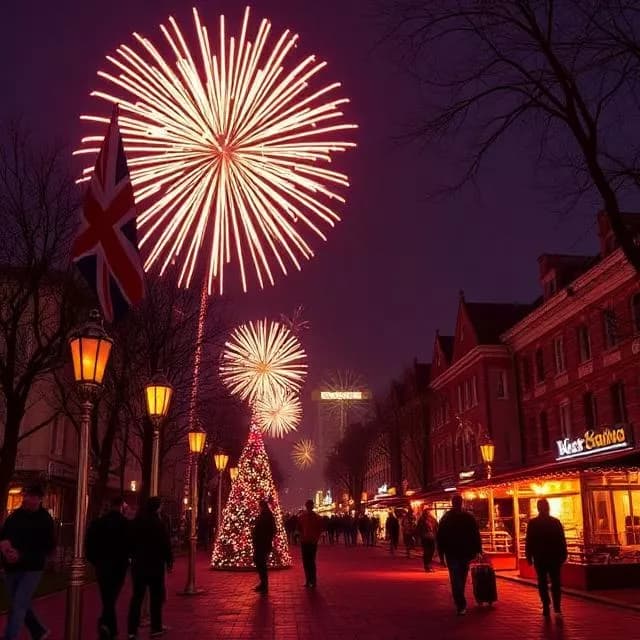
Attend the office party. Send greetings. Watch the fireworks. Reflect on the past year. Do all of this without attaching deep spiritual meaning to the date — because the date does not carry it. This is honest participation, not cultural surrender.
Actively Observe Your Regional Hindu New Year
Even a minimal observance matters. Cook one traditional dish. Read or listen to the panchanga. Light a lamp. Call family in India. Tell children the name of the new samvatsara and what it is said to augur. The Drik Panchang website provides accurate regional panchanga data for NRIs in any time zone — a practical tool for families abroad.
Teach Context, Not Conflict
Framing matters enormously for second-generation children. "We don't celebrate English New Year" creates confusion and resentment. "January 1 is the international date used everywhere for convenience — our traditional New Year follows the movement of the sun and moon and falls in April" creates understanding. Children who understand both systems carry both with confidence.
Connect with Local Hindu and Indian Community Organizations
Many Hindu temples and cultural associations in the diaspora organize Ugadi, Vishu, and Vaisakhi events. The Hindu Council UK and similar bodies in the United States and Canada maintain event calendars that help NRI families stay connected to the festival cycle even without extended family nearby.
Why This Question Matters Beyond the Calendar
The debate over January 1 is really a debate about identity maintenance in diaspora conditions. Research on immigrant cultural retention — including work published by the Migration Policy Institute — consistently shows that deliberate, conscious practice of heritage traditions is the single strongest predictor of cultural continuity across generations. Passive participation in the host culture's calendar, without active cultivation of one's own, correlates with accelerating cultural distance by the third generation.
This is not a reason for anxiety. It is a reason for intentionality. The NRIs who navigate this best are not the ones who refuse to attend New Year's Eve parties — they are the ones who also know exactly when Ugadi is, why it matters, and how to mark it meaningfully wherever they live.
Next Steps
- Look up the date of your regional Hindu New Year for this year on Drik Panchang and add it to your family calendar now.
- Find your nearest Hindu temple or Indian cultural association and check whether they organize a regional New Year event.
- Have one conversation with your children — or younger family members — explaining the astronomical basis of your traditional New Year. Even ten minutes builds lasting context.
- If you observe January 1, do so consciously: enjoy it as a global civic moment, not as a replacement for your own tradition's markers of renewal.
Sources
- Pew Research Center — The Global Religious Landscape: Hinduism (2012)
- Encyclopaedia Britannica — Why Does the New Year Start on January 1?
- Drik Panchang — Hindu Calendar and Panchanga Resource
- Hindu Council UK — Diaspora Festival Calendar
- Migration Policy Institute — Research on Immigrant Cultural Retention
Related NRI Globe pillar guide: Returning to India — Complete Checklist for NRIs
Related NRI Globe Coverage
- Hindu New Year Celebrations Worldwide: A Comprehensive NRI Guide 2026
- 10 Reasons Why Valentine’s Day Goes Against Hindu Values & Traditions
- Hindu Temples in Russia: A Spiritual Journey Through Eastern Europe's Growing Hindu Heritage
- Ganesh Chaturthi 2026: How Indian Families in USA, UK, Canada, Australia & Europe Are Celebrating
- Faith and Professional Success for Hindus
- Parabhava Year 2026: Ugadi Astrology Guide
- USA's Hindu Communities Celebrate Maha Shivaratri 2026 with Devotion and Vibrancy
- Canada's Hindu Communities Celebrate Maha Shivaratri 2026 with Deep Devotion and Community Spirit
Fresh from NRI Globe
- YouTuber Nandu's World (Rama Nandana) UK Visa & Job Fraud Case: Full Details + Key Lessons for NRIs (2026)
- Dussehra / Vijayadashami 2026 Events Country-Wise — Global NRI Directory (Ram Lila, Ravana Dahan, Durga Puja Pandals, Ayudha Puja Venues + Booking)
- Diwali 2026 Events Country-Wise — Global NRI Directory (White House, Leicester, London Trafalgar, Toronto, Auckland, Sydney Parramasala, Fiji, Mauritius, Trinidad, South Africa and More)
- Diwali / Deepavali 2026 Country-Wise NRI Celebrations — Complete Global Guide (USA, UK, Canada, Australia, Fiji, Mauritius, Trinidad, South Africa, UAE and 30+ Countries)