
Reported September 2, 2026 — companion pillar to the Karwa Chauth 2026 USA cluster (October 10). Devotional, cultural, and practical guide for NRI wives.
Karwa Chauth 2026 katha — the sacred story recited during the afternoon puja — sits at the emotional and ritual center of the day. This companion pillar unpacks the four traditional stories, the sixteen shringar (solah shringar) that transform an ordinary morning into a sacred one, the puja sequence from pre-dawn sargi to the moonrise chalni ritual, and the practical adaptations NRI wives in the USA, UK, Canada, Australia, and the GCC are making in 2026 to keep the tradition alive across time zones and apartments.
For the date, muhurat by US time zone, city-by-city moon-sighting windows, and the Sargi recipe menu, see the linked Companion Reading at the end. This post focuses on the katha, the shringar, and the meaning.
The Four Traditional Karwa Chauth Kathas
Multiple stories are told during the Karwa Chauth puja depending on family and regional tradition. The four most commonly narrated:
1. The Story of Veeravati
Veeravati was the only sister of seven loving brothers, married into a royal household. On her first Karwa Chauth after marriage, she came home to her parents and observed the fast strictly. Her brothers, unable to bear watching their sister go without food and water, devised a trick: they lit a lamp behind a peepal tree to make it look like the moon had risen. Veeravati saw the "moon," offered arghya, broke her fast — and immediately received news that her husband had died.
Overcome with grief, she performed penance and repeated the vrat with unwavering devotion. Impressed by her sincerity, Goddess Parvati (or in some traditions, Yama) restored her husband to life. The story emphasizes two lessons: the vrat's power depends on strict observance, and no shortcut — however well-intentioned — carries its blessing.
2. The Story of Queen Karva
Karva was a devoted wife whose husband was seized by a crocodile while bathing in a river. Rather than despair, she used the spiritual power built up from her vrat to bind Yama, the god of death, and demanded her husband's release. Yama, unable to overcome her tapasya, restored her husband to life and granted her long marital happiness. The festival's name — Karwa Chauth — is often linked to this Karva.
3. Savitri and Satyavan
The classic tale from the Mahabharata: Savitri knew from a sage's prophecy that her husband Satyavan would die on a specific day one year after their marriage. On that day she followed Yama as he took her husband's soul, argued with him wisely, and won three boons — the third being that Satyavan would live to father a hundred sons with her. Her intelligence, devotion, and refusal to accept fate make her the archetype of the wife who protects her husband's life through vrat and wisdom. Savitri's story is recited on Karwa Chauth in many households, even though her original vrat is a separate observance (Vat Savitri).
4. Draupadi's Karwa Chauth
During the Pandavas' exile, Arjuna went to the Nilgiri hills for penance and faced obstacles. Draupadi, worried for his safety, sought Krishna's counsel. Krishna advised her to observe the Karwa Chauth vrat, reminding her that Parvati had once done the same for Shiva. Draupadi observed the fast, and Arjuna returned safely. The story ties the vrat to divine precedent — Parvati herself performing it — and gives married women a Mahabharata-era anchor for the tradition.
The Solah Shringar — Sixteen Adornments
Karwa Chauth is one of the few festivals where the solah shringar — the traditional sixteen adornments a married Hindu woman wears on sacred and ceremonial occasions — becomes central to the day. Each has meaning:
- Bindi — the third-eye mark, symbolizing intuition and married status
- Sindoor — vermilion in the hair parting, sacred emblem of marriage
- Mangalsutra — the sacred black-bead necklace given at marriage
- Nath (nose ring) — traditionally worn on the left nostril in many regions
- Karn phool (earrings) — elaborate, often gold, framing the face
- Haar (necklace) — layered, often including a temple-jewelry piece
- Choodiyan (bangles) — red and green in many North Indian traditions
- Baajuband (arm bands) — worn on the upper arm
- Payal (anklets) — traditionally silver
- Bichhua (toe rings) — indicating married status
- Kamarband (waist chain) — worn over the saree
- Mehndi — henna applied the night before, ideally darkening beautifully
- Kajal — traditional kohl outlining the eyes
- Ittar (perfume) — traditional Indian attar rather than western perfume
- Gajra (hair flowers) — fresh mogra or jasmine woven into the bun
- Red saree or lehenga — the ceremonial outfit, ideally the wedding saree or a fresh one gifted for Karwa Chauth
Not every woman wears all sixteen; the point is intention. Many NRI wives select five to seven that feel authentic and manageable given work, weather, and available items — the tradition is honoured either way.
The Puja Sequence — From Pre-Dawn Sargi to Moonrise Chalni
The ritual arc of Karwa Chauth is remarkably specific and unchanged across generations:
Pre-Dawn (roughly 4:00-5:00 a.m. local time)
Sargi: the pre-dawn meal traditionally sent by the mother-in-law (or prepared by the wife in her absence). It sustains the woman through the day-long nirjala (waterless) fast. Typical items: dry fruits, matthi, seviyan, fresh fruit, milk-based sweets, coconut. Water is consumed before sunrise; after sunrise no food or water passes the lips.
Sunrise to Afternoon
The fast begins at sunrise. The woman goes about her day — many still work, cook for the family, care for children — while observing the fast. Traditional wisdom advises against lifting heavy items, arguing, or wearing black. Some women take the day off; many now attend office or WFH sessions.
Late Afternoon (roughly 4:00-5:30 p.m. local time)
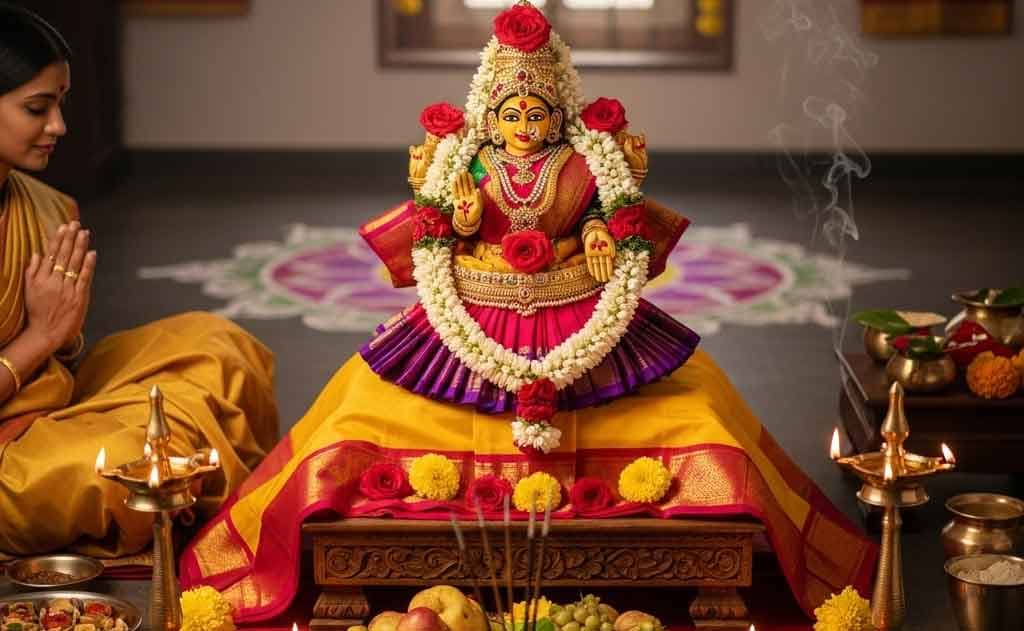
The Karwa Chauth puja takes place. Women gather — traditionally at a neighbour or family member's home, increasingly in NRI households at a temple or a community host's home. The thali is prepared with: a diya (oil lamp), incense sticks, sindoor, kumkum, sweets, roli, akshat (rice grains), a matthi, a karva (small clay or metal pot), and a chalni (sieve). The katha is recited by an elder or read collectively. The seven-round thali pheri — women passing thalis in a circle — is performed while singing traditional Karwa Chauth songs.
Evening (moonrise, timing varies by city)
Once the moon is sighted (or its appearance confirmed for cloudy sky), the woman performs chandra darshan: offering arghya (water) to the moon, viewing it through the chalni, then turning to view her husband's face through the same chalni. The husband gives her the first sip of water and the first bite of food — usually a piece of sweet or a matthi. This moment breaks the fast.
Karwa Chauth 2026 — What's Different for NRI Wives
For Non-Resident Indian wives in the USA, UK, Canada, Australia, GCC, and Singapore, Karwa Chauth 2026 presents specific practical challenges:
- Time-zone moon sighting. Moon rises at different local times across the world; the day of the vrat is October 10, 2026 in India, and the moon-sighting time in New Jersey, Toronto, London, Sydney, and Dubai will each differ. See the city-by-city timing linked in the Companion Reading.
- Sargi logistics. With mother-in-law often in India, many NRI wives prepare their own sargi from ingredients bought at Indian grocery stores in advance, or receive a symbolic care-package video call in the pre-dawn hour.
- Community pujas. Local Hindu temples in the US, UK, and Canadian metros — as well as informal community groups in the GCC — host afternoon Karwa Chauth pujas that let NRI wives gather in solah shringar and recite katha together.
- Apartment realities. Balcony puja is often not permitted for open-flame reasons; battery-operated diyas are widely used. The chalni ritual works equally well indoors.
- Working women. Many NRI wives take the day off, use PTO for the evening, or WFH; a growing number observe partial fasts (allowing water) with elder blessings, particularly in first trimester of pregnancy, medical exemption, or work-critical days.
- Interfaith and next-generation adaptations. Second-generation and interfaith couples increasingly observe a modified vrat — some couples both fast together as a shared devotional act.
What the Vrat Means Beyond the Ritual
Karwa Chauth is often described as a wife's fast for her husband's long life. That description is accurate but incomplete. The vrat is also a day-long meditation on partnership, patience, and the willingness to hold space for another person's wellbeing at the cost of one's own comfort. Many husbands respond by fasting alongside their wives (a growing 2020s+ trend), preparing the evening meal, or arranging the puja setup — turning the vrat into a shared act rather than a one-sided sacrifice.
The stories are ancient. The clothing is elaborate. The moon does what moons do. But the meaning — that love and long life are strengthened by intentional discipline shared with another person — belongs to the couple observing it, whether in a Punjabi joint family, a New Jersey apartment, a Sydney townhouse, or a Dubai villa.
Practical Checklist for NRI Wives — Karwa Chauth October 10, 2026
- Confirm the local moon-sighting time for your city (see linked guide)
- Pre-order or hand-carry sargi essentials 1-2 weeks in advance from an Indian grocery
- Book the day off work if possible; if not, batch morning commitments before 11 a.m.
- Apply mehndi on the evening of October 9 (October 10 morning is usually too rushed)
- Coordinate afternoon community puja with local temple or Indian-community WhatsApp group
- Prepare puja thali items: diya, incense, sindoor, matthi, sweets, karva, chalni
- Plan the evening meal for after moonrise — traditionally cooked by the husband or family
- Coordinate with elder mother/mother-in-law for pre-dawn video call blessing if in India
Companion Reading
- Karwa Chauth 2026 USA NRI Complete Guide (hub)
- Karwa Chauth 2026 Muhurat + Moon Timing by US City
- Karwa Chauth 2026 Sargi Menu + Recipes for NRI Wives
This article is a cultural and devotional guide as of September 2, 2026. It is not medical advice — pregnant, nursing, diabetic, or medically-fasting-contraindicated readers should consult a physician before undertaking a day-long nirjala vrat. The tradition explicitly recognises exemptions.
Related NRI Globe pillar guide: Returning to India — Complete Checklist for NRIs
Related NRI Globe Coverage
- Karwa Chauth 2026 Sargi Menu + Recipes for NRI Wives in the USA (Complete Pre-Dawn Meal Guide)
- Karwa Chauth 2026 USA NRI Complete Guide — October 10 (Fasting, Puja, Moon-Sighting, Sargi, Community Circle)
- Karva Chauth 2026 — Complete NRI Guide (Vrat Vidhi, Mantras, Fasting for Women Abroad)
- Karwa Chauth 2026 Muhurat + Moon Timing by US City — October 10 Pradosh + Chandra Darshan Windows
- The Moon on Ganesh Chaturthi 2026 — Why It Must Not Be Seen, the Syamantaka Katha & the Mantra If You Do
- Janmashtami 2026 for NRIs — 4-Country Rituals + Dates Guide
- Vinayaka Chavithi 2026: Date, Puja Muhurat, Timings, Rituals & Complete Guide for NRIs
- Pournami Vrat Katha: Full Moon Fasting Guide
Fresh from NRI Globe
- YouTuber Nandu's World (Rama Nandana) UK Visa & Job Fraud Case: Full Details + Key Lessons for NRIs (2026)
- Dussehra / Vijayadashami 2026 Events Country-Wise — Global NRI Directory (Ram Lila, Ravana Dahan, Durga Puja Pandals, Ayudha Puja Venues + Booking)
- Diwali 2026 Events Country-Wise — Global NRI Directory (White House, Leicester, London Trafalgar, Toronto, Auckland, Sydney Parramasala, Fiji, Mauritius, Trinidad, South Africa and More)
- Diwali / Deepavali 2026 Country-Wise NRI Celebrations — Complete Global Guide (USA, UK, Canada, Australia, Fiji, Mauritius, Trinidad, South Africa, UAE and 30+ Countries)