
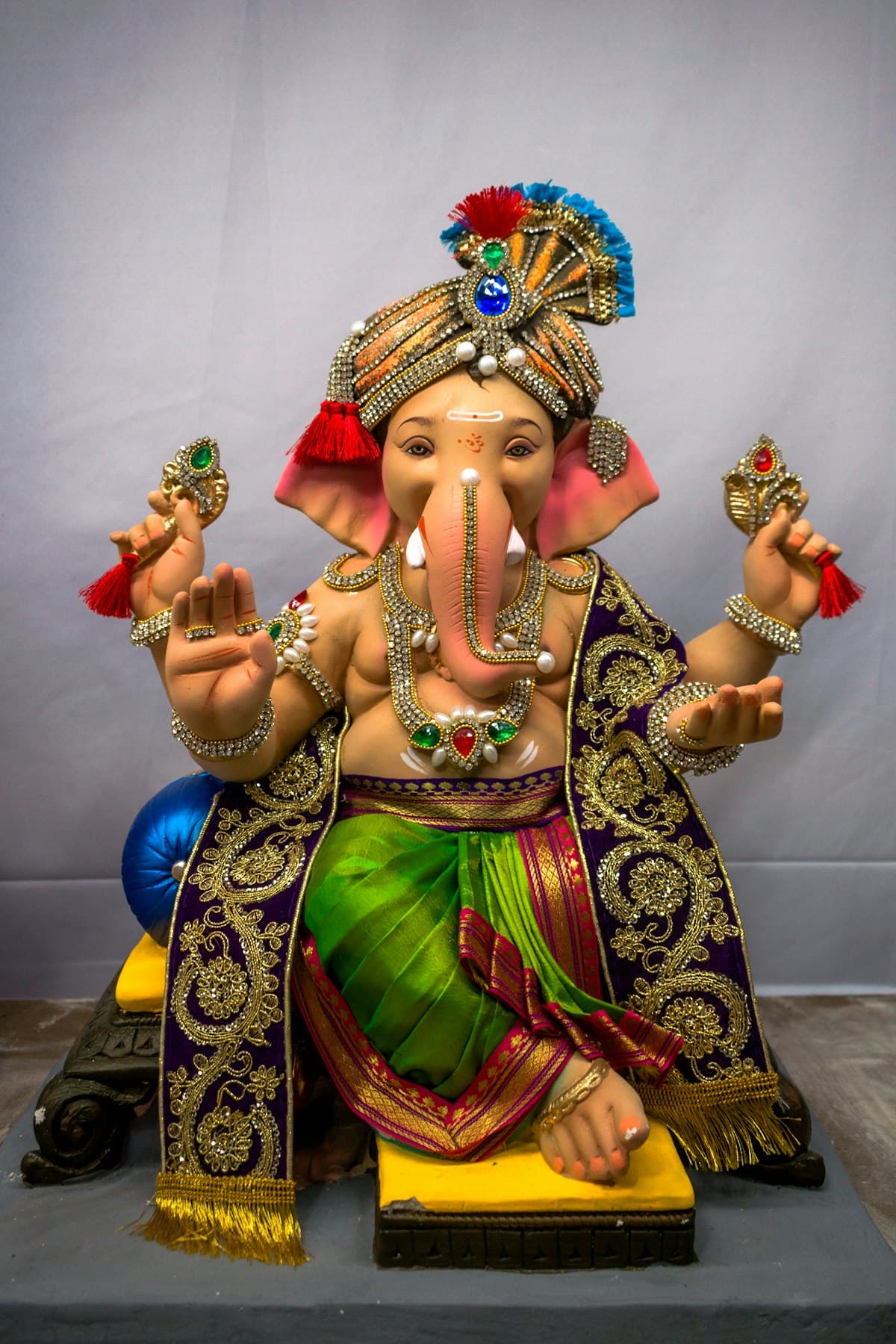
There are twelve Chaturthis in a year. On only one of them do people deliberately keep their eyes down after sunset.
The rule is precise. Seeing the moon on Bhadrapada Shukla Chaturthi is not held to bring general misfortune. It is held to bring one specific thing: mithya dosha — a false accusation. A charge you did not earn, a stain you cannot easily answer.
The tradition is unusually confident about this because it names a case. Krishna himself glimpsed the moon on this night, and within a day was publicly accused of murder and theft.
This is the full account — why the moon was cursed, what happened to Krishna, the exact window for 2026, and the verse to recite if you catch sight of it.
Quick Answer for 2026
- Avoid looking at the moon on Monday, 14 September 2026, during the hours it is above your local horizon.
- For New Delhi that is approximately 9:01 am – 8:09 pm IST (verify with panchang).
- If you are in the USA, UK, Canada, Australia, UAE or Singapore, calculate your own local moonrise to moonset. The Delhi timing does not apply.
- If you see it, recite the Syamantaka verse three times and hear or read the katha.
What the Dosha Actually Is
Mithya dosha (also called mithya kalank or mithya apavada) means false blame. Not misfortune, not illness, not financial loss. Specifically: being accused of something you did not do.
That precision matters. This is not a superstition about lunar influence in general. It is a warning attached to a single day about a single kind of harm — the harm of an untrue charge.
The 2026 Window
| Event | 2026 |
|---|---|
| Ganesh Chaturthi | Monday, 14 September |
| Chaturthi tithi begins | ~7:06 am IST, 14 September (verify with panchang) |
| Chaturthi tithi ends | ~7:44 am IST, 15 September |
| Madhyahna puja muhurat (New Delhi) | ~11:02 am – 1:31 pm (verify locally) |
| Moon to be avoided (New Delhi) | ~9:01 am – 8:09 pm |
| Anant Chaturdashi / Visarjan | Friday, 25 September |
Important for NRIs: The avoidance window is simply local moonrise to local moonset on that tithi. It changes with every city and time zone.
- Look up "moonrise and moonset on 14 September 2026" for your city (New York, London, Toronto, Sydney, Dubai, Singapore, etc.)
- That is your personal window
- The greatest practical risk is the hour after local sunset, looking west — when a thin crescent sits low and bright against the darkening sky
The Complete Story — Part One: Why Chandra Was Cursed
Ganesha had been made lord of the ganas and was being worshipped first among the gods. Devotees brought modakas — and more modakas — and Kubera's ghee ladoos besides.
He ate until he could not comfortably move, then set out on his mouse to make obeisance to his parents. The mouse startled (most tellings say at a snake) and stumbled. Ganesha fell. His belly split and the sweets spilled onto the road.
Unhurried, he gathered them up, took the snake, and tied it around his waist as a belt. This is why Ganesha wears a serpent around his middle.
From the sky, Chandra laughed. The moon, vain about his beauty, looked down at the fallen, round-bellied, snake-girdled deity and found it funny.
Ganesha broke off his tusk and hurled it at the moon. Parvati, arriving to find her son mocked, pronounced the curse: Let the moon's light be extinguished. And let whoever looks upon him carry a stain they did not earn.
The devas pleaded. Parvati relented, but only partly. Two conditions were set:
- The moon's light would not be permanently extinguished but would wane and return (the origin of the phases)
- The curse on those who see him would hold only on Bhadrapada Shukla Chaturthi, and even then a remedy would exist: whoever worships Ganesha, hears the story with faith, and places the katha akshata on their head is released from the false blame
The remedy was built into the curse from the beginning.
The Complete Story — Part Two: Krishna and the Syamantaka Gem
In Dvaraka lived Satrajit, who by severe austerities obtained from Surya the Syamantaka — a jewel that yielded eight bharas of gold each day and kept famine and disease away.
Satrajit refused Krishna's advice to give it to King Ugrasena and began to suspect that Krishna wanted it for himself.
On Bhadrapada Shukla Chaturthi evening, Krishna was at the cow-pens drawing milk into a silver vessel. He glanced down and saw the reflection of the moon in the milk. He knew immediately what it meant.
The next day Satrajit's brother Prasena went hunting wearing the gem. A lion killed him. Jambavan, the great bear, killed the lion, took the gem to his cave, and hung it above his infant son's cradle.
Prasena did not return. Satrajit publicly accused Krishna of murder and theft. Dvaraka believed it. This is what mithya dosha looks like — a whole city changing how it looks at you.
Krishna did not protest. He followed the trail into the forest, entered Jambavan's cave alone, and fought him for twenty-seven days. On the twenty-eighth day Jambavan recognised him as Rama of the previous age, surrendered the gem, and offered his daughter Jambavati in marriage.
Krishna returned, laid out the truth before the assembly, returned the gem to Satrajit, and accepted Satyabhama. On the following Bhadrapada Shukla Chaturthi he and his household performed the full worship of Vighneshwara.
A false accusation is not defeated by denial. It is defeated by the facts, retrieved at cost.
The Mantra to Chant If You See the Moon
सिंहः प्रसेनमवधीत् सिंहो जाम्बवता हतः।
सुकुमारक मा रोदीस्तव ह्येष स्यमन्तकः॥
Siṁhaḥ prasenam avadhīt siṁho jāmbavatā hataḥ |
sukumāraka mā rodīs tava hyeṣa syamantakaḥ ||
Meaning: The lion killed Prasena; the lion was killed by Jambavan. Weep not, little one — this Syamantaka is yours.
Recite it three times (some families recite eleven or twenty-one times).
This verse is not a prayer. It is the lullaby Jambavan sang to his baby son while the gem swung above the cradle. The remedy for a false accusation is to recite the plain chain of facts.
If You See the Moon — What to Do
- Do not panic. The remedy was granted at the same moment as the curse.
- Recite the Syamantaka verse three times.
- Hear or read the full katha.
- Take unbroken rice (akshata) in your right palm while listening and place it on your head at the end.
- Offer a namaskar to Ganesha and let it go.
Additional traditional practices include dana (especially food) and reciting the Ganesha Ashtottara (108 names).
Practical Questions for NRI Families
Does a photo, television, or phone screen count?
The tradition speaks of direct sight. Krishna, however, saw a reflection in milk. Opinion is divided. Follow your family's practice. If unsure, recite the verse — it costs nothing.
A reflection in a puddle, window, or car mirror?
Same reasoning. Recite the verse and move on.
Does this apply to every Chaturthi?
No. On Sankashti Chaturthi the moon must be seen (the fast is broken only after moonrise). The prohibition belongs only to Bhadrapada Shukla Chaturthi.
What if I live in a country where the moon is very bright and I might see it walking home?
Practical NRI advice: keep your eyes down or use the horizon-line trick — look at a point below the moon's altitude. If you catch a glimpse, recite the verse three times and proceed with your evening. The tradition is not designed to trap you; the remedy is built in.
Regional Names for the Dosha
| Region | Term |
|---|---|
| Sanskrit / pan-Indian | Mithya dosha, mithyaropana |
| Hindi belt | Mithya kalank, jhootha kalank |
| Marathi | Khota aarop |
| Telugu | Neelapa nindalu ("blue blame") |
| Tamil | Pillayar Chaturthi moon avoidance |
Related NRI Globe Coverage
- Ganesh Chaturthi 2026 Puja Vidhi + Muhurat + Mantras
- Ganesh Puja at Home for NRI Families — Madhyahna + Sankalpa
- Ganesh Chaturthi Mantras + Slokas + Sanskrit Chants
- Sri Vinayaka Chavithi vs Ganesh Chaturthi — Regional Differences
- Ganesh Chaturthi and NRI Kids — Hard Questions Answered
Frequently Asked Questions
Why should you not see the moon on Ganesh Chaturthi?
Because of Parvati's curse after Chandra mocked Ganesha for his fallen, round-bellied, snake-girdled appearance. Seeing the moon on this day (Bhadrapada Shukla Chaturthi only) is held to bring mithya dosha — a false accusation.
What time should the moon be avoided on Ganesh Chaturthi 2026?
Local moonrise to moonset on Monday 14 September 2026. For New Delhi approximately 9:01 am – 8:09 pm IST. For NRIs abroad, look up moonrise/moonset times for your specific city — the Delhi timing does not apply outside India.
What is the mantra to chant if I see the moon on Ganesh Chaturthi?
Recite three times: "Siṁhaḥ prasenam avadhīt siṁho jāmbavatā hataḥ, sukumāraka mā rodīs tava hyeṣa syamantakaḥ" — the lullaby Jambavan sang to his infant son. Meaning: "The lion killed Prasena; the lion was killed by Jambavan. Weep not, little one — this Syamantaka is yours."
Does the moon prohibition apply to seeing it on TV or a phone screen?
Opinion is divided. Krishna saw the moon's reflection in milk in the founding story, which suggests reflections count. If unsure, recite the verse — it costs nothing and the remedy is built in.
Which Chaturthis have moon-related rules?
Bhadrapada Shukla Chaturthi (Ganesh Chaturthi) — the ONLY day the moon must be AVOIDED. Sankashti Chaturthi (monthly, on Krishna Paksha Chaturthi) — the moon MUST be SEEN before breaking fast. Opposite rules for opposite tithis; be careful not to confuse them.
What is the Syamantaka gem?
A jewel obtained by Satrajit from Surya (the Sun) through severe austerities, which yielded eight bharas of gold each day and protected against famine and disease. It became the object of the false accusation against Krishna in the founding katha.
Can NRI kids understand this story?
Yes — and it is one of the most useful stories in Hindu tradition for children. It teaches: (1) that stains can be applied unfairly, (2) that shouting "I didn't do it" does not clear them, (3) that facts, patience and eventual demonstration do. See our Ganesh Chaturthi and NRI Kids Guide for age-appropriate storytelling approaches.
Ganpati Bappa Morya.
May the remover of obstacles also remove every false stain, and may the truth always find its way home.
Disclaimer: NRI Globe provides journalism and general information only. Traditional Hindu ritual practice varies by family, sampradaya and region. Consult your family purohit or local temple priest for specific ritual questions. Moon/tithi timings should be verified with a reliable Panchang for your specific city.