
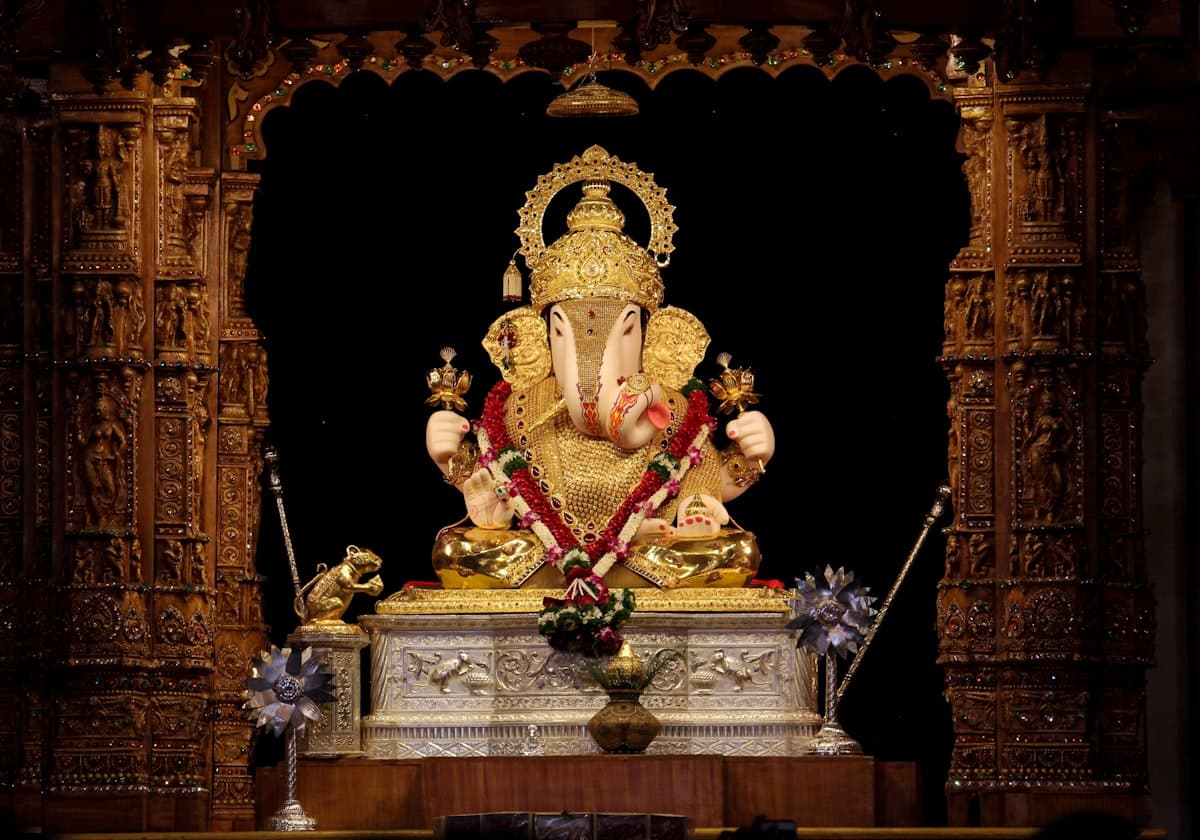
There is no shortage of advice on crafts and colouring pages. What there is very little of is help with the moment your eight-year-old looks at the idol on the counter and asks, flatly, "Is it real?"
Or the morning your twelve-year-old says she would rather not take prasad to school. Or the point at visarjan when a five-year-old realises what is about to happen and starts to cry.
These are the parts of the festival that actually determine whether it survives into the next generation, and almost nobody writes about them. This is a guide to those conversations — and to the school logistics that sit alongside them.
Ganesh Chaturthi 2026 falls on Monday, 14 September, with visarjan on Friday, 25 September.
"Why does he have an elephant head?"
Usually the first question, usually around age three or four.
What works at 3-6: Keep it short and keep it warm. "His mother made him, and something happened to his head, so his father gave him an elephant's head instead — and that made him even more special." Small children accept transformation easily. They do not need the mechanism.
What works at 7-10: They will want the whole story, and they will notice the violence in it. Tell it — but tell it as a story about a mother's love and a father's mistake being put right, because that is what it is. Children this age can hold "and then something terrible happened, and then it was made better."
What works at 11+: Give them the symbolism, because at this age it is more interesting than the plot. Big ears for listening, small eyes for focus, a broken tusk he snapped off himself to keep writing, a trunk strong enough to uproot a tree and delicate enough to lift a grain of rice. Older children who find the story childish often find the symbolism genuinely clever.
"Did Shiva really cut his head off?"
This one catches parents out, and the instinct to soften it usually backfires — children can tell when they are being managed.
Say yes, that is the story. Then say what the story is doing. "It's a story about what happens when two people who love each other don't recognise each other. And about how far a mother will go for her child."
What not to do: do not pretend the violent part is not there, and do not rush past it. A child who senses you are hiding something in the story concludes there is something wrong with the story.
If your child is distressed, that is a reasonable response to a distressing image, not a problem to be fixed. Acknowledge it. "It is a hard bit. It bothered me too when I was your age."
"Is it real?"
The question every diaspora parent gets, usually between eight and twelve, usually asked with genuine curiosity rather than challenge.
It deserves a real answer, and the honest one depends on what you actually believe. What we can say is what does not work:
- "Don't ask that" teaches them the tradition cannot survive a question. It will not hold.
- "It's just a story" empties the thing you are asking them to participate in.
- "Yes, exactly as described" — if you do not believe that, they will know, and they will discount everything else you say about it.
What tends to work is separating the layers. "Some of it is history, some of it is story, and some of it is true in the way that stories are true. What's real is that for thousands of years people have done this on this day, and we're part of that."
That answer is available to families across the whole range from literal belief to cultural practice, and it does not require anyone to pretend.
If you are a believing household, say so plainly — "Yes. I believe he is." Children can hold that their parent believes something they are still deciding about. What they cannot hold is a parent who will not say.
"Why do we do this when nobody else does?"
This lands around seven or eight, when a child first registers that their house is different from their friends' houses.
Do not treat it as a complaint. It is usually a factual observation delivered with mild bewilderment.
What helps:
- Numbers. "About a billion people do this. Just not many on this street." Children who feel like the only ones are often reassured simply to learn they are not.
- Other examples. Their friends have things too — Christmas, Eid, Hanukkah, Lunar New Year, a grandmother's particular Sunday. Difference stops being isolating once it is framed as everyone having something.
- Community. The single most effective answer is not verbal. It is a room full of other families doing the same thing. A temple event or a gathering of two or three families does more than any explanation.
"Do I have to?"
Sometimes the honest answer is no.
A child compelled into a ritual they resent learns that the tradition is something done to them. A child given a real choice, and a real role if they take it, often comes back to it later.
A workable middle: "You don't have to do the puja. You do have to be in the room, and you do have to be respectful. And if you want a job, it's yours."
The exception worth holding is presence at the family aarti — not participation, just presence. Most families find that non-negotiable presence with optional participation works far better than the reverse.
If they opt out entirely one year, that is not a failure. Adolescent withdrawal from family religious practice is common in every community and is frequently temporary. Keep the door open and stop negotiating.
The Cringe Phase
Somewhere around eleven to fifteen, many second-generation children become acutely embarrassed by visible cultural difference. It arrives suddenly and it has very little to do with the festival itself.
What it actually is: a developmental stage about fitting in with peers, aimed at whatever is nearest. In a diaspora household, what is nearest is the culture.
What does not work:
- Taking it personally, or treating it as rejection of you
- Guilt, or invoking grandparents
- Arguing them out of it
- Forcing visible participation in front of their friends
What does work:
- Lowering the visibility, not the practice. Home aarti yes; posting about it no. They will come back to the visibility later.
- Giving them competence. A teenager who can actually explain the festival well is far less embarrassed than one who cannot.
- Letting them bring a friend. A non-Indian friend who finds it interesting resets the whole frame faster than anything a parent says.
- Waiting. Most families report it passes by sixteen or seventeen, often with real interest on the other side.
School: The Practical Side — Absence on the Day
Ganesh Chaturthi is not a public holiday in the USA, UK, Canada or Australia, and 14 September 2026 is a Monday.
Most school systems in all four countries recognise religious observance as an excused absence category — but it generally requires written notice in advance, not a call on the morning.
A workable note: "[Child] will be absent on Monday 14 September for Ganesh Chaturthi, a Hindu religious observance. Please mark as excused religious absence. Work will be made up."
Send it now, not the night before. Some districts and academies require a form rather than a note; check yours.
Show-and-Tell and International Day
This is the best opportunity in the festival calendar to turn difference into status, and it works far better when the child leads it.
What presents well:
- The story, told in three minutes
- A small clay idol they made themselves
- The symbolism — big ears, small eyes, broken tusk
- Photographs of a large pandal in India, which reliably produce a reaction
- The visarjan idea: a guest who is welcomed knowing he will leave
Prasad in the Classroom — Read This Carefully
Do not send food into a classroom without checking first. This matters more than the tradition of sharing.
- Nut bans are widespread in primary schools across all four countries. Most Indian sweets contain nuts, and many are made on shared equipment.
- Dairy, sesame and wheat are also common declared allergens. Besan ladoo, coconut ladoo and most modak fail at least one.
- Many schools prohibit home-baked food entirely and accept only commercially packaged items with ingredient labels.
What to do: email the class teacher a week ahead, ask what is permitted, and offer to send individually wrapped, commercially labelled items if home-made is not allowed. Some families send a non-food token instead — a small card explaining the festival.
Never send something a child might hand round unsupervised without the teacher's explicit agreement. An allergic reaction in a classroom is a serious event and it would attach to the festival in that child's memory permanently.
A Teacher Who Has Never Heard of It
Most will not have. A short, friendly email does more than you expect:
"Ganesh Chaturthi is a ten-day Hindu festival beginning 14 September. Families install a clay image of Ganesha at home, worship him daily, and then immerse the image in water at the end. [Child] may want to talk about it — she'd be delighted if there were a chance."
Teachers in all four countries generally respond well to this. Many will make space for it.
When a Classmate Says Something Hurtful
It happens — usually clumsy curiosity rather than malice, occasionally not.
First, separate the two. "Did they mean it unkindly, or did they just not know?"
Give them a line. Children who have something to say are far less hurt than children who freeze. Something short and unbothered works best: "It's our festival. He's the one you pray to before you start something."
Do not escalate to the school over genuine ignorance. Do escalate over repeated mockery — every school in these four countries has a policy on religious harassment, and it applies.
Do not tell them to ignore it. That teaches them their discomfort does not count.
Visarjan With Children
This is the hardest day, and almost no guide mentions it.
Children get genuinely upset. They have spent days or a week and a half greeting a guest in their house, feeding him, singing to him, having a job to do. Then the guest goes into the water and does not come back. For a small child that is a real loss, and the tears are real.
What helps:
- Tell them in advance, on day one, that Bappa is visiting and will go home on a particular day. Surprise is what makes it hard, not the departure.
- Give them the chant. "Ganpati Bappa Morya, pudhchya varshi laukar ya" — come back early next year. The whole ritual is a promise of return, and children take that seriously.
- Let them help. Carrying the thali, pouring the water, saying goodbye out loud.
- A seed Ganesha — the kind containing embedded seeds that dissolves into a pot and sprouts — solves this better than any explanation. The child watches the plant come up. Nothing disappeared.
Do not minimise it. "It's just clay" is both untrue to what you spent ten days teaching them and dismissive of a real feeling.
What you can say: "I know. It's sad. That's the whole lesson — we love things properly even though they don't stay." That is not too heavy for a seven-year-old. It is one of the best things this festival has to offer a child.
What Actually Makes It Stick
Families who successfully pass this on tend to report the same three things — and none of them is scale.
1. A job that is theirs. Not a task assigned each year, but a standing role they own. She does the durva. He rings the bell. She counts out the modak. Ownership over years beats novelty every time.
2. Repetition, unglamorous. The seventh consecutive small aarti in a rented flat does more than one spectacular year. Consistency is what the memory attaches to.
3. The food. Overwhelmingly, adults who grew up in diaspora households name a smell or a taste as the thing that carries the festival for them — not a ritual, not a story. Cooking with them is not a supplementary activity. It may be the main one.
What does not seem to matter: idol size, decoration budget, how many days you keep him, or whether you got the Sanskrit right.
Mixed-Faith and Mixed-Culture Households
Give the non-Hindu parent a real role, not an observer's seat. Cooking, lighting the lamp, carrying the idol, holding the thali. Children read participation far more accurately than they read stated approval.
The frame that travels: a guest has been formally invited into the house, will be looked after for a set number of days, and will be sent off with affection and an invitation to return. Nobody needs to share a theology to take part in that.
Do not make the child the bridge. Kids in mixed households sometimes end up managing the adults' comfort. Sort it between the adults first.
Grandparents Across Time Zones
IST runs 9.5-12.5 hours ahead of North America, 4.5 hours ahead of the UK, and behind Australia.
Fix the call time now, not on the day. The Indian evening aarti lands in the North American morning and the Australian late evening.
What works better than a video call: ask the grandparent to tell the story to the child directly, rather than the family talking about logistics on speaker. Children will sit through a grandmother telling the Syamantaka story far longer than they will sit through adults discussing arrangements.
A quiet suggestion: record it. In twenty years it will be the most valuable thing in this entire festival.
Related NRI Globe Coverage
- Ganesh Chaturthi for Kids Born Abroad — Activities + Stories + Crafts
- Ganesh Puja at Home for NRI Families — Madhyahna + Sankalpa Guide
- Ganesh Chaturthi Recipes — Modak/Ladoo Cooking Guide
- Ganesh Visarjan Abroad — Country-by-Country Rules
- Ganesh Visarjan USA 2026 NRI Guide
- Ganesh Visarjan Australia 2026 NRI Guide
Frequently Asked Questions
How do I explain Ganesh Chaturthi to a young child?
Keep it short and warm. For under-sixes, that his mother made him, his head was replaced with an elephant's, and that made him special. Older children can take the full story and, from about eleven, the symbolism.
Should I tell my child the violent part of the story?
Yes, and without rushing it. Children sense when a story is being managed. Tell it as what it is — a story about recognition, love and repair.
My child is embarrassed about the festival. What should I do?
Treat it as a developmental stage about peer belonging rather than rejection of the culture. Lower the visibility rather than the practice, help them become able to explain it well, and wait. It usually passes.
Can I make my child participate?
Presence at the family aarti is a reasonable expectation. Compelled participation in the ritual itself tends to produce resentment. Non-negotiable presence with optional participation works better than the reverse.
Can I send prasad to school?
Check with the teacher first. Nut bans are widespread across all four countries, most Indian sweets contain nuts or dairy, and many schools accept only commercially packaged items with ingredient labels. Ask before sending; a food-related incident in a classroom is serious.
Will school mark the absence as excused?
Most systems in the USA, UK, Canada and Australia recognise religious observance as excused, but it generally requires written notice in advance rather than a call on the morning. Send a note now for September 14.
My child cries at visarjan. How do I handle it?
Tell them on day one that Bappa is visiting and will go home. Give them the chant about returning next year, let them help with the farewell, and don't minimise the sadness. A seed Ganesha that grows into a plant helps a great deal.
What actually makes a child keep the tradition?
A standing job that is theirs, unglamorous repetition year on year, and cooking together. Not scale, budget or ritual precision.
Disclaimer: NRI Globe provides journalism and general information only. Not parenting or educational advice. Every family + child is different — adapt these suggestions to your household + your child's specific temperament + your family's religious tradition.