
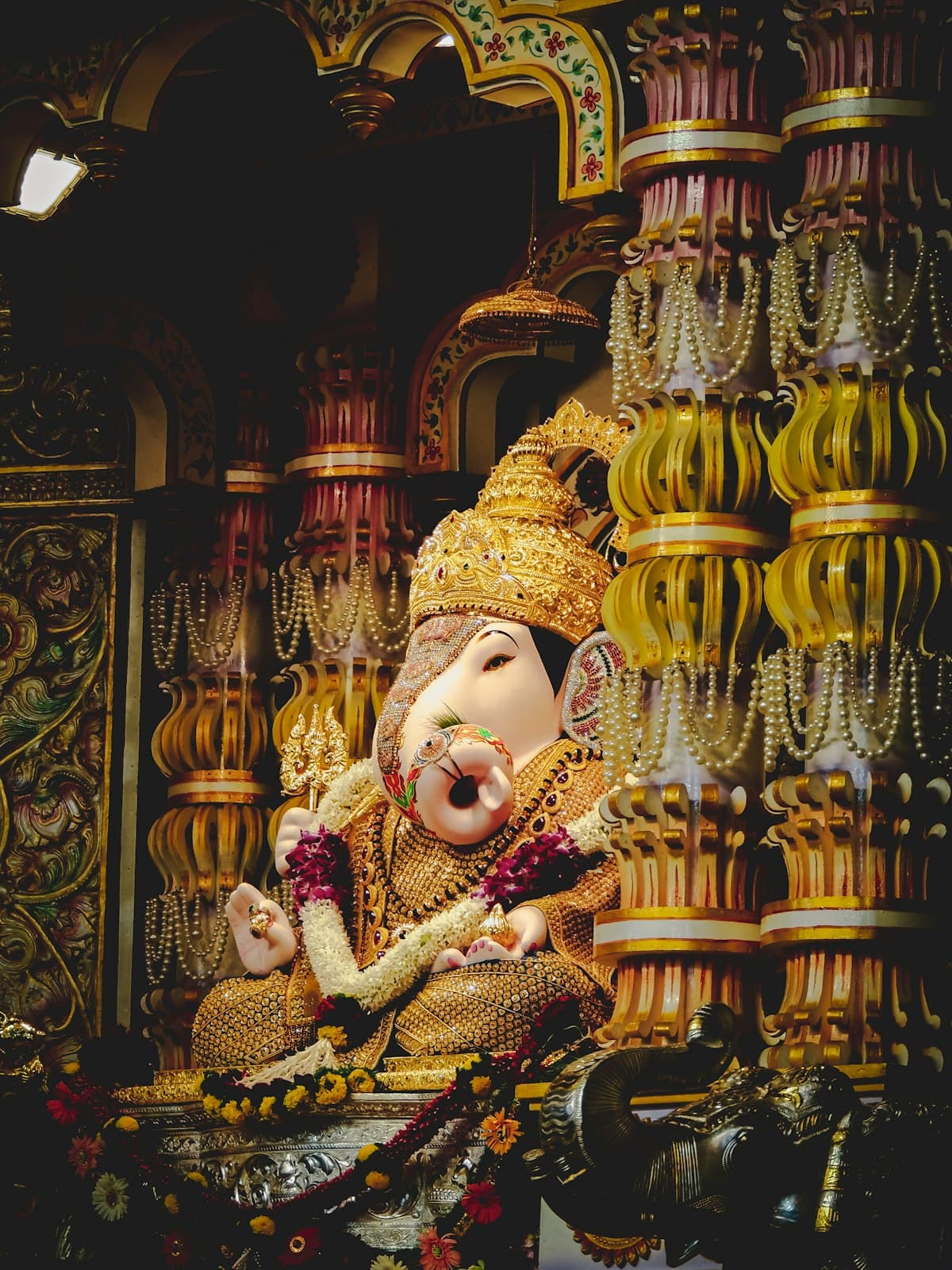
Three questions come up in every diaspora household on Chaturthi morning, and no traditional paddhati answers any of them.
What time is madhyahna here? What do I say in the sankalpa when I am not in Bharatavarsha? What do I offer when I cannot find twenty of the twenty-one leaves?
This guide answers those three, then gives the full puja sequence adapted for a kitchen counter in Edison, a flat in Wembley, a condo in Mississauga or a house in Parramatta. Ganesh Chaturthi 2026 is Monday, September 14, 2026, with visarjan on Anant Chaturdashi Friday, September 25.
Quick answer: Do not convert India's muhurat to your time zone. Madhyahna is recomputed from your own sunrise and sunset — divide your local daylight into five parts; the third part is your window. In the sankalpa, name your actual country, state and city after the traditional frame, following whatever form your family purohit uses. For patri, offer what you can source and complete the count with durva, which grows in most lawns across all four countries.
Part 1 — Your Date May Not Be India's Date
Ganesh Chaturthi follows the Chaturthi tithi as reckoned against local sunrise and the local madhyahna period. It does not transfer from the Indian calendar date.
| Country | Likely date 2026 | Note |
|---|---|---|
| USA — all time zones | Monday 14 September | Settled |
| UK | Monday 14 September | Settled |
| Canada — all provinces | Monday 14 September | Settled |
| Australia / New Zealand | 14 or 15 September | Panchangs differ. Confirm with your temple |
Australia is the real question. Because Sydney runs 4.5 hours ahead of IST, the tithi window can resolve differently depending on the calculation method. Some Australian panchangs place the observance on Tuesday 15 September 2026. Others keep 14 September.
What to do: follow your local temple or family purohit, not the Indian date and not a website. Confirm this week, not on the morning.
Visarjan falls on Anant Chaturdashi, Friday 25 September 2026. And a practical reality across all four countries: 14 September is a Monday and 25 September a Friday. Most temples and associations are holding their public programmes on the surrounding weekends so working families and schoolchildren can attend. Your household puja and your temple event may well be on different days. Both are fine.
Part 2 — Finding Your Madhyahna
This is the part people get wrong, and it is worth understanding rather than looking up.
Madhyahna is not noon, and it is not the Indian muhurat converted. It is the third of five equal parts into which the local day — sunrise to sunset — is divided. Ganesha is held to have appeared in that period, which is why the sthapana belongs there.
The method
- Find sunrise and sunset for your city on your Chaturthi date
- Subtract to get total daylight
- Divide by five
- The third part is your madhyahna
Worked example, New York, 14 September: sunrise around 6:35 am, sunset around 7:10 pm. Daylight is roughly 12 hours 35 minutes. Divided by five, each part is about 2 hours 31 minutes. The third part runs from roughly 11:37 am to 2:08 pm. That is the window.
Indicative windows (approximate only — compute your own city)
| City | Approximate madhyahna, 14 Sept |
|---|---|
| New York / Toronto | ~11:35 am – 2:10 pm |
| Chicago | ~11:50 am – 2:25 pm |
| Houston / Dallas | ~12:00 pm – 2:30 pm |
| San Francisco / Seattle | ~12:00 pm – 2:35 pm |
| London / Leicester | ~11:50 am – 2:25 pm |
| Vancouver | ~12:05 pm – 2:40 pm |
| Sydney / Melbourne | ~10:50 am – 1:10 pm |
| Perth | ~11:10 am – 1:30 pm |
Verify against a panchang calculated for your city. These illustrate the method; they are not a substitute for it. Note how early the Australian window sits — southern-hemisphere September days are shorter, so madhyahna arrives sooner and closes sooner.
Part 3 — If You Cannot Do Madhyahna
For most working households in these four countries, madhyahna lands squarely in the middle of a Monday.
The honest position: madhyahna is prescribed and is preferable. It is not a condition of validity. A sthapana performed at another hour within the tithi, with a sincere sankalpa, is a real sthapana.
In order of preference:
- Take the morning off and do it properly in the window. Religious observance is a recognised leave category with most employers in all four countries.
- Install within madhyahna briefly — even a short prana pratishtha, dhyana and dhupa-dipa — and perform the full puja that evening when the family is home.
- Perform the whole puja in the evening within the tithi.
- Observe on the weekend with the community, if that is your household's practice.
What does not work: deciding it is too difficult and skipping it. The Kshama Prarthana at the close of the puja exists precisely to cover a worship performed short, late, or imperfectly.
Part 4 — The Sankalpa Outside India
The traditional sankalpa locates you in space before it locates you in time: jambūdvīpe bhāratavarṣe bhāratakhaṇḍe meroḥ dakṣiṇa digbhāge — in Jambudvipa, in Bharatavarsha, south of Meru.
What do you say in New Jersey? There is no single answer, and anyone who tells you otherwise is overstating the case. Three forms are in active use among diaspora purohits, and all three are defensible.
Form 1 — Retain the traditional frame. Some purohits hold that the puranic geography is a cosmological reference rather than a postal address, and that jambūdvīpe bhāratavarṣe is recited unchanged wherever the devotee stands.
Form 2 — Use the puranic dvipa for your region. Others assign the continents to the puranic dvipas and substitute accordingly — most commonly Krauncha dvipa for the Americas, with corresponding assignments for Europe and Australia.
Form 3 — Name your actual location. The most common practice in diaspora households: keep the traditional frame, then add your real place — amerikā deśe, iṅglaṇḍ deśe, kanaḍā deśe, ausṭreliyā deśe — followed by your state and city, before continuing into the time fields.
Our recommendation: ask your family purohit and use his form. If you have no one to ask, Form 3 is the safest for a householder: it is honest about where you are standing, it is widely used, and it keeps the sankalpa doing what a sankalpa is for — stating plainly who is doing what, where, when and why.
The time fields for 14 September 2026
| Field | Value |
|---|---|
| Samvatsara | The current Telugu or regional samvatsara — confirm with your panchang |
| Ayana | Dakshinayana |
| Ritu | Varsha ritu |
| Masa | Bhadrapada masa |
| Paksha | Shukla paksha |
| Tithi | Chaturthi |
| Vasara | Somavara (Monday) |
| Nakshatra, Yoga, Karana | From a panchang for your city |
A note on ritu and ayana in the southern hemisphere. Australian and New Zealand families sometimes ask whether dakshinayana and varsha ritu still apply when it is early spring outside their window. The overwhelming practice is yes — the ritu and ayana are reckoned against the sun's declination as traditionally computed, not against local weather. Recite them as given.
Declare your vrata length in the sankalpa — one and a half, three, five, seven or ten days. The vow fixes your visarjan date.
Part 5 — Sourcing Samagri in Four Countries
Start in the freezer aisle. It is where most of what you need actually lives abroad.
| Item | Where to find it |
|---|---|
| Clay (shadu) idol | Indian grocers from mid-August; temple gift counters, usually the most reliable for genuine clay; online marketplaces shipping to all four countries — order by early August |
| Durva grass | Your own lawn (see Part 6) |
| Mango leaves | Frozen, in Indian and Southeast Asian grocers |
| Banana leaf | Frozen; thaw and pass briefly over a flame |
| Fresh coconut | Whole coconuts in most large supermarkets; frozen grated for naivedya |
| Haldi, kumkum, akshata, chandan | Indian grocers; buy a made-up puja kit if you are starting from nothing |
| Camphor, agarbatti, cotton wicks | Indian grocers; also widely available online |
| Ghee | Or make it: simmer unsalted butter 15 minutes, strain |
| Hibiscus | Garden centres stock potted hibiscus in season |
| Betel leaves + areca nut | Indian and Southeast Asian grocers, often refrigerated |
Temple shops are underused. Most large temples in all four countries run a counter with clay idols, patri bundles and complete puja kits, assembled by people who know what a Vinayaka vrata actually needs. Call before Chaturthi — they sell out.
Part 6 — The 21 Patri Abroad
The Ekavimshati Patra Puja is the heart of the Telugu and South Indian vrata, and sourcing twenty-one specific leaves in Leeds or Calgary is not going to happen.
The good news about durva
Durva is Cynodon dactylon — common Bermuda grass — and it grows widely across the United States, Australia, and warmer parts of the UK and southern Canada. It is very likely already in your lawn or your local park.
Before you pick it:
- Avoid any lawn treated with herbicide or pesticide. Treated turf is common in American and Australian suburbs
- Pick from an untreated garden, a quiet park verge, or grow a pot of it yourself
- Wash thoroughly
- Offer in bunches of three or five blades, twenty-one bunches
Durva is the offering held dearest of all. A puja completed with durva alone is not a compromised puja.
Substitution table
| Traditional patram | Abroad |
|---|---|
| Durva (garika) | Bermuda grass from an untreated lawn |
| Chuta (mango) | Frozen mango leaves, Indian grocers |
| Bilva (maredu) | Dried bilva from Indian grocers or temple shops |
| Tulsi | Live plant from an Indian grocer or garden centre |
| Jati (jasmine) | Garden centre jasmine, widely stocked |
| Karavira (ganneru) | Oleander, common in warm-climate gardens |
| Badari, Shami, Apamarga, Arka, Vishnukranta | Rarely available. Substitute with durva |
Offer what you have, and complete the twenty-one count with durva, reciting the corresponding name of Ganesha for each. This is standard practice, not a diaspora concession — Indian households in cities do exactly the same.
Part 7 — The Puja, Adapted
The full sequence, condensed for a household kitchen or living room.
Before you begin
Bathe, wear clean clothes, and set the chowki in the northeast with the idol facing north or east. Cover it in red or yellow cloth. Do not taste the naivedya.
1. Opening
Śuklāmbaradharaṁ viṣṇuṁ śaśivarṇaṁ caturbhujam | prasannavadanaṁ dhyāyet sarvavighnopaśāntaye ||
Achamana. Then Apavitraḥ pavitro vā... and Puṇḍarīkākṣāya namaḥ three times, sprinkling water on your head.
2. Lamp
Light two lamps. Sājyaṁ trivarti-saṁyuktaṁ vahninā yojitaṁ priyam | gṛhāṇa maṅgalaṁ dīpaṁ trailokya timirāpaham ||
3. Sankalpa
Use the form from Part 4. State your place, the date fields, your gotra and name, your household, the purpose, and the number of days you will keep Bappa.
4. Kalasha
Gaṅge ca yamune caiva godāvari sarasvati | narmade sindhu kāveri jale'smin sannidhiṁ kuru ||
Sprinkle that water on the articles, the idol and yourself.
5. Haridra Ganapati
Form a small Ganapati from turmeric paste on a betel leaf. Recite the sixteen names — Sumukhaścaikadantaśca kapilo gajakarṇakaḥ... — offer briefly, and proceed.
6. Prana pratishtha
Uncover the idol's face. Touch its heart and limbs with a durva blade dipped in water:
Asya prāṇāḥ pratiṣṭhantu asya prāṇāḥ kṣarantu ca | asya devatvam arcāyai māmaheti ca kaścana ||
Then Om Gaṁ Gaṇapataye Namaḥ, twenty-one or one hundred and eight times.
7. Dhyanam and avahanam
Vakratuṇḍa mahākāya sūryakoṭi samaprabha | nirvighnaṁ kuru me deva sarvakāryeṣu sarvadā ||
Āgaccha bhagavan deva sthāne cātra sthiro bhava | yāvat pūjāṁ kariṣyāmi tāvat tvaṁ sannidhau bhava ||
8. Upacharas
Water at the feet and hands, panchamrita bath, clean water, cloth, sacred thread, sandalwood, akshata, flowers — each with Śrī mahāgaṇādhipataye namaḥ.
9. Patri and durva
The twenty-one leaves per Part 6, then twenty-one bunches of durva.
10. Ashtottara + Naivedyam
The 108 names. Modak, undrallu, kudumulu or ladoo — twenty-one where you can. See our Ganesh Chaturthi Recipes 2026 Complete Guide.
11. Aarti and pushpanjali
Camphor aarti, then flowers in cupped palms, then circumambulate and prostrate.
12. Kshama prarthana
Mantrahīnaṁ kriyāhīnaṁ bhaktihīnaṁ gaṇādhipa | yat pūjitaṁ mayā deva paripūrṇaṁ tad astu te ||
Then Om Acyutāya namaḥ | Om Anantāya namaḥ | Om Govindāya namaḥ, three times.
Part 8 — Practicalities of an Apartment Puja
Smoke detectors. Camphor aarti and heavy dhoop will set off a smoke alarm in an American or Canadian apartment, and in many British and Australian flats.
What works:
- Perform camphor aarti beside an open window or under the kitchen extractor
- Use a small camphor tablet rather than a large one
- Prefer agarbatti over loose dhoop indoors
- Never cover or disable a detector. Open a window instead
HOA and strata. Outdoor processions on shared property, amplified sound and open flames on balconies are the three things that generate complaints. Keep it indoors. A short courtesy note to neighbours in advance resolves almost all of it.
Part 9 — Visarjan Where You Live
Immersion in a lake, river or the sea is a legal question abroad before it is a devotional one, and the rules differ across the four countries.
Home visarjan in a tub is fully valid. Perform the uttar puja, chant Yāntu devagaṇāḥ sarve, lower the clay idol into clean water, let it dissolve, and pour the clay water into a garden bed or a potted plant — never a sink, drain or toilet.
For the country-by-country legal position, see our Ganesh Visarjan Abroad — Country-by-Country Rules.
Part 10 — Children and Mixed Households
Give them the parts that work. Rolling ladoos, shaping undrallu, picking and counting durva, counting out twenty-one modak, ringing the bell, holding the aarti thali. The kitchen and the thali teach this better than an explanation does.
Related NRI Globe Coverage
- Ganesh Chaturthi 2026 Puja Vidhi Complete Guide
- Ganesh Chaturthi Recipes 2026 — Detailed Cooking Guide
- Ganesh Chaturthi Decorations 2026
- Ganesh Visarjan Abroad — Country-by-Country Rules
- Ganesh Chaturthi Mantras + Slokas
Frequently Asked Questions
What time should I do Ganesh puja in the USA?
During your local madhyahna — the third of five equal parts of the day from sunrise to sunset. In most American cities on September 14, 2026 this falls roughly between 11:35 am and 2:35 pm depending on longitude. Compute it for your city rather than converting the Indian muhurat.
Is Ganesh Chaturthi 2026 on the same day in Australia as in India?
Not necessarily. Australian panchangs differ between 14 and 15 September 2026. Follow your local temple.
What do I say in the sankalpa when I live abroad?
Three forms are in use: retaining the traditional puranic frame, substituting the puranic dvipa for your continent, or keeping the frame and adding your actual country, state and city. Ask your family purohit; the third form is the safest default for a householder.
Where do I get durva grass in the USA or Australia?
Durva is Bermuda grass (Cynodon dactylon) and grows in most lawns and parks. Pick only from untreated ground — avoid herbicide-treated turf — and wash thoroughly.
What if I cannot get the 21 patri?
Offer what you can source and complete the count with durva, reciting the corresponding name for each. Many temples sell patri bundles in the week before Chaturthi.
Will the camphor aarti set off my smoke alarm?
Very likely in an apartment. Perform it beside an open window or under the kitchen extractor, use a small tablet, and never disable a detector.
Can I perform the puja without a priest?
Yes. This is a householder's vrata, performed at home throughout India and the diaspora without a purohit.
Disclaimer: NRI Globe provides journalism and general information only. Not religious advice. Follow your family's paddhati and your local temple's guidance for specific ritual questions. Verify tithi + muhurat + sankalpa desha with your family purohit.