
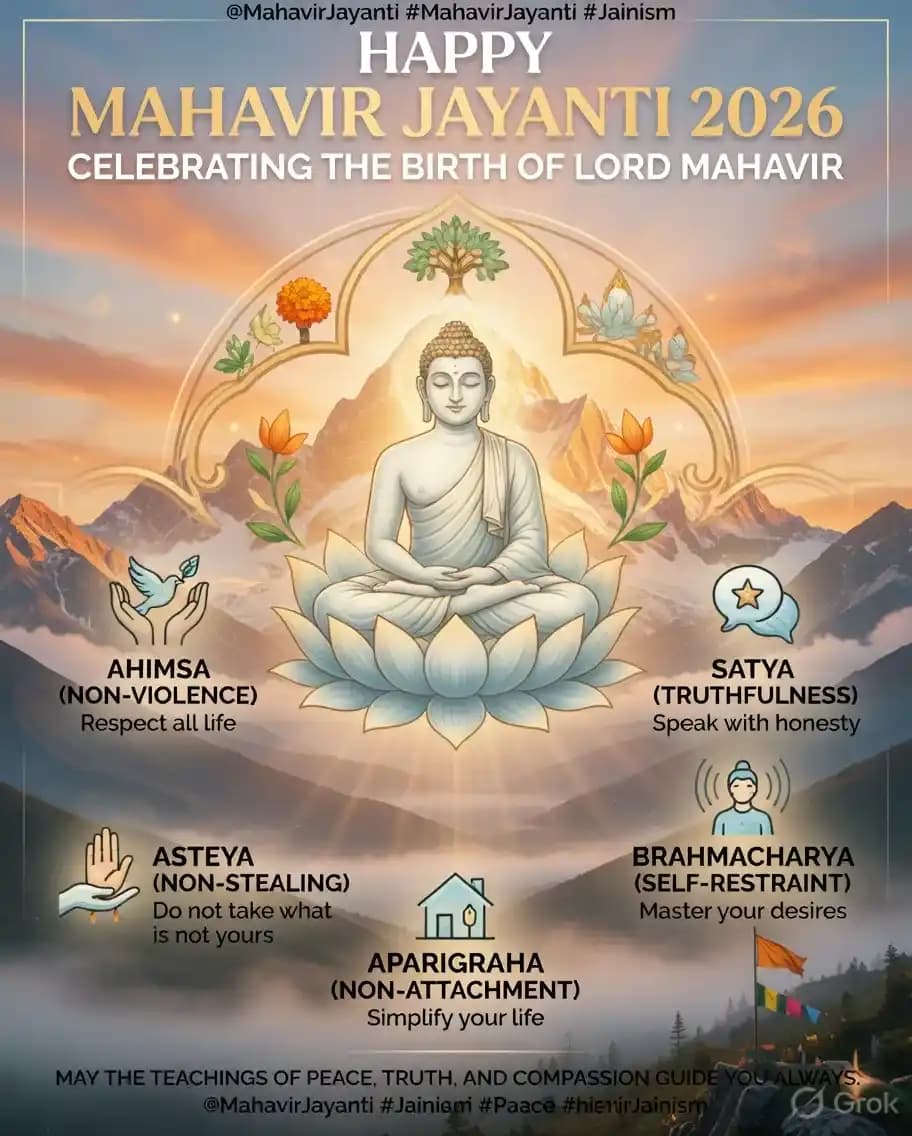
Mahavir Jayanti 2026 brings the Jain diaspora together across continents. Communities gather to honour the 24th Tirthankara through prayer, service and reflection on core vows. For many NRI families, the occasion carries a weight that goes beyond a single day of observance — it represents an annual anchor point that connects generations separated by thousands of miles.
TL;DR
- Mahavir Jayanti 2026 falls on Chaitra Shukla Trayodashi and marks the 2624th birth anniversary of Lord Mahavira.
- NRIs in the UK, USA, Canada, Australia and Gulf countries organise temple rituals, processions and charity drives.
- Key practices include abhisheka, fasting, blood donation and online sessions for children.
- The five great vows remain practical guides for ethical living far from India.
Mahavir Jayanti 2026 Date & Significance
The tithi remains Chaitra Shukla Trayodashi, which typically falls in late March or April in the Gregorian calendar; community temple committees generally confirm the precise date several months in advance, so checking your local Jain centre's calendar closer to the time is advisable. Because the Jain lunar calendar does not align perfectly with the Gregorian year, the corresponding Gregorian date shifts slightly from one year to the next, which is why diaspora families are encouraged to verify the date with their regional Jain association rather than relying on a fixed date from a previous year.
Lord Mahavira was born in 599 BCE in Kundagram near Vaishali. He attained Kevala Jnana — often described as omniscient, all-encompassing knowledge — after intense penance and taught liberation through five vows: Ahimsa, Satya, Asteya, Brahmacharya and Aparigraha. These vows were intended not only for ascetics but were adapted by lay followers into a set of partial vows known as Anuvratas, making them accessible to householders across every walk of life.
The anniversary is observed not merely as a historical commemoration but as a living call to renew those vows. For diaspora communities, the occasion offers a structured moment to step back from the pace of professional life and reconnect with teachings that predate many of the world's major philosophical traditions by centuries. Scholars of Jain philosophy widely note that the relevance of Mahavira's message has, if anything, grown in an era of environmental concern, economic inequality and digital distraction — themes that resonate deeply with NRIs navigating life between two cultures. The Jain concept of Anekantavada, or many-sidedness of truth, is also frequently cited in diaspora educational settings as a philosophical basis for pluralism and respectful dialogue — qualities that NRIs often find themselves drawing on in diverse workplaces and multicultural neighbourhoods.
How NRIs Mark the Day in Major Countries
Temple committees coordinate events months ahead. Families often combine in-person rituals with video calls to relatives in India. The scale and format of celebrations vary considerably depending on the size of the local Jain population, the age of the community's institutions, and the availability of trained religious scholars willing to travel abroad for the occasion.
| Country | Typical Activities | Common Locations |
|---|---|---|
| UK | Rath Yatra, abhisheka, virtual discourses | Wembley, Harrow, Leicester, Birmingham |
| USA | Bhajans, children's programs, ethical-living talks | New Jersey, California, Texas, Illinois |
| Canada | Processions, charity drives | Toronto, Brampton, Edmonton |
| Australia | Youth workshops, Ahimsa campaigns | Sydney, Melbourne, Auckland |
| UAE | Home poojas, sattvik community meals | Dubai, Abu Dhabi community halls |
Across all these regions, a common thread emerges: the day functions as both a religious observance and a community-building exercise. In cities where the Jain population is relatively small, Mahavir Jayanti often draws together families from different Indian states — Gujarat, Rajasthan, Karnataka — who might otherwise socialise only within their own regional circles. The shared ritual creates a broader sense of belonging that many NRIs describe as essential to raising children with a grounded cultural identity. In Gulf countries, where public religious processions may not always be feasible, communities tend to focus on home-based observance and private gatherings in community halls, adapting the spirit of the celebration to the local regulatory and social environment while preserving its core meaning.
A First-Hand Perspective from an NRI in New Jersey
Meera Patel moved from Mumbai to Edison, New Jersey, in 2008. Each year she and her two teenage sons spend the weeks before Mahavir Jayanti preparing vegetarian meals for a local shelter. On the day itself the family wakes before dawn to join the abhisheka at the Jain temple in Franklin Township. Meera says the ritual reminds her sons that material success must stay balanced with compassion. After the temple visit they return home for a single sattvik meal and then log into a live webinar hosted by a scholar in Ahmedabad. The boys take notes on how the vow of Aparigraha applies to their own screen-time habits. In the evening the family packs boxes of school supplies for a drive organised by the temple youth group.
Meera notes that these repeated actions have become the thread connecting her children to their grandparents' values even though they have never lived in India. The same pattern repeats among her neighbours from Gujarat, Rajasthan and Karnataka. Shared seva projects turn strangers into an extended family that supports one another through job changes, college applications and health scares. Over fifteen years Meera has watched the temple grow from a rented hall into a permanent centre with classrooms and a library. She credits the annual Mahavir Jayanti cycle for keeping the community cohesive despite the pressures of American suburban life. Her experience reflects a broader pattern documented by researchers who study diaspora religion: recurring festival cycles tend to be among the most durable mechanisms for transmitting cultural and spiritual identity across generations, particularly when those cycles involve active service rather than passive attendance alone.
The Role of Digital Connectivity in Diaspora Observance
One of the more striking shifts in recent years has been the role of live-streamed discourses and online study circles in keeping diaspora members connected to religious learning. Families in time zones far removed from India can now join morning prayers broadcast from temples in Ahmedabad or Jaipur in real time. Youth groups in the UK and Canada use messaging platforms to coordinate charity drives across cities, pooling resources for food banks and blood donation campaigns.
This digital layer does not replace in-person gathering — most community members are clear on that point — but it does lower the barrier for families who live far from a Jain temple or who are new to a city and have not yet found their local community. For children growing up abroad, the combination of physical ritual and online learning creates multiple entry points into a tradition that might otherwise feel remote from their daily school experience. Some temples have begun archiving recorded discourses and children's educational sessions so that families can revisit them throughout the year, not only around Mahavir Jayanti. This approach treats the festival not as an isolated event but as a gateway into year-round engagement with Jain philosophy and practice — a model that several diaspora organisations, as referenced in community publications cited by the sources already noted in this article, have found effective in retaining the interest of second-generation members.
Relevance of the Five Vows Today
Ahimsa extends beyond diet to include respectful speech in multicultural workplaces. Satya encourages transparent business dealings even when deadlines tighten. Asteya prompts NRIs to respect intellectual property in competitive industries. Brahmacharya supports healthy boundaries around digital consumption. Aparigraha counters the accumulation of possessions that often accompanies higher incomes abroad.
Many Jain community leaders and educators abroad frame these vows not as restrictions but as a practical ethical framework — one that translates readily into the language of corporate responsibility, environmental sustainability and mental wellbeing. The vow of Aparigraha, for instance, maps closely onto contemporary conversations about minimalism and conscious consumption. Ahimsa finds expression in plant-based dietary choices that are increasingly mainstream in Western countries. This alignment between ancient teaching and modern concern gives NRI families a confident way to discuss their faith with colleagues and neighbours who may have little prior knowledge of Jainism.
For NRI professionals in particular, the five vows offer a vocabulary for ethical decision-making that does not depend on the cultural context of India to remain meaningful. A software engineer in California weighing the ethics of data privacy, or a finance professional in London considering the boundaries of competitive practice, can draw on the same framework that guided Jain merchants and scholars across centuries of trade and scholarship. This portability is one reason why diaspora educators often describe the vows as among the most transferable aspects of the Jain tradition — relevant not only within the community but in the wider societies where NRIs live and work.
Next steps
Check local temple calendars for 2026 event listings. Plan a family charity activity aligned with one of the five vows. Share stories of observance with younger relatives through video calls.
Sources
Continue reading — NRI Globe pillar guide: Returning to India — Complete Checklist
Related NRI Globe Coverage
- Paris Under Fire: Violent Clashes Erupt as PSG Fans Celebrate Champions League Victory
- White House New Year 2026: Patriotic Celebrations and America’s 250th
- The Most Vibrant New Year's Eve Celebrations in Africa: Top Destinations to Welcome 2026 for NRIs
- The Most Spectacular New Year's Eve Celebrations in the USA: Top Destinations
- How NRIs Are Celebrating Labor Day 2026 Differently This Year — Community, Gas Prices & the Shift to Local
- Top Indian Community Labor Day Melas Across USA 2026 — City-by-City Guide (NJ, Chicago, Houston, Bay Area, NYC, Texas)
- David Warner's Janmashtami 2026 Wishes Touch NRIs Worldwide — 'Jai Shri Krishna' Post Sparks Global Diaspora Celebration
- Labor Day 2026 Events in USA: Complete Guide for Indian Families & NRIs — Indo American Fair, Bollywood Nights, Temple Events
Fresh from NRI Globe
- YouTuber Nandu's World (Rama Nandana) UK Visa & Job Fraud Case: Full Details + Key Lessons for NRIs (2026)
- Dussehra / Vijayadashami 2026 Events Country-Wise — Global NRI Directory (Ram Lila, Ravana Dahan, Durga Puja Pandals, Ayudha Puja Venues + Booking)
- Diwali 2026 Events Country-Wise — Global NRI Directory (White House, Leicester, London Trafalgar, Toronto, Auckland, Sydney Parramasala, Fiji, Mauritius, Trinidad, South Africa and More)
- Diwali / Deepavali 2026 Country-Wise NRI Celebrations — Complete Global Guide (USA, UK, Canada, Australia, Fiji, Mauritius, Trinidad, South Africa, UAE and 30+ Countries)