
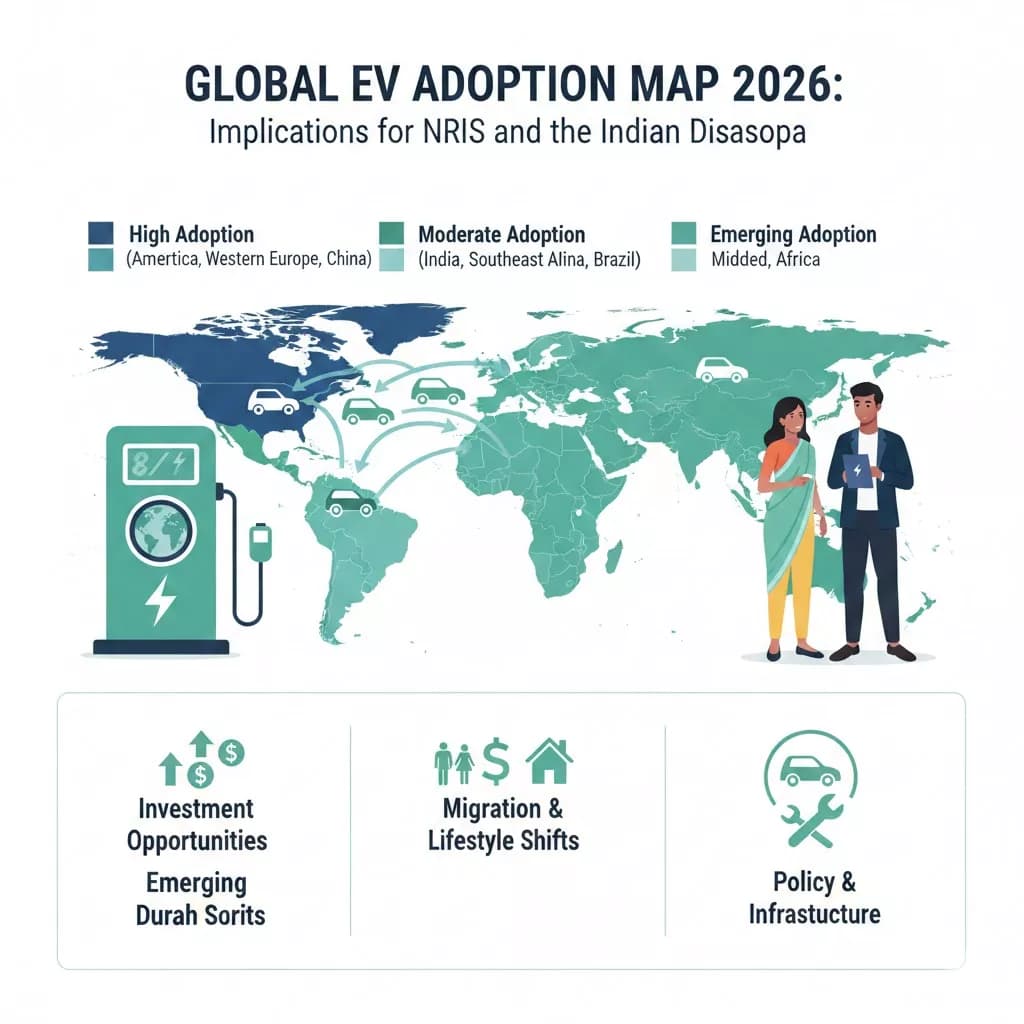
Global EV Adoption Map 2026: Implications for NRIs and the Indian Diaspora
As we move deeper into 2026, the global transition to electric vehicles (EVs) is gaining momentum, reshaping transportation, energy consumption, and economies worldwide. For Non-Resident Indians (NRIs) and the Indian diaspora—many of whom live in tech-savvy hubs across the US, Europe, Canada, Australia, and the Middle East—EV adoption trends matter significantly. Whether you're an NRI professional considering an EV for daily commutes, investing in green tech, or planning family visits to India amid its own EV boom, understanding the global landscape is key.
This NRIGlobe.com feature maps the fastest-moving countries in EV penetration (share of new passenger vehicle sales that are electric, including BEVs and PHEVs), spotlights leaders and emerging hotspots, and explores how these shifts impact NRIs—from job opportunities in EV sectors to cost savings, environmental benefits, and ties to India's accelerating domestic market.
Global EV Landscape in Early 2026: Steady Growth Amid Regional Variations
Global EV sales continue to climb, with projections for around 25-27% market share in new vehicle sales this year. China dominates in volume and increasingly in share, while Nordic countries lead in penetration rates. Emerging markets in Southeast Asia are surging, often leapfrogging traditional adopters thanks to affordable models and incentives.
Key drivers include plummeting battery costs, expanded charging networks, government policies, and industrial demand for sustainable transport. However, slowdowns in the US and parts of Europe highlight policy and economic sensitivities.
Top Countries Leading EV Adoption in 2026
Norway continues to set the global benchmark, with electric vehicles dominating new registrations. Rapid risers in Asia are narrowing the gap, offering lessons for India's own push.
- Norway: EV share remains exceptionally high, often exceeding 90-95% of new passenger vehicle sales. Long-standing incentives like tax exemptions, free tolls, and robust infrastructure have made EVs the default choice.
- China: Surpassed 50% EV share in recent periods, with massive domestic production and urban policies fueling growth. The country accounts for a majority of global sales.
- Vietnam: One of the fastest climbers, with EV penetration nearing or exceeding 30-40% in key periods, driven by local brands like VinFast and supportive measures.
- Nordic Peers (Sweden, Denmark, Finland): Maintain strong shares in the 50-60% range, backed by green policies and high consumer acceptance.
- Thailand: Exceeded 20% EV share, with incentives and manufacturing hubs accelerating adoption.
- Netherlands: Consistently high (around 45-50%), supported by infrastructure and regulations.
Other standouts include Singapore and Indonesia, where penetration rivals or surpasses many developed markets.
Regional Breakdown: A Diaspora-Focused View of Adoption
Visualize a global map color-coded by EV market share of new sales in early 2026:
- Dark Green (Leaders >40-90%+): Norway, Vietnam (a rising star in Asia).
- Bright Green (High 20-50%): China, Sweden, Denmark, Finland, Netherlands, Thailand.
- Medium Green (10-25%): Much of Western Europe (EU average ~20-25%), parts of ASEAN, and emerging pockets in Latin America and India.
- Light Green/Yellow (5-10%): United States (impacted by policy changes like reduced tax credits), United Kingdom, Germany, France.
- Lower (<5%): Many developing regions, though select areas show rapid gains.
Emerging markets now contribute significantly to global growth, with dozens of countries surpassing 10% EV share—many outside Europe.
India's EV Momentum: Relevance for NRIs
India's EV market is transitioning rapidly, with total EV sales (across two-, three-, and four-wheelers) reaching around 2.3 million units in 2025, representing about 8% of new vehicle registrations. Electric two-wheelers lead, followed by three-wheelers, while passenger EVs gain traction in metros.
- Projections for 2026 point to continued acceleration, with passenger car penetration potentially entering double digits in urban areas.
- Government initiatives like PM E-DRIVE, state-level incentives, and expanding charging infrastructure are key drivers.
- For NRIs, this means growing opportunities during visits home—affordable e-two-wheelers for family use, electric cabs in cities, and potential investments in India's booming EV ecosystem (manufacturing, batteries, charging).
Many NRIs in tech and engineering fields are already involved in global EV supply chains, with India's push creating repatriation or collaboration prospects.
Challenges and Laggards: Where NRIs May Feel the Impact
- United States: EV share remains in the low double digits or below, affected by subsidy cuts and market preferences. NRIs in tech hubs like California or Texas may face higher costs or limited model choices compared to global leaders.
- Japan and parts of Europe: Slower in some segments due to hybrid focus or policy shifts.
- Infrastructure and affordability gaps persist in many diaspora-heavy regions, though improvements are underway.
Why EV Trends Matter to NRIs in 2026
For the Indian diaspora:
- Cost and Convenience: In high-adoption countries, EVs offer lower running costs and incentives—appealing for NRIs managing households abroad.
- Career and Investment: Booming sectors in China, Europe, and emerging Asia create jobs in software, batteries, and manufacturing—opportunities for Indian talent.
- Sustainability Ties: Aligns with India's net-zero goals and family values around clean air.
- Remittances and Home Impact: As India ramps up (targeting higher penetration by 2030), NRIs can support family transitions to EVs.
The global EV shift is not just about cars—it's about energy independence, job creation, and climate action. NRIs, with their cross-border perspectives, are uniquely positioned to benefit and contribute.
NRIGlobe.com will keep tracking these developments, from global leaders to India's progress. How is the EV wave affecting your life as an NRI? Share your experiences in the comments below!
Stay connected for the latest on diaspora news, immigration, and global trends.
Latest NRI News & Global Updates:
Health, Wellness & Lifestyle for NRIs
https://nriglobe.com/lifestyle/
Latest NRI News & Global Updates
https://nriglobe.com/news/
Business & Finance News for NRIs
https://nriglobe.com/business/
Investment Guides for NRIs
https://nriglobe.com/investment/
Jobs & Career Opportunities for NRIs
https://nriglobe.com/jobs/
Continue reading — NRI Globe pillar guide: Canada Express Entry for Indians
Related NRI Globe Coverage
- Trump-Putin Summit Fallout: Implications for Ukraine and the Indian Diaspora
- Texas Senate Approves GOP-Favored Redistricting Map: Implications for NRIs and Indian-American Representation
- US News Weekly NRI Briefing — September 9, 2026 (Tariffs, Jobs, Gas Prices, H-1B, Visa, Diaspora)
- Women Accounted for 98% of US Job Gains in August 2026 — What It Means for the Economy & NRIs
- Indian Diaspora Reactions Across Countries
- ChatGPT Linked to 9 Deaths Including 5 Suicides: What NRI Families Must Know
- 2026 War Possibilities: Global Flashpoints & What They Mean for NRIs – Risks, Safety, and Diaspora Impactsa
- What Is the Insurrection Act? Implications for NRIs Amid U.S. Domestic Unrest
Fresh from NRI Globe
- YouTuber Nandu's World (Rama Nandana) UK Visa & Job Fraud Case: Full Details + Key Lessons for NRIs (2026)
- Dussehra / Vijayadashami 2026 Events Country-Wise — Global NRI Directory (Ram Lila, Ravana Dahan, Durga Puja Pandals, Ayudha Puja Venues + Booking)
- Diwali 2026 Events Country-Wise — Global NRI Directory (White House, Leicester, London Trafalgar, Toronto, Auckland, Sydney Parramasala, Fiji, Mauritius, Trinidad, South Africa and More)
- Diwali / Deepavali 2026 Country-Wise NRI Celebrations — Complete Global Guide (USA, UK, Canada, Australia, Fiji, Mauritius, Trinidad, South Africa, UAE and 30+ Countries)