
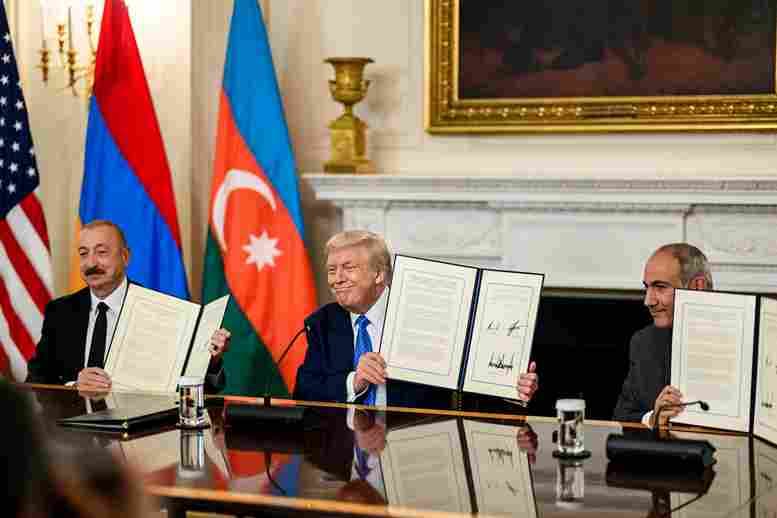
Trump Brokers Historic Armenia-Azerbaijan Peace Agreement
On August 8, 2025, a landmark peace agreement was signed at the White House, marking the end of a decades-long conflict between Armenia and Azerbaijan over the Nagorno-Karabakh region. U.S. President Donald J. Trump facilitated the historic accord, bringing together Azerbaijani President Ilham Aliyev and Armenian Prime Minister Nikol Pashinyan to sign a joint declaration that commits both nations to cease hostilities, open borders for trade, and foster economic cooperation in the South Caucasus. This agreement, hailed as a significant diplomatic achievement, not only resolves a conflict that has claimed tens of thousands of lives since 1988 but also reshapes the geopolitical landscape of the region, strengthening U.S. influence while diminishing Russia’s historical dominance.
Background of the Conflict
The Armenia-Azerbaijan conflict over Nagorno-Karabakh, a mountainous region within Azerbaijan’s internationally recognized borders but historically populated by ethnic Armenians, began in 1988 during the waning years of the Soviet Union. As ethnic tensions escalated, Nagorno-Karabakh, with support from Armenia, sought independence from Azerbaijan, leading to a full-scale war from 1991 to 1994. The conflict resulted in approximately 30,000 deaths and displaced over a million people. A ceasefire in 1994 left Armenian forces in control of Nagorno-Karabakh and surrounding territories, but intermittent clashes persisted.
The conflict reignited in September 2020, when Azerbaijan launched a military operation to reclaim Nagorno-Karabakh, culminating in a 44-day war that killed over 6,000 people. Backed by Turkey, Azerbaijan regained significant territories, and a Russia-brokered ceasefire deployed Russian peacekeepers to the region. In September 2023, Azerbaijan launched a swift offensive, reclaiming all of Nagorno-Karabakh and prompting nearly 100,000 ethnic Armenians to flee to Armenia. The displacement and unresolved issues, including Azerbaijan’s demand for a transit corridor through Armenia’s Syunik Province to connect mainland Azerbaijan to its Nakhchivan exclave, kept peace talks stalled until recent U.S. intervention.
Trump’s Diplomatic Breakthrough
President Trump’s administration intensified efforts to resolve the conflict in early 2025, with special envoy Steve Witkoff engaging both leaders in Baku and Yerevan. The breakthrough came through a creative solution to the contentious Zangezur Corridor issue. The agreement grants the United States exclusive development rights to a transit corridor through southern Armenia, named the “Trump Route for International Peace and Prosperity.” This corridor will connect Azerbaijan to Nakhchivan, facilitating the movement of goods, energy resources, and eventually people via rail, oil and gas pipelines, and fiber optic lines. The deal respects Armenia’s sovereignty while addressing Azerbaijan’s connectivity needs, overcoming a major sticking point that had derailed previous negotiations.
The agreement also includes bilateral economic deals between the U.S., Armenia, and Azerbaijan, aimed at unlocking the South Caucasus’s potential in trade, energy, infrastructure, and technology. The White House emphasized that the corridor will boost American businesses and energy exports to Europe, positioning the U.S. as a key player in a geostrategically critical region. Additionally, both nations signed a joint letter requesting the dissolution of the Organization for Security and Co-operation in Europe’s Minsk Group, a mediation body co-chaired by the U.S., Russia, and France, which Azerbaijan deemed irrelevant after its 2023 military success.
Signing Ceremony and Global Reactions
At the White House signing ceremony in the State Dining Room, Presidents Trump and Aliyev and Prime Minister Pashinyan celebrated the accord as a turning point. Trump described the agreement as a triumph after “35 years of fighting,” proclaiming, “Now they’re friends, and they’re going to be friends for a long time.” Aliyev praised Trump’s leadership, stating, “Within several months, he managed to put an end to conflicts in Asia, Africa, and now in the South Caucasus.” Pashinyan called the deal a “significant milestone,” crediting Trump’s personal engagement for its success.
Both leaders endorsed Trump for the Nobel Peace Prize, joining other world leaders like Cambodia’s Hun Manet and Israel’s Benjamin Netanyahu in nominating him for his role in resolving global conflicts. The agreement adds to Trump’s diplomatic portfolio, which includes ceasefires between Cambodia and Thailand, Rwanda and the Democratic Republic of the Congo, and India and Pakistan, though high-profile conflicts in Ukraine and Gaza remain unresolved.
The deal has geopolitical implications, particularly for Russia, which has historically mediated the conflict to maintain influence in the South Caucasus. Russia’s waning regional clout, exacerbated by its focus on the Ukraine war and deteriorating relations with both Armenia and Azerbaijan—especially after the unapologized downing of an Azerbaijani passenger plane in 2024—created an opening for U.S. diplomacy. The agreement also aligns with Turkey’s interests, as it paves the way for normalized relations and reopened borders with Armenia, enhancing regional connectivity.
Challenges and Criticisms
Despite the optimism, the agreement faces challenges. Armenian diaspora groups have criticized it for sidelining discussions on the right of return for ethnic Armenians displaced from Nagorno-Karabakh in 2023 and the status of Armenian cultural sites and prisoners of war held by Azerbaijan. Azerbaijan’s demand for Armenia to amend its constitution to remove references to Nagorno-Karabakh remains a potential flashpoint, though the agreement postpones this issue for future negotiations. Human rights groups, such as Freedom Now, have urged the Trump administration to address Azerbaijan’s detention of approximately 375 political prisoners.
Russia, though weakened, could still act as a spoiler. Its economic ties with Armenia, particularly in energy and trade, give it leverage to create domestic challenges. However, both Armenia and Azerbaijan are increasingly distancing themselves from Moscow, with Armenia seeking Western alignment and Azerbaijan strengthening ties with Turkey and Israel.
A New Chapter for the South Caucasus
The Armenia-Azerbaijan peace agreement, brokered by President Trump, marks a transformative moment for the South Caucasus. By committing to mutual recognition of territorial integrity, ceasing hostilities, and opening borders, the two nations are poised to shift from conflict to cooperation. The Trump Route, expected to attract investment from U.S. and international companies, promises to enhance regional connectivity, linking Europe to Central Asia through energy, trade, and technology corridors.
For the global Armenian and Azerbaijani diasporas, particularly those in the United States, the agreement offers hope for stability and economic opportunities in their ancestral homelands. However, sustaining the peace will require careful diplomacy to address unresolved issues and manage regional rivalries. As President Trump continues to position himself as a global peacemaker, this accord strengthens his legacy and underscores the U.S.’s growing role in a region at the crossroads of Europe and Asia.
Related NRI Globe Coverage
- Modi-Putin Discuss Trump Summit in Alaska, Reaffirm Commitment to Ukraine Peace and Bilateral Ties
- Is Donald Trump Eligible for the Nobel Peace Prize?
- Major US News This Week (September 14-15, 2026): Supreme Court Blocks Trump Mail Voting Rules, AI Debate Explodes, Space Weapons Confirmed
- $5,000 Trump Dividend Proposal — Complete Details, Feasibility & NRI Impact Analysis (Nov 2026 Midterms)
- Trump Urges Support for AI Data Centers on Fox News — US-China Race, Stocks, Local Opposition (NRI Perspective)
- Trump Imposes Up-to-100% Tariffs on Foreign-Made Drones (Effective Sep 3, 2026) — DJI, Chinese Suppliers Hit Hard
- Trump Says US 'Essentially Taken Over' Iran (May 2026): Context, Operation Epic Fury & Current Status
- Trump UFO Files 2026: Pentagon Releases First Bombshell Batch — Videos, Apollo Anomalies & Extraterrestrial Evidence
Fresh from NRI Globe
- YouTuber Nandu's World (Rama Nandana) UK Visa & Job Fraud Case: Full Details + Key Lessons for NRIs (2026)
- Dussehra / Vijayadashami 2026 Events Country-Wise — Global NRI Directory (Ram Lila, Ravana Dahan, Durga Puja Pandals, Ayudha Puja Venues + Booking)
- Diwali 2026 Events Country-Wise — Global NRI Directory (White House, Leicester, London Trafalgar, Toronto, Auckland, Sydney Parramasala, Fiji, Mauritius, Trinidad, South Africa and More)
- Diwali / Deepavali 2026 Country-Wise NRI Celebrations — Complete Global Guide (USA, UK, Canada, Australia, Fiji, Mauritius, Trinidad, South Africa, UAE and 30+ Countries)