
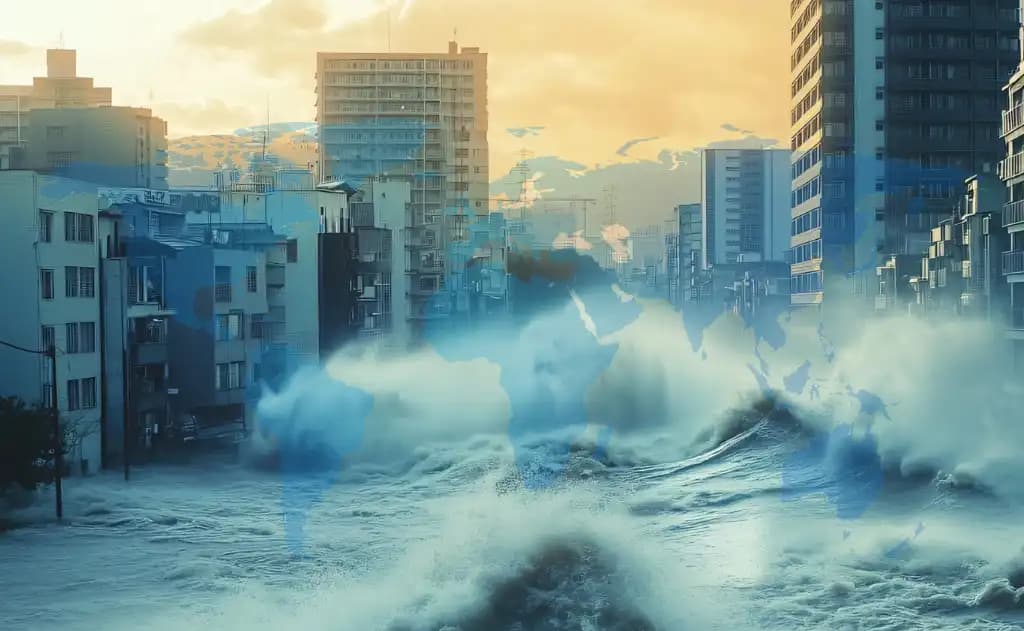
Tsunami Alerts in USA 2025: A Gripping Tale of Nature’s Fury
For the NRI community, staying connected to global events is a way of life, bridging the gap between their adopted homes and their roots. On July 29, 2025, a massive 8.8-magnitude earthquake off Russia’s Kamchatka Peninsula sent shockwaves across the Pacific, triggering tsunami alerts that gripped the United States with suspense. From the blaring sirens in Honolulu to the tense evacuations in California, this event unfolded like a real-life thriller, reminding NRIs and Americans alike of nature’s unpredictable power. Here’s the complete story, crafted for NRIGlobe.com, with vivid details and a narrative that captures the heart-pounding drama.
The Earthquake That Shook the Pacific
It was just past 7:24 p.m. ET on July 29, 2025, when the earth ruptured 126 kilometers southeast of Petropavlovsk-Kamchatsky, a coastal city in Russia’s far east. At a shallow depth of 19.3 kilometers, the 8.8-magnitude quake—one of the strongest ever recorded—unleashed a colossal force, likened by experts to the devastating 2011 Tohoku earthquake in Japan. The United States Geological Survey (USGS) quickly confirmed the quake’s magnitude, setting off a chain reaction of alerts across the Pacific. For NRIs in the U.S., many of whom have ties to coastal regions like California or Hawaii, the news hit close to home, evoking memories of past tsunamis that have shaped their global awareness.
The quake’s location in a subduction zone, where tectonic plates collide, made it a prime candidate for generating a tsunami. As the seafloor jolted, it displaced massive volumes of water, sending waves radiating outward at speeds up to 800 kilometers per hour—faster than a jet plane. Within minutes, the Pacific Tsunami Warning Center (PTWC) and National Tsunami Warning Center (NTWC) sprang into action, issuing alerts for coastal regions from Russia to New Zealand, with the U.S. firmly in the crosshairs.
Tsunami Alerts Grip the U.S.: A Four-Tiered Warning System
The U.S. Tsunami Warning System, operated by NOAA’s National Weather Service, employs a four-tiered alert system to communicate the threat: Warning, Advisory, Watch, and Information Statement. Each level carries specific instructions, designed to protect lives and property. As the earthquake’s impact became clear, the NTWC and PTWC issued a range of alerts tailored to different U.S. regions, creating a mosaic of urgency across the nation.
- Tsunami Warning: The highest alert, signaling imminent danger with potential for widespread flooding and powerful currents. Coastal evacuation is mandatory.
- Tsunami Advisory: Indicates strong currents or waves dangerous to those near the water, but significant flooding is unlikely. Beaches and harbors may close.
- Tsunami Watch: A preliminary alert for areas where a tsunami is possible, urging preparedness until more data confirms the threat.
- Tsunami Information Statement: Reassures that no threat exists or the event is too far to pose danger.
On July 29, the U.S. saw a flurry of these alerts, each painting a picture of a nation on edge.
Hawaii: The Heart of the Drama
Hawaii, with its history of tsunami devastation, faced the most severe alerts. At 7:17 p.m. HST, the PTWC issued a Tsunami Warning, predicting waves up to 3 meters (9.8 feet) in some areas. Sirens wailed across Oahu, Kauai, and the Big Island, a chilling sound that sent residents and tourists scrambling. In Honolulu, traffic jammed Bethel Street as families fled to higher ground, clutching essentials and praying for safety. The Honolulu Department of Emergency Management tweeted, “EVACUATE coastal areas in PRIMARY EVACUATION ZONE,” linking to maps of safe zones.
For NRI families in Hawaii, many of whom run businesses or work in tourism, the alert was a stark reminder of their vulnerability. “I was at my restaurant in Waikiki when the sirens went off,” said Priya Sharma, an NRI from Mumbai. “We closed up and drove to the hills. It felt like a movie, but the fear was real.” Schools canceled summer activities, and the National Tropical Botanical Garden on Kauai evacuated visitors to safety.
By 5 a.m. ET on July 30, the waves arrived, but they were smaller than feared, peaking at about 1 meter. The warning was downgraded to an advisory, and Hawaii County lifted evacuation orders, though beaches remained closed. “We were fortunate,” said Eric Wier, city manager of Crescent City, California, echoing Hawaii’s relief.
Alaska: A Rugged Coast on Alert
The NTWC issued a Tsunami Warning for Alaska’s Aleutian Islands, from Shemya to Unimak Pass, with potential wave heights of 3 to 5.6 feet. The quake’s proximity to Alaska—closer than to Hawaii—prompted swift action. Coastal communities, accustomed to seismic activity, activated emergency plans. In Old Harbor, a recent memory of tsunami sirens from a July 17, 7.3-magnitude quake heightened the urgency.
As waves arrived, they caused minor surges but no major damage. By July 30 morning, most of Alaska’s alerts were downgraded to advisories, with South Alaska and the Central Aleutians still cautioned about strong currents. For NRIs in Anchorage or Fairbanks, the event underscored the raw power of the Pacific Ring of Fire, a region they share with their ancestral homeland.
West Coast: California, Oregon, and Washington Brace for Impact
The U.S. West Coast, from California to Washington, faced a mix of Tsunami Advisories and Watches. Northern California’s Crescent City, a town scarred by the 1964 tsunami, remained under a Tsunami Warning for a 40-mile stretch from Klamath to the Oregon border, with projected wave heights of 3.1 to 5.7 feet. San Francisco saw waves arrive at 1:12 a.m. GMT, with Point Reyes reporting water level fluctuations over a foot. Advisories covered coastal areas from the California-Mexico border to Humboldt, including San Francisco Bay.
In Oregon and Washington, advisories warned of waves up to 2 feet in Port Orford and 1.4 feet in La Push. Authorities urged residents to avoid beaches and harbors, with the Coast Guard evacuating commercial vessels from Hawaiian harbors as a precaution. Despite the alerts, a lone surfer was spotted at Ocean Beach in San Francisco, defying warnings and adding a touch of human defiance to the narrative.
For NRIs in Silicon Valley or Seattle, the alerts were a wake-up call. “My family in Chennai called me, worried about the news,” said Rohan Patel, a tech worker in San Jose. “It’s humbling to see how connected we all are by these global events.” By late July 30, most West Coast advisories remained, but the threat of widespread flooding had subsided.
The Global Ripple Effect
The tsunami’s reach extended far beyond the U.S., affecting NRIs’ global consciousness. In Russia, Severo-Kurilsk saw waves up to 4 meters, flooding ports and sweeping away buildings, though all 2,000 residents were safely evacuated. Japan issued evacuation orders for 900,000 people, with waves up to 1.3 meters hitting its eastern coast. The Fukushima nuclear plant, scarred by 2011, was evacuated as a precaution, but no damage was reported.
South America braced for impact, with Ecuador evacuating the Galápagos Islands and Chile issuing a red alert for Easter Island. French Polynesia’s Marquesas Islands expected waves up to 2.5 meters, down from initial fears of 4 meters. Even distant New Zealand and Indonesia issued advisories, highlighting the Pacific’s interconnectedness.
The Science and Systems Behind the Alerts
The U.S. Tsunami Warning System, a marvel of modern science, relies on a network of seismic stations, coastal tide gauges, and 39 deep-ocean DART® buoys to detect tsunamis. The NTWC in Alaska and PTWC in Hawaii operate 24/7, monitoring earthquakes and forecasting wave impacts. Alerts are broadcast via NOAA Weather Radio, local media, text messages, and sirens, ensuring rapid dissemination.
Natural warnings—strong earthquakes, sudden ocean changes, or a loud roar from the sea—also play a role. “If you feel the ground shake or see the ocean recede, don’t wait for an alert. Run to high ground,” advises NOAA. This blend of technology and instinct saved countless lives on July 29.
A Tale of Resilience and Reflection
As the tsunami threat waned, the U.S. exhaled. Homeland Security Secretary Kristi Noem declared the danger of a “major” tsunami had “passed completely,” though advisories lingered for caution. President Donald Trump, posting on Truth Social, urged Americans to “STAY STRONG AND STAY SAFE,” reflecting national solidarity.
For the NRI community, this event was more than a news story—it was a reminder of their shared stake in a global world. From the chaos of Honolulu’s evacuations to the quiet vigilance in Crescent City, the tsunami alerts of July 2025 wove a narrative of fear, preparedness, and survival. As NRIs across the U.S. checked on loved ones and shared updates on WhatsApp, they reaffirmed their resilience, rooted in both their adopted homeland and their cultural heritage.
This saga, penned for NRIGlobe.com, captures a moment when nature roared, and humanity responded with courage. As the Pacific settles, the story lingers, a testament to the power of preparation and the enduring spirit of the NRI diaspora.