
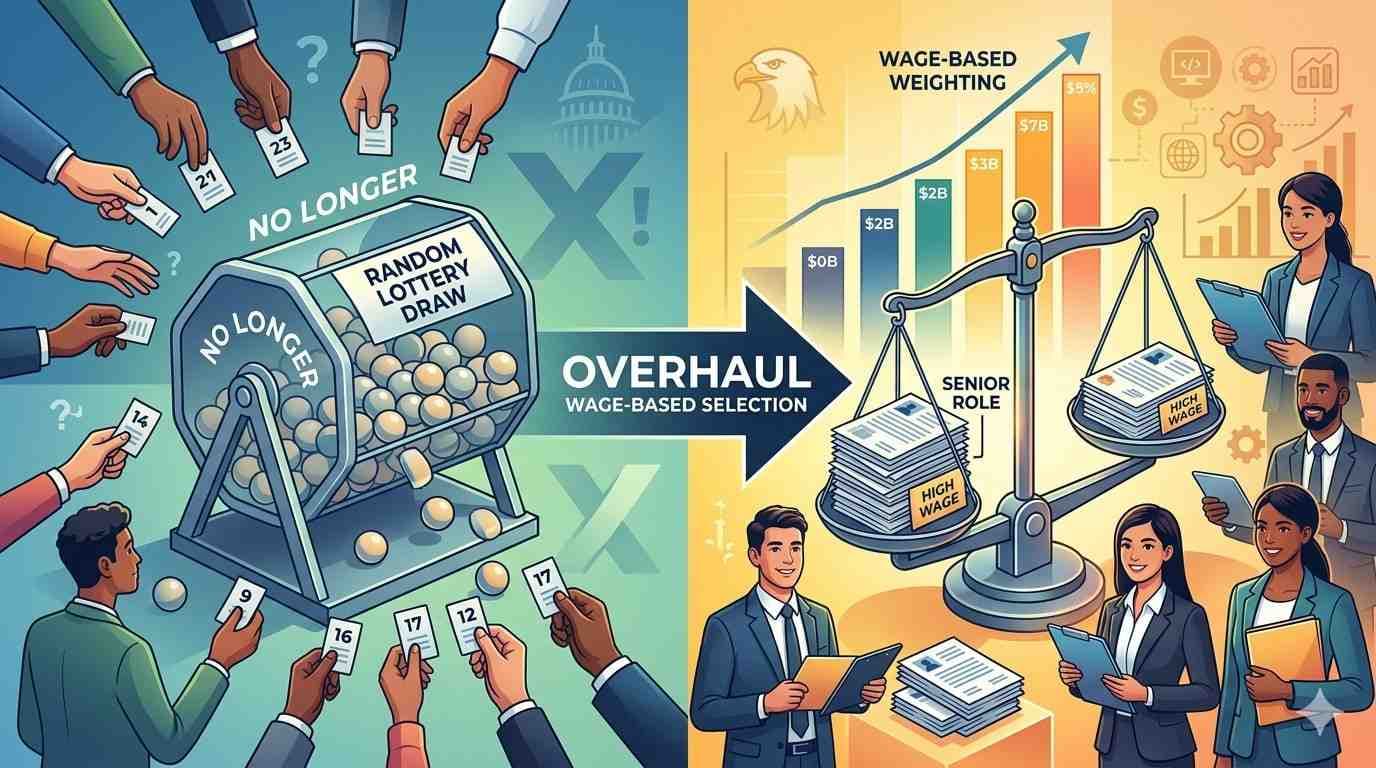
Hyderabad, April 7, 2026 – In a landmark policy shift aimed at protecting American workers, the U.S. Department of Homeland Security (DHS) and U.S. Citizenship and Immigration Services (USCIS) have officially scrapped the decades-old random lottery system for H-1B visas. The new wage-based weighted selection process prioritizes higher-skilled and higher-paid foreign professionals, effective February 27, 2026, for the Fiscal Year (FY) 2027 cap season.
This change, finalized on December 23, 2025, and published in the Federal Register on December 29, 2025, marks one of the most significant reforms to the H-1B program in years. It comes under the Trump administration’s broader push to reform the program and “put America first.”
How the New H-1B Selection Process Works
Under the old system, when registrations exceeded the annual cap of 85,000 visas (65,000 regular + 20,000 for U.S. advanced degree holders), USCIS conducted a purely random lottery, giving every eligible registration an equal chance.
The new rule replaces randomness with a weighted selection based on the U.S. Department of Labor’s (DOL) Occupational Employment and Wage Statistics (OEWS) prevailing wage levels for the specific job, occupation (SOC code), and geographic area:
- Wage Level IV (highest): 4 entries in the selection pool
- Wage Level III: 3 entries
- Wage Level II: 2 entries
- Wage Level I (entry-level): 1 entry
The weight is determined by the highest wage level that the employer’s offered (proffered) salary equals or exceeds. Even if a position would normally qualify as Level I, a higher salary can push it into a higher tier.
Registrations for FY 2027 opened March 4–19, 2026. USCIS has already confirmed that the cap was reached, selections completed, and notifications sent by late March 2026. Selected employers can now file full H-1B petitions (using the new Form I-129 edition) until June 30, 2026.
Why the Change? Official Rationale
USCIS spokesman Matthew Tragesser stated: “The existing random selection process of H-1B registrations was exploited and abused by U.S. employers who were primarily seeking to import foreign workers at lower wages than they would pay American workers. The new weighted selection will better serve Congress’ intent for the H-1B program and strengthen America’s competitiveness by incentivizing American employers to petition for higher-paid, higher-skilled foreign workers.”
The administration argues the lottery allowed outsourcing firms to flood the system with low-wage applications, undercutting U.S. wages and job opportunities. The reform aligns with other measures, including a separate Presidential Proclamation imposing a $100,000 additional fee on certain H-1B petitions.
Heavy Impact on Indian Professionals and IT Sector
Indians have long dominated H-1B approvals, receiving over 70% of visas in recent years (71% last year in one reported figure). An estimated 300,000 Indian professionals currently work in the U.S. on H-1B visas, mostly in tech, engineering, consulting, and IT services.
NASSCOM’s Strong Concerns India’s apex IT industry body, NASSCOM, has flagged serious risks. In a detailed statement, it called the shift a “significant departure from the long-standing, neutral lottery system” that raises “legal, economic, and operational concerns.”
Key points from NASSCOM:
- It could disadvantage small and mid-sized enterprises, startups, research institutions, and university-linked employers that offer market-appropriate (often Level I/II) wages.
- Entry-level roles for U.S. university STEM graduates (a key pipeline for Indian talent) may face reduced opportunities, weakening the future talent base and discouraging international students.
- Increased compliance complexity and uncertainty will disrupt workforce planning, especially for firms tied to academic calendars and client projects.
- While the intent to curb misuse is understood, the change risks moving beyond the statutory “specialty occupation” focus toward pure wage ranking, with regional distortions.
NASSCOM emphasized that its member companies support over 1.6 million skilled U.S. jobs, contribute $198 billion to U.S. GDP, and employ 264,500 people directly in America—many outside Silicon Valley. It urged a phased rollout (e.g., delay to FY 2028) for smoother adaptation.
Large Indian IT firms like TCS and Infosys have indicated minimal disruption due to localized U.S. hiring, offshoring strategies, and global capability centers (GCCs). However, smaller consultancies and mid-level professionals sponsored by outsourcing firms are likely to feel the biggest squeeze.
What This Means for NRIs and Future Applicants
- Higher-skilled, higher-paid roles (senior engineers, AI specialists, researchers) now have significantly better odds.
- Entry-level and mid-career professionals from India may face tougher competition unless employers offer competitive salaries.
- Employers must now strategically decide wage offers at registration time to maximize selection chances.
- The program still welcomes talent at all levels, but the odds are no longer equal.
Critics (including some immigration experts and business groups) worry it could reduce diversity in the talent pipeline, hurt U.S. universities’ appeal to international students, and accelerate offshoring. Supporters say it restores the H-1B’s original purpose: filling genuine high-skill shortages without depressing wages.
Looking Ahead
The FY 2027 season under the new rules is already underway. Future seasons will likely see employers adjusting strategies—offering higher wages, focusing on premium talent, or shifting more work to India-based GCCs and remote models.
For NRIs, Indian students in the U.S., and IT professionals planning U.S. moves, the message is clear: Skill up, aim higher on compensation benchmarks, and work with employers ready to compete on wage levels.
Stay tuned to NRIGlobe.com for ongoing updates, employer guidance, and expert analysis on how this reshaping of the H-1B program affects the Indian diaspora and Indo-U.S. tech ties.
Continue reading — NRI Globe pillar guide: H-1B Complete Guide for Indians 2026
Related NRI Globe Coverage
- H-1B Changes Hit Indian Tech Professionals
- US Crime & Safety This Week — September 17-21, 2026 (NRI Family Guide, FBI Alerts, H-1B/Immigration Scams, Tech Support Fraud, Emergency Resources)
- US Midterms 2026 Key Issues Affecting NRIs — H-1B Reform, Tariffs, Taxes, Immigration, Tech Jobs
- US News Weekly NRI Briefing — September 9, 2026 (Tariffs, Jobs, Gas Prices, H-1B, Visa, Diaspora)
- NRI Latest News Roundup: June 8, 2026 — H-1B Changes, RBI Investment Boost & Key Updates for NRIs
- US Jobless Claims Hit 2026 High — What It Means for Indian H-1B Workers
- Tech Layoffs June 2026: What H-1B Indians Need to Know Now
- US H1B Visa Latest News June 2026 for Indians: What Changed
Fresh from NRI Globe
- YouTuber Nandu's World (Rama Nandana) UK Visa & Job Fraud Case: Full Details + Key Lessons for NRIs (2026)
- Dussehra / Vijayadashami 2026 Events Country-Wise — Global NRI Directory (Ram Lila, Ravana Dahan, Durga Puja Pandals, Ayudha Puja Venues + Booking)
- Diwali 2026 Events Country-Wise — Global NRI Directory (White House, Leicester, London Trafalgar, Toronto, Auckland, Sydney Parramasala, Fiji, Mauritius, Trinidad, South Africa and More)
- Diwali / Deepavali 2026 Country-Wise NRI Celebrations — Complete Global Guide (USA, UK, Canada, Australia, Fiji, Mauritius, Trinidad, South Africa, UAE and 30+ Countries)