
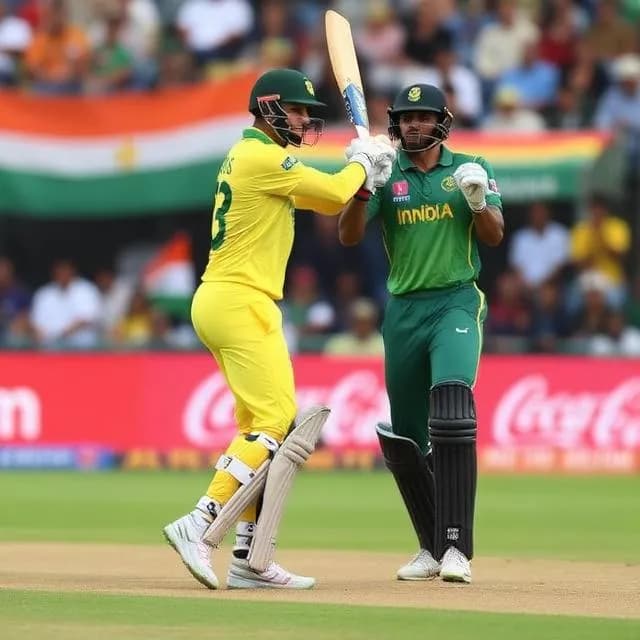
India delivered a dominant performance in the opening match of their five-match T20I series against South Africa, securing a commanding 101-run victory at the Barabati Stadium in Cuttack on December 9, 2025. The emphatic win, which saw South Africa collapse to their lowest-ever T20I total of 74, gave the hosts a 1–0 series lead and showcased the depth and balance that the Indian team has been building ahead of major international tournaments.
India's Batting Resurgence Led by Hardik Pandya's Explosive Comeback
After losing the toss and being asked to bat first, India's innings began uncertainly on a pitch that appeared conducive to batting. The top order, typically the backbone of any T20 innings, struggled to find rhythm early on. Shubman Gill and Suryakumar Yadav, both capable of playing aggressive cricket, managed to get starts but failed to convert them into substantial contributions. At one stage, India found themselves precariously placed at 78 for 4 wickets, with the innings threatening to derail entirely.
The turning point came with the arrival of Hardik Pandya at the crease. Making his international comeback following a period of injury rehabilitation, Pandya announced his return in the most emphatic manner possible. The all-rounder unleashed an unbeaten 59 runs off just 28 deliveries, featuring 6 fours and 4 sixes. His explosive batting transformed India's position from vulnerable to commanding, single-handedly lifting the team from 78/4 to a competitive total of 175/6 by the end of the 20 overs. The innings demonstrated not only Pandya's technical prowess but also his ability to read match situations and accelerate when required—a quality that will be invaluable for India in the lead-up to the 2026 T20 World Cup.
For South Africa, Lungi Ngidi emerged as the standout performer with the ball, claiming 3 wickets for 31 runs. Despite his efforts, the Proteas' bowling unit was unable to prevent India from posting a total that would prove beyond their reach. The 175-run target, while not extraordinarily high by modern T20 standards, would become insurmountable given what transpired in the chase.
South Africa's Capitulation: A Historic Low Point
Early Breakthroughs Set the Tone
Chasing 176 runs for victory, South Africa's innings unraveled almost immediately. The Proteas' opening batsmen failed to provide the platform that any successful T20 chase requires. Arshdeep Singh and Jasprit Bumrah, operating with the new ball for India, struck with precision and pace, claiming early wickets that put South Africa on the back foot before the innings had truly begun. The loss of quick wickets in the powerplay overs—the first six overs of the innings when fielding restrictions are in place—is often fatal in T20 cricket, and so it proved here.
What followed was a complete batting collapse that saw South Africa bundled out for just 74 runs in 12.3 overs. This total represents the lowest-ever score by South Africa in T20 International cricket, a historic low that underscores the magnitude of their defeat. The Proteas' inability to construct even a semblance of a competitive innings raised questions about their preparation, their approach to the series, and their current form heading into the latter stages of the international cricket calendar.
Bowling Excellence Across the Lineup
India's bowling performance was a masterclass in controlled aggression and variety. While Arshdeep Singh and Jasprit Bumrah made early inroads, the Indian attack was far from a one-dimensional assault. Varun Chakravarthy, the team's primary spinner, claimed 2 wickets for 19 runs, demonstrating the kind of control that spinners can exert in T20 cricket when conditions and execution align. Axar Patel, another left-arm spinner, was particularly economical, conceding just 7 runs while taking 2 wickets—a remarkable performance that showcased the value of disciplined bowling in the shortest format.
Hardik Pandya, fresh from his batting heroics, also contributed with the ball, claiming 1 wicket for 16 runs. This dual contribution—scoring 59 runs and taking a wicket while maintaining an economy rate of 8 per over—exemplifies the all-round value that Pandya brings to the Indian team. In T20 cricket, where matches are often decided by fine margins, the ability of a player to impact the game in multiple ways is invaluable.
Jasprit Bumrah's performance held particular significance beyond the immediate match. With his wickets in this encounter, Bumrah reached the milestone of 100 T20 International wickets, a historic achievement that places him among the elite bowlers in the shortest format of the game. This milestone, reached while playing for his country against a traditional rival, underscores Bumrah's consistency and excellence over an extended period of international cricket.
Match Summary and Statistical Perspective
The match statistics tell a story of complete Indian dominance. India's total of 175/6 was built on the back of Hardik Pandya's unbeaten 59, while contributions from other batsmen, though modest individually, added up to a defendable total. South Africa's response of 74 all out was anchored by Dewald Brevis's 22 runs, but no other batsman could make a meaningful contribution. The gulf between the two performances—a 101-run victory margin—reflects the comprehensive nature of India's superiority on the day.
The match was decided within 12.3 overs of South Africa's chase, meaning that more than seven overs of the allocated 20 were unused. This rapid conclusion is indicative of the one-sided nature of the contest. In T20 cricket, where momentum and early breakthroughs can snowball into complete collapses, South Africa's early loss of wickets proved catastrophic to their chances.
Implications for the Series and Beyond
India's Momentum Heading into the Series
With a 1–0 lead in a five-match series, India have seized the initiative. The victory is particularly significant because it demonstrates the team's ability to perform across all facets of the game—batting, bowling, and fielding. For a team preparing for the 2026 T20 World Cup, such comprehensive performances build confidence and provide valuable data about what works in high-pressure situations.
The return of Hardik Pandya to international cricket after injury is a major positive for India. His ability to impact matches with both bat and ball, combined with his experience in high-pressure situations, makes him a crucial player for the team's World Cup aspirations. The fact that he announced his return with such a dominant performance will have boosted morale within the Indian camp.
South Africa's Challenge
For South Africa, this defeat represents a significant setback. The Proteas have traditionally been a competitive force in T20 cricket, and a collapse to their lowest-ever total raises concerns about their current form and preparation. The team faces a tough task to bounce back in the remaining matches of the series. The psychological impact of such a heavy defeat cannot be understated; teams often struggle to recover confidence after being dismantled so comprehensively.
The series now enters a critical phase, with South Africa needing to reassess their approach and find ways to compete with an Indian team that has demonstrated clear superiority in this opening encounter. The remaining four matches will be crucial in determining the overall winner of the series and in providing both teams with valuable insights ahead of their respective international commitments.
Player of the Match Recognition
Hardik Pandya's dual contribution—59 runs with the bat and 1 wicket with the ball—earned him the Player of the Match award. This recognition reflects the impact he had on the game's outcome and underscores his importance to the Indian team. Awards like this, while symbolic, also serve as motivation for players and recognition of their efforts in helping their team achieve victory.
Related NRI Globe Coverage
- Sports This Week — September 17-21, 2026 (NFL, NBA, MLB, Cricket, Premier League, F1) NRI Weekend Guide
- Hero Ajith Kumar's Racing Career: Achievements, Rankings and Journey in Motorsport
- IPL 2027 Season Preview — Format, Team Retentions, Broadcast Coverage for NRIs Abroad
- India Cricket 2026-27 — Complete NRI Streaming Guide (USA, UK, Canada, Australia)
- F1 Latest Updates September 2026: Shock Gasly Pole at Monza Italian GP — Full Analysis & Race Preview
- 2026 Italian Grand Prix Qualifying Analysis at Monza: Pierre Gasly Shocks with Maiden Pole Position
- Sports Weekend USA Sept 5-7, 2026: College Football, MLB, NASCAR Southern 500 & F1 Italian GP Complete Guide
- NRI Sports Streaming Options 2026 — Cricket, NFL, NBA, MLB + VPN Guide
Fresh from NRI Globe
- YouTuber Nandu's World (Rama Nandana) UK Visa & Job Fraud Case: Full Details + Key Lessons for NRIs (2026)
- Dussehra / Vijayadashami 2026 Events Country-Wise — Global NRI Directory (Ram Lila, Ravana Dahan, Durga Puja Pandals, Ayudha Puja Venues + Booking)
- Diwali 2026 Events Country-Wise — Global NRI Directory (White House, Leicester, London Trafalgar, Toronto, Auckland, Sydney Parramasala, Fiji, Mauritius, Trinidad, South Africa and More)
- Diwali / Deepavali 2026 Country-Wise NRI Celebrations — Complete Global Guide (USA, UK, Canada, Australia, Fiji, Mauritius, Trinidad, South Africa, UAE and 30+ Countries)