
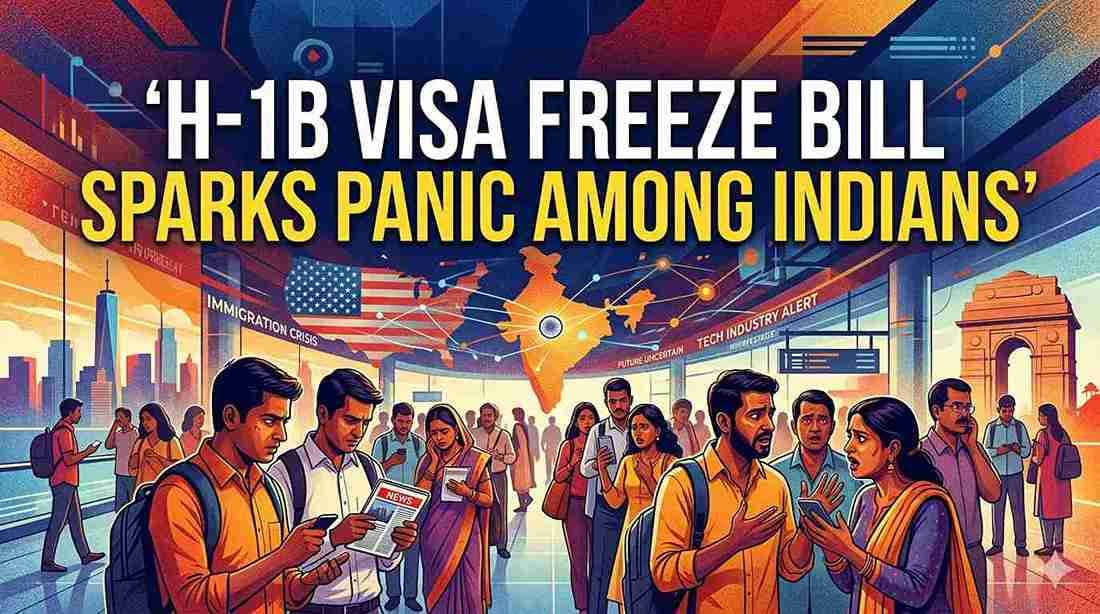
A bill introduced in the US Congress proposes major changes to the H-1B program. Indian professionals on these visas face uncertainty about renewals and long-term stays. The proposal, if enacted, would represent one of the most significant structural changes to the specialty occupation visa category since the program was established under the Immigration and Nationality Act.
TL;DR
- The End H-1B Visa Abuse Act of 2026 calls for a three-year pause on new issuances.
- Current holders may face phased departures under the draft text.
- Maximum stay would drop to one three-year term with no extensions.
- Indians hold the majority of H-1B approvals each year.
- Status remains proposed only; no changes apply until passage and enactment.
Bill Background and Sponsor
Republican Representative Eli Crane of Arizona presented the legislation. It targets perceived program misuse while claiming to prioritize domestic hiring. The text amends the Immigration and Nationality Act. Early readings show support limited to a subset of House Republicans focused on labor protections.
NRIs in technology roles have tracked similar proposals through prior sessions. One architect in Seattle noted that each new restriction shifts family timelines by years because of employment-based green card queues. Employers in the same sector already track petition volumes filed with USCIS to forecast staffing gaps. The sponsor's district includes manufacturing zones where local hiring claims receive emphasis during committee debates.
Bills of this type typically emerge from a broader legislative debate about whether the H-1B program depresses wages for domestic workers or, alternatively, fills genuine gaps in the labor market. Proponents of restriction argue that some employers use the program to substitute lower-cost foreign labor for available American candidates. Opponents, including many technology industry groups, contend that the specialty occupation category addresses skills that domestic pipelines cannot supply at the pace the market requires. Both arguments have appeared in committee testimony on past reform proposals cited in Congress.gov records, giving context to why the current bill's framing — emphasizing abuse prevention — resonates with a particular bloc of legislators even if the broader chamber remains divided.
Core Provisions Compared
The draft introduces several restrictions absent from current statute. A side-by-side view clarifies the shift.
| Aspect | Current Rules | Proposed Changes |
|---|---|---|
| New visas | Annual cap with lottery | Three-year freeze on all new issuances |
| Maximum duration | Up to six years plus extensions | Single three-year term only |
| Cap exemptions | Available for certain employers | Eliminated |
| OPT and H-4 | Extensions permitted | Limits or removal proposed |
Current rules allow specialty occupation petitions up to the statutory cap plus exemptions for advanced degree holders and nonprofit research entities. The proposal removes those exemptions outright. Duration limits would end the common practice of extending beyond the initial three-year period even when labor condition applications remain valid. H-4 work authorization, which many spouses rely on for household income, faces proposed curtailment without a stated replacement pathway.
For NRI households, the elimination of the advanced-degree exemption carries particular weight. A significant share of Indian H-1B holders entered the program through the master's cap lottery, which currently provides a second draw for those with US advanced degrees. Removing that pathway would reduce the statistical probability of selection for a large segment of the Indian applicant pool even before the proposed three-year freeze takes effect. The OPT changes also matter for recent graduates who bridge from student status to H-1B sponsorship, a sequence that many Indian students on F-1 visas rely upon when completing degrees at US universities.
Status of the Legislation
As of the latest congressional records the measure sits in committee. No floor vote has occurred. Reports from Congress.gov suggest the bill has not advanced beyond its initial referral stage, a pattern consistent with similar reform proposals in recent sessions. Passage would require both chambers and presidential signature. Historical patterns show similar reform bills stall before becoming law.
Committee referral is the earliest stage in the legislative process. From that point, a bill must receive a hearing, a markup session, a committee vote, floor scheduling in the originating chamber, passage, a parallel process in the other chamber, and then reconciliation if the two versions differ. Each step represents a potential stopping point. Prior H-1B reform proposals have repeatedly cleared early stages only to lose momentum when employer lobbying, economic data, or competing legislative priorities intervened. That history does not guarantee the same outcome here, but it does explain why immigration attorneys generally advise clients to monitor rather than panic at the introduction stage.
Indian Community Exposure
USCIS data consistently shows Indian nationals receive over 70 percent of H-1B approvals in recent fiscal years. Many work in software, engineering, and research roles. Families on H-4 visas would also encounter new constraints on work authorization. Career timelines tied to green-card backlogs could face abrupt interruption.
One NRI software architect who arrived in 2019 described the anxiety of planning a family move while monitoring every legislative update. He and his spouse weighed options such as intra-company transfers or Canadian alternatives months before any vote. Such personal calculations now multiply across thousands of households in the same situation.
Additional households report similar reviews of I-797 approval notices to confirm remaining validity periods. Parents with school-age children examine lease terms and state tax withholding in anticipation of possible relocation. Community organizations in California and Texas have begun circulating summaries of the draft text to members who hold active H-1B status. These summaries compare the proposed single-term limit against the six-year maximum currently available under statute.
The green card backlog dimension compounds the exposure for Indian nationals specifically. Because employment-based preference categories are subject to per-country limits, Indian-born applicants in the EB-2 and EB-3 categories face wait times that can extend well beyond a single H-1B term under current rules. The existing six-year maximum, with further extensions available once a priority date is established, effectively allows many Indian professionals to remain in status while their green card cases mature. A hard cap of one three-year term would sever that bridge for a large portion of the backlog population, forcing departure before their priority dates become current. This is the scenario that immigration counsel most frequently flag when discussing the bill's practical consequences for the Indian community.
Economic Context for Employers
Technology firms that scaled teams using H-1B talent would need to adjust hiring pipelines. Some already increased domestic recruitment after prior fee hikes. A sudden three-year gap could accelerate offshoring or automation investments already underway at several large contractors.
Contractors serving federal agencies maintain separate compliance logs that distinguish H-1B workers from US workers. A freeze would require those logs to reflect zero new foreign hires for the stated period. Smaller product companies that rely on extensions for key engineers have begun modeling scenarios in which project handoffs occur within existing three-year windows. Industry associations have submitted comments on past H-1B rule changes that cite wage data from the Department of Labor's LCA database.
Mid-size companies face a different calculus than large enterprises. A corporation with global mobility infrastructure can redeploy affected engineers to offices in Canada, the United Kingdom, or India with relative ease. A startup or regional firm typically lacks that infrastructure, meaning a key technical contributor who cannot extend status represents an unrecoverable loss of institutional knowledge. Those firms have historically been among the most vocal in opposing restrictive H-1B proposals, and their advocacy through industry coalitions often shapes the final contours of any legislation that does advance. The economic argument they advance centers on the cost of replacing specialized talent rather than on immigration policy as such.
Practical Steps for Visa Holders
Individuals should review their petition history and pending extensions with qualified counsel. The official USCIS H-1B page remains the authoritative source for forms and current processing times. Congress.gov provides bill text and committee status updates that holders can monitor directly.
Monitoring the Federal Register for any rulemaking tied to the bill supplies another layer of preparation. Early outreach to employers about possible internal mobility programs can surface options before deadlines tighten.
Visa holders can also request copies of their approved I-129 petitions from employers to verify exact expiration dates listed on Form I-94. Those dates determine the window available for any transition planning. Several NRIs have scheduled calls with their company's immigration liaison to discuss L-1 eligibility when qualifying prior employment abroad exists. Others have begun updating profiles with skills that align to Canadian Express Entry categories while retaining US work authorization. Consulting an immigration attorney early — before a bill reaches a floor vote — gives households the most time to evaluate alternatives without pressure.
Keeping personal immigration records organized is a practical baseline regardless of how the legislation proceeds. That means retaining all I-797 approval notices, labor condition application copies, and passport stamps in a secure but accessible format. If a household has dependents on H-4 status, their I-94 records and any Employment Authorization Documents should be stored alongside the primary holder's file. This documentation becomes essential if an employer changes, a company is acquired, or a future attorney needs to reconstruct a complete petition history quickly.
Next steps
Track committee hearings through Congress.gov alerts. Schedule reviews with immigration counsel familiar with both H-1B and employment-based green card categories. Maintain all filing receipts and I-94 records in accessible digital form.
Sources
Continue reading — NRI Globe pillar guide: H-1B Complete Guide for Indians 2026
Related NRI Globe Coverage
- U.S. Lawmakers Introduce Bill to End H-1B Pathway to Green Cards: Major Blow for Indian Tech Professionals and NRIs?
- H-4 EAD 2026 — Complete Guide for Spouses of H-1B Workers (Eligibility, Application, Employment)
- H-1B FY 2027 Lottery Registration Preparation Guide — What NRI Indian Tech Workers Need to Know
- H-1B 60-Day Grace Period Rules 2026: Complete NRI Guide — Portability, Status Change, DHS Proposed Elimination
- New US Visa Rules in 2026 for Indians: Complete Guide for Students, H-1B Workers & Green Card Applicants
- H-1B Job Loss: The 60-Day Playbook — NRI Pillar Guide 2026
- H-1B Complete Guide for Indians 2026 — Eligibility, Lottery, Timeline, Costs, Alternatives (NRI Pillar)
- USA Visa Grace Period New Rules 2026 — H-1B, F-1 NRI Guide
Fresh from NRI Globe
- YouTuber Nandu's World (Rama Nandana) UK Visa & Job Fraud Case: Full Details + Key Lessons for NRIs (2026)
- Dussehra / Vijayadashami 2026 Events Country-Wise — Global NRI Directory (Ram Lila, Ravana Dahan, Durga Puja Pandals, Ayudha Puja Venues + Booking)
- Diwali 2026 Events Country-Wise — Global NRI Directory (White House, Leicester, London Trafalgar, Toronto, Auckland, Sydney Parramasala, Fiji, Mauritius, Trinidad, South Africa and More)
- Diwali / Deepavali 2026 Country-Wise NRI Celebrations — Complete Global Guide (USA, UK, Canada, Australia, Fiji, Mauritius, Trinidad, South Africa, UAE and 30+ Countries)