
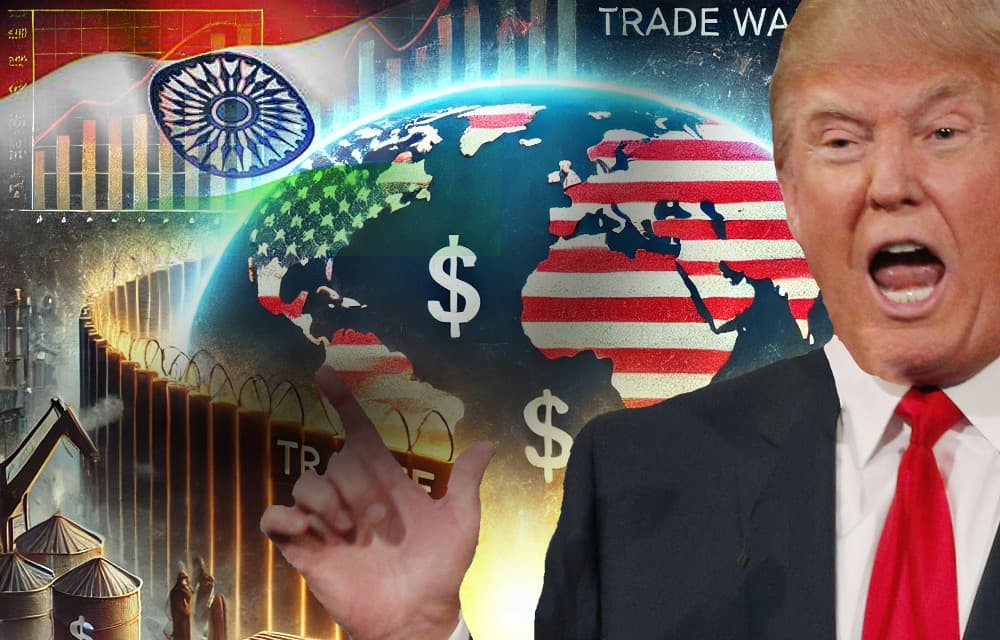
US tariffs on Indian goods reached 50 percent in late August 2025. The change directly affects more than half of India’s shipments to its largest single market.
TL;DR
- Five export sectors face immediate margin pressure and buyer shifts.
- GDP growth may drop 0.4 to 0.8 percentage points in FY26.
- Market diversification and selective relocation offer the clearest relief paths.
- MSMEs in gems, textiles and seafood carry the highest job risk.
Industries Facing the Sharpest Pressure
Five sectors together account for roughly 55 percent of India’s US-bound exports. Each operates with thin margins and limited ability to absorb extra duties.
NRIs who run distribution networks in New Jersey and California report sudden order cancellations. They now compare landed costs with shipments routed through Mexican maquiladoras. Some have begun redirecting capital toward warehousing in Dubai to test re-export routes.
Gems and Jewellery
The United States buys nearly 30 percent of India’s gems and jewellery exports. At the new rate those shipments lose price competitiveness against suppliers in Vietnam and Mexico.
Surat-based cutters ship polished diamonds that lose roughly 18 percent margin once the tariff stacks on existing duties. NRIs who own retail outlets in Atlanta note that customers now ask for Vietnamese stones at lower price points. Trade data from earlier years shows India held a 35 percent share of US diamond imports before the first round of duties.
Textiles and Apparel
Tirupur and other clusters ship $2.8 billion of garments and fabrics to the US each year. Effective tariffs now exceed 60 percent once existing duties are added. Bangladesh and Vietnam retain lower rates and are gaining orders.
Knitwear units in Tirupur employ more than 400,000 workers. Several NRI investors who fund these units have shifted partial production to Ethiopia under AGOA preferences. Fabric samples sent last month arrived with 31 percent total duty versus the 61 percent applied to direct Indian shipments.
Seafood
Shrimp exports worth $2 billion head mainly to US buyers. Ecuador and Indonesia already operate under lower tariff ceilings and have captured share since the first 25 percent duty took effect.
Processing plants in Andhra Pradesh and West Bengal face reduced container bookings. NRI seafood traders in Houston report that Ecuadorian farms now quote prices 12 percent below Indian offers after duty. Cold-storage operators in Kochi have begun exploring cold-chain partnerships with Indonesian exporters to maintain volumes.
Auto Components
Commercial-vehicle and tractor parts valued at $2.6 billion face the full 50 percent rate. Mexican plants enjoy USMCA preferences that Indian suppliers cannot match.
Suppliers in Pune and Chennai that serve US truck makers have seen 22 percent of confirmed orders moved to Mexican facilities. NRIs who manage aftermarket networks in the Midwest note longer lead times and higher air-freight costs for urgent replacements. Component traceability rules under USMCA further limit Indian participation.
Chemicals
Specialty and organic chemicals lose ground to Asian competitors. Smaller producers lack the cash reserves to hold inventory while buyers test alternatives.
Units in Gujarat that export dye intermediates report inventory piles of 45 days. Larger Indian chemical groups have opened small blending facilities in Singapore to qualify for ASEAN duty rates when shipping onward to the United States.
Economic Ripple Effects
Analysts at Nomura and other houses project a measurable slowdown in overall export growth. The rupee touched 85.69 against the dollar after the announcement, raising imported input costs for domestic manufacturers.
Reserve Bank of India data for July 2025 already showed a 9 percent drop in export credit disbursements. NRIs who hold equity in listed textile and auto-component firms have seen portfolio values decline 6 to 11 percent since the tariff announcement. Remittance flows from the United States remain steady, yet several family businesses report delayed payments from US buyers awaiting clarity on duty refunds.
| Sector | US Export Value (2024) | Effective Tariff | Primary Competitor Tariff |
|---|---|---|---|
| Gems & Jewellery | $10 bn | 50% | Vietnam 20% |
| Textiles | $2.8 bn | 61% | Bangladesh 31% |
| Seafood | $2 bn | 50% | Ecuador 25% |
| Auto Components | $2.6 bn | 50% | Mexico 0-2.5% |
Market Diversification Steps
Exporters are already booking space at trade shows in the Middle East and Africa. Dubai remains a practical rerouting hub for jewellery.
India’s existing free-trade agreements with ASEAN nations provide duty reductions for textiles and processed seafood. Negotiations with the EU and UK continue; any signed pact would open tariff-free lanes for garments and chemicals within two years.
Indian missions in Kenya and Nigeria have scheduled buyer-seller meets for October 2025. NRI business councils in Lagos have offered warehouse space on a trial basis for textile and chemical consignments. Early shipments of processed shrimp to the UAE have cleared at 5 percent duty under the existing India-UAE CEPA.
Manufacturing Relocation Options
Larger groups in the gems sector are evaluating small assembly units in Mexico. The move adds logistics cost but restores access to the original 25 percent tariff band. Textile firms are studying joint ventures in Ethiopia where duty-free access to the US market still applies under AGOA.
Two mid-sized Surat jewellery houses have signed memoranda with Mexican partners for polishing units near Monterrey. Initial capital outlay runs near $1.8 million per line. Ethiopian industrial parks near Addis Ababa offer 10-year tax holidays plus duty-free US entry for apparel under AGOA. Indian textile associations have scheduled delegation visits for November 2025.
Next steps
Exporters should map current buyer contracts, calculate landed-cost gaps versus competitors, and shortlist two alternative markets for pilot shipments before the end of Q4 2025. Industry associations can coordinate group participation at Africa’s Trade Summit 2026 to reduce per-company costs.
Sources
Continue reading — NRI Globe pillar guide: NRI Taxation India — NRE/NRO/DTAA/FBAR
Related NRI Globe Coverage
- Impact of Trump’s Tariffs on India and the USA: A Detailed Analysis
- Global Impact of Trump’s Tariffs: A New Era of Trade Tensions
- Global Trade on Edge: Will Trump's Tariffs Backfire?
- India-US Trade Relations 2026 Analysis: $240B Bilateral, Section 301 Tariffs, Interim Trade Agreement & NRI Impact
- US Tariffs on India 2026: Latest Updates, Impact on Exports & What Exporters Need to Know
- US Tariffs 2026: Impact on India and What NRIs Should Know
- Trump’s Iran Warning Sends Oil Past $110
- US Tariffs Guide for NRIs: Latest Rates & Trade Deals
Fresh from NRI Globe
- YouTuber Nandu's World (Rama Nandana) UK Visa & Job Fraud Case: Full Details + Key Lessons for NRIs (2026)
- Dussehra / Vijayadashami 2026 Events Country-Wise — Global NRI Directory (Ram Lila, Ravana Dahan, Durga Puja Pandals, Ayudha Puja Venues + Booking)
- Diwali 2026 Events Country-Wise — Global NRI Directory (White House, Leicester, London Trafalgar, Toronto, Auckland, Sydney Parramasala, Fiji, Mauritius, Trinidad, South Africa and More)
- Diwali / Deepavali 2026 Country-Wise NRI Celebrations — Complete Global Guide (USA, UK, Canada, Australia, Fiji, Mauritius, Trinidad, South Africa, UAE and 30+ Countries)