
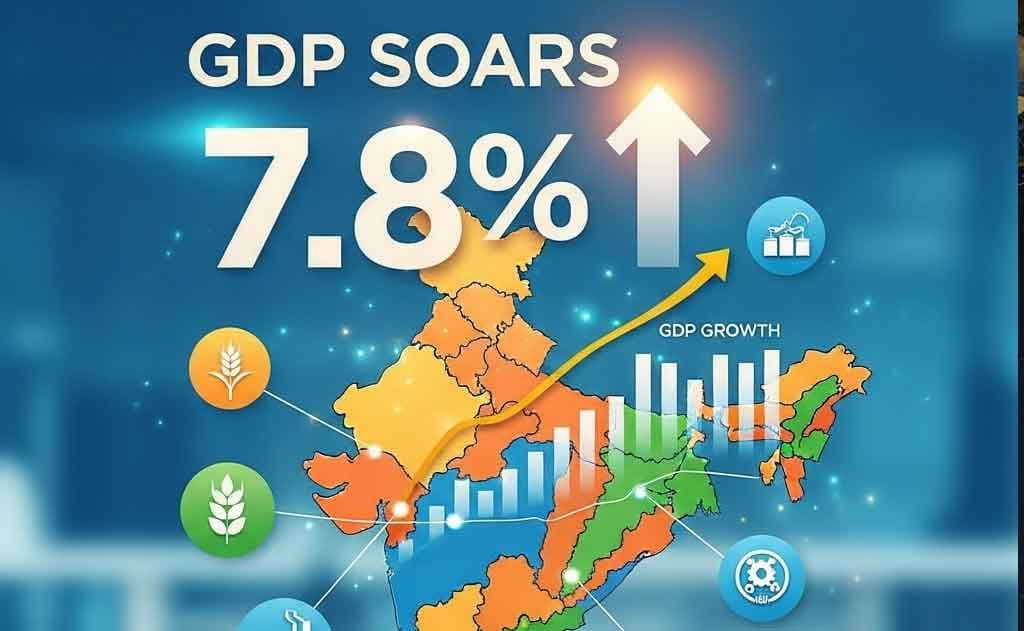
On August 29, 2025, India delivered a resounding economic statement, reporting a stellar 7.8% GDP growth for the first quarter of the fiscal year 2025-26 (April-June 2025). This figure, released by the Ministry of Statistics and Programme Implementation (MoSPI), not only surpassed analyst expectations, which ranged between 6.5% and 7%, but also solidified India’s position as the world’s fastest-growing major economy. Outpacing global peers like the United States (3.3%) and China (5.4%), India’s economic performance serves as a powerful rebuttal to skeptics, including former U.S. President Donald Trump and Indian opposition leader Rahul Gandhi, who had previously dismissed the Indian economy as "dead." This article delves into the factors driving this robust growth, the sectors leading the charge, and the broader implications for India’s economic trajectory amidst global challenges.
A Resilient Economy Defies Expectations
India’s 7.8% GDP growth in Q1 FY26 marks a significant acceleration from the 6.5% recorded in the same quarter of the previous fiscal year (Q1 FY25). According to the National Statistical Office (NSO), real GDP at constant (2011-12) prices reached ₹47.89 lakh crore, up from ₹44.42 lakh crore in Q1 FY25. In nominal terms, which include inflation, GDP grew by 8.8% to ₹86.05 lakh crore, compared to ₹79.08 lakh crore a year ago. Real Gross Value Added (GVA), a key measure of economic output excluding taxes and subsidies, also rose by 7.6% to ₹44.64 lakh crore, reflecting broad-based growth across multiple sectors.
Economists had anticipated a slowdown due to global headwinds, particularly the looming threat of 50% U.S. tariffs on Indian exports under a potential second Trump administration. However, India’s economy demonstrated remarkable resilience, driven by strong domestic demand, supportive monetary policies, and a rebound in key sectors. The Reserve Bank of India (RBI) had projected a more conservative 6.5% growth for Q1 FY26, making this outperformance particularly notable. As Joe Maher, assistant economist at Capital Economics, noted, “The surprise acceleration in India’s GDP growth in Q2 means that the economy is still on course to expand by a world-beating 7% this year, despite the upcoming hit from punitive U.S. tariffs.”
Sectoral Performance: Services, Agriculture, and Construction Lead the Way
The services sector emerged as the standout performer, growing at an impressive 9.3% in Q1 FY26, up from 6.8% in the same period last year. This sector, which constitutes a significant portion of India’s economy, was bolstered by strong performances in trade, hotels, transport, and communication services. The construction sector also showed robust growth, expanding by 7.6%, driven by sustained infrastructure investments and urban development projects. Manufacturing, a critical pillar of India’s economic diversification, grew by 7.7%, maintaining steady momentum from the previous year’s 7.6%.
Agriculture, often a volatile sector due to its dependence on monsoon patterns, recorded a notable rebound with a 3.7% growth rate, compared to just 1.5% in Q1 FY25. This improvement was attributed to an above-normal southwest monsoon, which boosted agricultural output and rural consumption. However, not all sectors performed equally well. Mining and quarrying contracted by 3.1%, impacted by flood-related disruptions, while the electricity, gas, water supply, and other utility services sector saw muted growth at 0.5%.
On the demand side, Private Final Consumption Expenditure (PFCE), which reflects household spending, grew by 7.0%, slightly down from 8.3% in Q1 FY25 but still indicative of strong consumer confidence. Gross Fixed Capital Formation (GFCF), a measure of investment in long-term assets like infrastructure and machinery, rose by 7.8%, signaling sustained private and public investment. Government Final Consumption Expenditure (GFCE) surged by 9.7% in nominal terms, up from 4.0% in the previous year, reflecting increased public spending to stimulate economic activity.
Shattering Skeptics’ Claims
The 7.8% GDP growth figure directly challenges the narratives of critics who have questioned India’s economic vitality. Former U.S. President Donald Trump, during his campaign, had claimed that India’s economy was faltering, a statement that this data clearly refutes. Similarly, opposition leader Rahul Gandhi’s assertion that the Indian economy was “dead” has been proven unfounded, as the latest figures underscore India’s ability to thrive despite global uncertainties. The economy’s performance reflects the strength of its domestic fundamentals, including a young and skilled workforce, robust savings and investment rates, and prudent fiscal and monetary policies.
Chief Economic Advisor V. Anantha Nageswaran emphasized the significance of this growth, stating, “India’s comparative strengths, its young and skilled workforce, robust saving and investment rates, and relatively sustainable debt profile will help sustain high growth even in a volatile global environment.” The data also aligns with India’s broader economic ambitions, as articulated in the vision of Viksit Bharat@2047, which aims to transform India into a developed nation by its centennial year of independence.
Navigating Global Headwinds
Despite the strong Q1 performance, India faces challenges on the global stage. The threat of U.S. tariffs, which could reduce GDP growth by 20-90 basis points according to some economists, looms large. However, India’s relatively low dependence on exports—coupled with strong domestic consumption, which accounts for approximately 61.4% of GDP—has insulated it from external shocks. The RBI’s proactive monetary policy, including a 100-basis-point rate cut between February and June 2025, has further supported growth by boosting credit availability and consumer spending. Inflation, which fell to a six-year low of 2.1% in June 2025, has provided additional room for monetary easing, with the RBI cutting its policy rate to 5.5% in June.
Government spending, while restrained in the previous fiscal year, has picked up, with a focus on capital expenditure to drive long-term growth. The fiscal deficit for FY25 stood at 4.8% of GDP, an improvement from previous years, reflecting disciplined fiscal management. However, global uncertainties, including geopolitical tensions and volatile financial markets, continue to pose risks. The RBI has cautioned that prolonged trade disruptions could impact exports, which grew by 6.3% in FY25 but moderated to 3.9% in the fourth quarter.
A Bright Outlook for India
India’s Q1 FY26 GDP growth of 7.8% not only reaffirms its status as the world’s fastest-growing major economy but also positions it as a beacon of stability in a turbulent global landscape. The International Monetary Fund (IMF) projects that India will overtake Japan to become the fourth-largest economy by the end of FY26, with a nominal GDP of $4.19 trillion. Looking ahead, India is on track to achieve a $5 trillion economy by 2027 and surpass Germany to become the third-largest economy by 2028, according to IMF forecasts.
The government’s focus on structural reforms, including ease of doing business, digitalization, and infrastructure development, continues to drive India’s growth story. Initiatives like Make in India and increased foreign direct investment (FDI) in sectors like manufacturing and technology are enhancing India’s global competitiveness. For instance, companies like Apple are shifting production to India, positioning the country as a manufacturing hub amid global supply chain realignments.
Conclusion
India’s 7.8% GDP growth in Q1 FY26 is a testament to its economic resilience and strategic policymaking. By leveraging strong domestic demand, a dynamic workforce, and proactive reforms, India has silenced critics and reaffirmed its position as a global economic powerhouse. While challenges such as potential U.S. tariffs and global uncertainties remain, the economy’s broad-based growth and supportive policy environment provide a solid foundation for sustained progress. As India continues its journey toward becoming a $5 trillion economy and a developed nation by 2047, its performance in Q1 FY26 serves as a powerful reminder of its potential to shape the global economic order.
Sources: Ministry of Statistics and Programme Implementation (MoSPI), Reserve Bank of India (RBI), International Monetary Fund (IMF)
Continue reading — NRI Globe pillar guide: NRI Taxation India — NRE/NRO/DTAA/FBAR
Related NRI Globe Coverage
- JPMorgan Chase Controversy 2026: Indian-Origin Banker Chirayu Rana Accuses Executive Lorna Hajdini of Sexual Abuse & Racial Harassment – Bank Calls Claims Fabricated
- US Economy Slows: What It Means for NRIs in 2026
- Trump's 100% Tariff on Pharma Imports: A Devastating Blow to India's Lifesaving Drug Exports
- Ethereum Soars to $4,880 All-Time High: Fed Rate Cut Hype Sparks Crypto Frenzy for NRIs
- Understanding the USA Federal Debt to GDP Ratio
- Attero’s ₹100 Crore Investment to Scale Rare Earth Recycling to 30,000 TPA: India’s Bold Step to Reduce Dependence on China
- H-1B Cap-Exempt Employers 2026 — The No-Lottery Path (Universities, Nonprofits, Research Institutions) for Indian Professionals
- F-1 OPT to H-1B Roadmap 2026 — Complete Timeline for Indian Students (STEM-OPT, Cap Lottery, Employer Sponsorship)
Fresh from NRI Globe
- YouTuber Nandu's World (Rama Nandana) UK Visa & Job Fraud Case: Full Details + Key Lessons for NRIs (2026)
- Dussehra / Vijayadashami 2026 Events Country-Wise — Global NRI Directory (Ram Lila, Ravana Dahan, Durga Puja Pandals, Ayudha Puja Venues + Booking)
- Diwali 2026 Events Country-Wise — Global NRI Directory (White House, Leicester, London Trafalgar, Toronto, Auckland, Sydney Parramasala, Fiji, Mauritius, Trinidad, South Africa and More)
- Diwali / Deepavali 2026 Country-Wise NRI Celebrations — Complete Global Guide (USA, UK, Canada, Australia, Fiji, Mauritius, Trinidad, South Africa, UAE and 30+ Countries)