
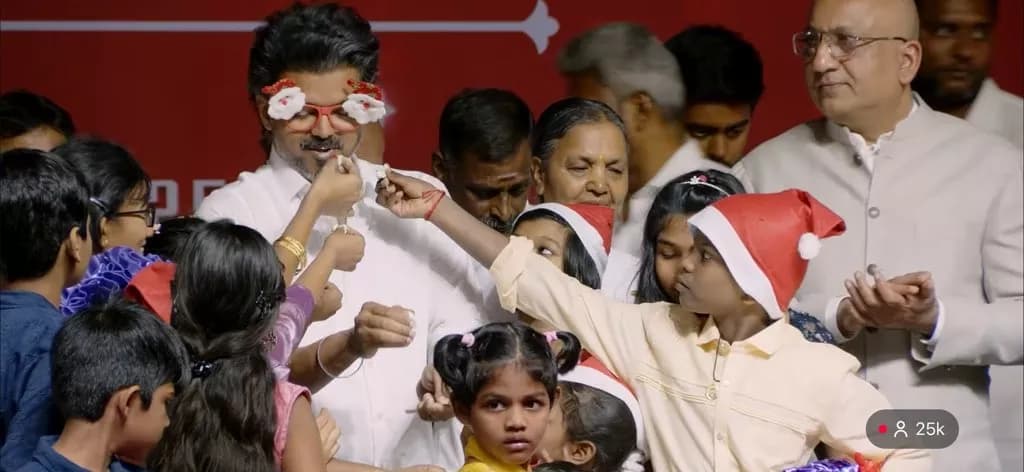
Actor-turned-politician Thalapathy Vijay's Tamilaga Vettri Kazhagam (TVK) party marked a significant milestone in its electoral strategy on December 22, 2025, by hosting its first-ever Equality Christmas Celebration in Mamallapuram. The event signals a deliberate pivot toward building bridges with minority communities ahead of the 2026 Tamil Nadu Assembly elections, a move that underscores the party's positioning as a secular, inclusive political force in a state known for its complex religious and cultural tapestry.
The Mamallapuram Event: Scale and Symbolism
Vijay, serving as president of TVK, inaugurated the celebration by lighting the Christmas tree and cutting a grand cake with children at the Four Points by Sheraton Resort & Convention Centre in Mamallapuram. The event was carefully curated as an invitation-only gathering, with entry restricted to attendees holding QR code passes—a security and organizational measure that reflected the party's intent to manage the narrative around the occasion.
Approximately 1,500 people attended, a substantial turnout that included priests, community leaders, and party cadres. The presence of religious figures alongside political workers underscored TVK's messaging of interfaith cooperation. Vijay's personal engagement at the event—distributing gifts, feeding cake to children, and interacting warmly with young supporters—was designed to project an image of accessibility and genuine concern for all sections of society, a critical element in Tamil Nadu's electoral politics where personal charisma and perceived empathy carry considerable weight.
Among the notable moments was Vijay's receipt of a miniature temple model from Dr. N. Marie Wilson, a gesture that symbolically bridged Hindu and Christian traditions within the same event space.
The Political Message: Secularism and Communal Harmony
In his address, Vijay emphasized two foundational themes: communal harmony and secularism. Rather than relying on generic political rhetoric, he drew from the biblical story of Joseph to illustrate deeper philosophical points about faith, love, and perseverance—a choice that demonstrated cultural literacy and an attempt to speak directly to Christian audiences using their own religious narratives.
His most direct statement on Tamil Nadu's religious pluralism came in this declaration: "Tamil Nadu is a land of motherly love where Pongal, Diwali, Ramzan, and Christmas are celebrated with equal joy and unity." By naming four major festivals—Pongal (Tamil Hindu harvest festival), Diwali (pan-Indian Hindu festival), Ramzan (Islamic holy month), and Christmas (Christian celebration)—Vijay articulated a vision of the state as inherently multicultural, with no single religious tradition dominating public life.
He reinforced this message with a metaphorical statement: "A light will surely be born, and that light will guide us," which carried both spiritual and political undertones. The "light" could be interpreted as hope, guidance, or TVK itself as a beacon for a new political direction. Vijay then made an explicit commitment: "Both I and TVK are 100% dedicated to safeguarding social harmony and religious amity through firm secular principles. Praise the Lord." The closing phrase—"Praise the Lord"—was a deliberate linguistic choice that demonstrated respect for Christian faith while maintaining his secular political positioning.
Strategic Timing and Electoral Context
The timing of this event is significant. The 2026 Tamil Nadu Assembly elections represent a critical juncture for TVK, a relatively new political entrant founded by Vijay. Tamil Nadu has long been dominated by two major coalitions: the DMK (Dravida Munnetra Kazhagam) and the AIADMK (All India Anna Dravida Munnetra Kazhagam), with the DMK currently in power. For TVK to establish itself as a viable electoral force, it must appeal beyond its initial base of Vijay's film fans and build credibility among diverse voter groups, particularly minorities who have historically been courted by both major parties.
Christians constitute approximately 6–7% of Tamil Nadu's population, with significant concentrations in districts like Kanyakumari, Tirunelveli, and parts of Chennai. While this percentage may seem modest, in a closely contested election with multiple parties fragmenting the vote, minority communities can prove decisive in specific constituencies. By hosting a high-profile Christmas celebration and positioning TVK as a guardian of minority rights, Vijay is attempting to secure a foothold in these communities before the 2026 campaign intensifies.
Similarly, the explicit mention of Ramzan in his speech signals outreach to Tamil Nadu's Muslim population, which comprises roughly 6% of the state. The careful balance of naming all four festivals suggests TVK's strategy is not to favor one minority over another, but to present itself as a party that respects all faiths equally—a positioning that contrasts sharply with the polarization that has characterized recent Indian politics.
Vijay's Transition from Cinema to Full-Time Politics
This event also marks a symbolic moment in Vijay's career transition. The actor, known for blockbuster Tamil films and a massive fan following, has been gradually shifting his focus toward political work. The Equality Christmas Celebration represents one of his first major public events as a full-time politician rather than as a celebrity dabbling in politics. This transition carries implications for how he is perceived: is he a film star using politics for relevance, or a genuine political leader committed to governance and public service?
By engaging in community-building activities like this celebration, Vijay is attempting to answer that question affirmatively. He is demonstrating that his political work extends beyond electoral rallies and campaign speeches to include sustained engagement with diverse communities on matters of cultural and religious significance.
Online Reactions and Political Pushback
The event did not escape controversy. BJP Tamil Nadu leaders pointed to what they characterized as Vijay's silence on recent issues, specifically citing the Thiruparankundram temple lamp controversy. This criticism reflects a broader pattern in Indian politics where political opponents attempt to undermine a rival's secular credentials by highlighting perceived inaction on matters affecting Hindu interests or institutions.
The Thiruparankundram temple controversy—though not detailed in the original reporting—appears to be a reference to a specific incident that BJP leaders believe Vijay should have addressed. By raising this during a Christmas celebration event, BJP critics were attempting to delegitimize Vijay's claims to secular neutrality, suggesting instead that his silence on Hindu temple matters revealed a bias.
However, TVK supporters countered this narrative by celebrating the Equality Christmas Celebration as a genuine reflection of Tamil Nadu's historical tradition of peaceful coexistence across religions. This counter-argument appeals to the state's Dravidian political legacy, which has long emphasized rationalism, social equality, and religious pluralism as core values. Tamil Nadu, under DMK rule for much of its modern history, has indeed cultivated an image as India's most secular state, with relatively lower communal tensions compared to other regions.
Implications for NRI Communities
For the Indian diaspora, particularly NRIs with roots in Tamil Nadu, this political development carries several implications. Many NRIs maintain strong emotional and financial connections to their home state and follow its political developments closely. TVK's positioning as a secular, inclusive party may appeal to diaspora members who are concerned about rising communal polarization in India and prefer political alternatives that emphasize unity over division.
Additionally, if TVK gains electoral traction in 2026, it could influence diaspora engagement with Tamil Nadu's governance. NRIs often invest in real estate, businesses, and charitable projects in their home states; a new political party with a secular, development-focused agenda might attract their support and participation in state-level initiatives.
TVK's Broader Electoral Strategy
The Equality Christmas Celebration is part of a larger strategy by TVK to position itself as a fresh alternative in Tamil Nadu's political landscape. The party's emphasis on "equality" in the event's very name suggests a commitment to addressing social hierarchies and discrimination—themes that resonate with Tamil Nadu's egalitarian political culture.
As Vijay transitions fully into politics following his final film projects, initiatives like this celebration are designed to reinforce TVK's appeal as a secular, inclusive force. Whether this strategy will translate into electoral success in 2026 remains to be seen, but the event demonstrates that TVK is investing significant resources and political capital into building a diverse coalition ahead of the state elections.
The celebration also illustrates how contemporary Indian politics increasingly involves cultural and religious symbolism as tools of political messaging. By hosting a Christmas event, lighting trees, cutting cakes, and quoting biblical narratives, Vijay and TVK are engaging in what might be called "cultural politics"—using symbols and rituals to communicate political values and build emotional connections with voters. In a state like Tamil Nadu, where religious and cultural identity remain deeply intertwined with political affiliation, such symbolic gestures carry weight.
Looking Ahead to 2026
The 2026 Tamil Nadu Assembly elections will be a crucial test for TVK's viability as a political force. The party's outreach to minority communities, exemplified by the Equality Christmas Celebration, suggests that Vijay and his team are taking the electoral challenge seriously and are willing to invest in building grassroots support across diverse constituencies.
Whether TVK can translate this outreach into actual electoral gains, and whether Vijay can overcome the skepticism of those who view him primarily as an actor rather than a politician, will become clear in the coming months. For now, the Equality Christmas Celebration stands as a significant marker of TVK's political ambitions and its commitment to positioning itself as a secular alternative in Tamil Nadu's competitive political arena.
Continue reading — NRI Globe pillar guide: H-1B Complete Guide for Indians 2026
Related NRI Globe Coverage
- Prabhas' The Raja Saab and Vijay's Jana Nayagan Set for Epic Sankranti Clash in 2026
- Software & Tech Layoffs in the USA (Week of September 13, 2026) — Uber, Apple, PayPal, Amazon Cuts & NRI Impact
- Uber Layoffs 3,300 Jobs Sept 2026 — NRI Tech Impact + H-1B Playbook
- Cloudsoft AI, Cloud + Cybersecurity Demo — Recording + Live Session 10:30 IST
- WSJ Ghost Jobs Report 2026 — Fake Postings + NRI Job Seeker Guide
- NRIs Returning to India 2026: Jobs, Salaries, Cities, and the Honest Reality Check
- Tech Careers for NRIs in the USA 2026: In-Demand Skills, Salary Ranges, and Positioning Playbook
- Best US States for Indian Immigrants in 2026: California, Texas, New Jersey, Washington Compared
Fresh from NRI Globe
- YouTuber Nandu's World (Rama Nandana) UK Visa & Job Fraud Case: Full Details + Key Lessons for NRIs (2026)
- Dussehra / Vijayadashami 2026 Events Country-Wise — Global NRI Directory (Ram Lila, Ravana Dahan, Durga Puja Pandals, Ayudha Puja Venues + Booking)
- Diwali 2026 Events Country-Wise — Global NRI Directory (White House, Leicester, London Trafalgar, Toronto, Auckland, Sydney Parramasala, Fiji, Mauritius, Trinidad, South Africa and More)
- Diwali / Deepavali 2026 Country-Wise NRI Celebrations — Complete Global Guide (USA, UK, Canada, Australia, Fiji, Mauritius, Trinidad, South Africa, UAE and 30+ Countries)