
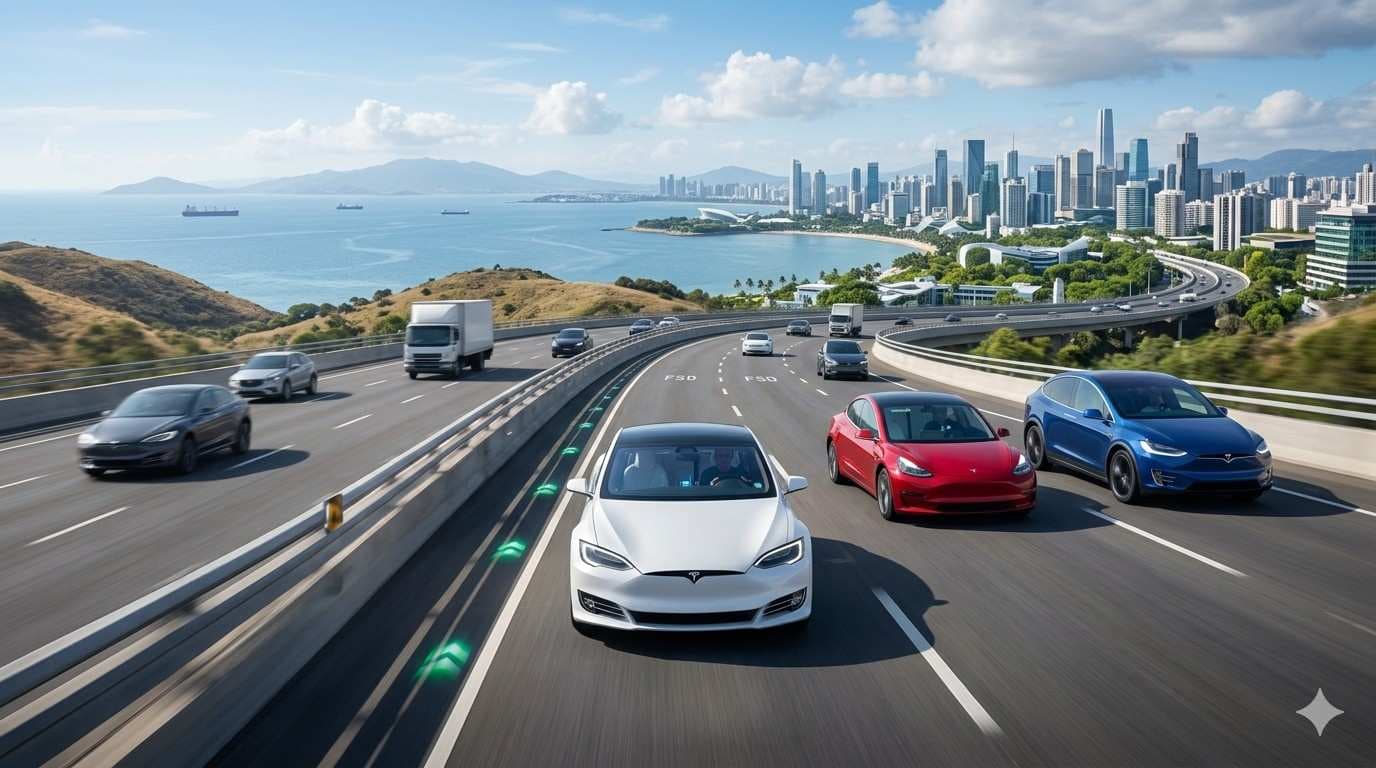
New York / Global – April 2026 – As electric vehicles reshape the automotive landscape worldwide, Tesla continues to stand out for its exceptional safety performance. Independent crash-testing agencies across the United States and Europe have awarded top honors to Tesla models, while the company’s own vast fleet data suggests that vehicles equipped with Full Self-Driving (Supervised) technology are experiencing significantly fewer collisions than both manually driven cars and the broader U.S. average.
This combination of robust passive safety design and advanced active driver-assistance systems has positioned Tesla vehicles — particularly the Model Y, Model 3, and the rugged Cybertruck — as leaders in overall road safety for 2026.
Outstanding Crash-Test Results from IIHS and Euro NCAP
The Insurance Institute for Highway Safety (IIHS) has once again recognized Tesla models with its highest accolades for 2026. The Tesla Model Y earned the Top Safety Pick+ award for the seventh consecutive year, demonstrating excellent performance in updated small overlap front, moderate overlap front, and side-impact tests.
The Tesla Cybertruck achieved a rare feat, becoming the only pickup truck — electric or gasoline-powered — to secure the Top Safety Pick+ rating under the stricter 2026 criteria. It excelled in structural integrity, pedestrian crash prevention, and headlight performance, making it a standout in the large pickup category. The Model 3 also performed strongly, earning a Top Safety Pick with good ratings across key crash scenarios.
In Europe, the 2025 Tesla Model Y achieved the highest overall score among small SUVs tested by Euro NCAP (362 points out of 400), while the Model 3 led the large family car segment with 359 points. Both vehicles received the maximum five-star rating, with exceptional marks in adult and child occupant protection, as well as safety for vulnerable road users such as pedestrians and cyclists.
The National Highway Traffic Safety Administration (NHTSA) has consistently awarded nearly all recent Tesla models its top 5-Star Overall Safety Rating, crediting the vehicles’ low center of gravity (thanks to the floor-mounted battery pack), rigid passenger cell, and advanced energy-absorbing structures.
These results highlight Tesla’s engineering focus on passive safety — how well the vehicle protects occupants when a crash occurs — setting a high benchmark for the global EV industry.
The Full Self-Driving Advantage: Tesla’s Fleet Data Tells a Compelling Story
Beyond structural crash protection, Tesla emphasizes that its Full Self-Driving (Supervised) system delivers measurable improvements in preventing crashes altogether. According to Tesla’s latest Vehicle Safety Report, vehicles with FSD (Supervised) engaged recorded one major collision for every 5.3 million miles driven in the most recent 12-month period covering billions of fleet miles.
By comparison:
- Manually driven Teslas with active safety features: one major collision every ~2.17 million miles
- Manually driven Teslas without active safety features: one every ~855,000 miles
- U.S. national average: one every ~660,000 miles
Tesla interprets this as FSD (Supervised) making its vehicles roughly 7–9 times safer than the typical American driver for major collisions. The system benefits from continuous learning through over 9 billion miles of real-world data collected from the global Tesla fleet, with features such as automatic emergency braking, predictive object recognition, and improved handling of complex urban and highway scenarios.
The company stresses that FSD remains a supervised system, requiring drivers to stay attentive and ready to intervene at all times. Regular over-the-air software updates continue to refine its capabilities.
Global Context and Ongoing Regulatory Scrutiny
While Tesla’s safety narrative is strong in crash tests and fleet-wide statistics, the technology faces continued examination. In March 2026, the NHTSA escalated its investigation into over 3.2 million Tesla vehicles equipped with Full Self-Driving, focusing on the system’s ability to detect degraded visibility conditions (such as sun glare, fog, or dust) and provide timely driver alerts. The probe includes reports of nine crashes, one of which was fatal, with additional incidents under review.
Tesla has responded by noting that software improvements could have mitigated several of the cases, and it continues to collaborate with regulators. Critics argue that real-world safety outcomes require careful interpretation, as factors like driving patterns, road types, and driver behavior can influence statistics.
Internationally, Tesla’s approach — relying primarily on vision-based AI rather than additional sensors like lidar — sparks debate among experts. Competitors in robotaxi services, such as Waymo, operate under different fully driverless frameworks with their own safety profiles.
Nevertheless, many insurers worldwide already offer premium discounts for Tesla owners using Autopilot or FSD features, citing the reduced collision risk shown in fleet data.
Why This Matters for Global Drivers and the EV Transition
For millions of drivers in the United States, Europe, Asia, and beyond, Tesla’s safety leadership combines cutting-edge design with data-driven active assistance. Families appreciate the peace of mind from top crash ratings, while tech-savvy users value the potential of FSD to reduce human error — a leading cause of road accidents globally.
As countries push toward electrification and smarter mobility, Tesla’s 2026 results reinforce the role of advanced driver-assistance systems in making roads safer overall. The company has indicated that future hardware and software iterations could push these safety metrics even higher.
In an era where road safety remains a pressing global concern, Tesla’s vehicles — especially those equipped with Full Self-Driving (Supervised) — present a compelling case as among the safest choices available today, backed by rigorous independent testing and extensive real-world data.
Related NRI Globe Coverage
- Indian Driving Rules vs International Driving Rules: 7 Common Mistakes Indian Drivers Make Abroad
- Electric Vehicles by Country 2026: Top Nations, EV Sales Numbers, Market Share Percentages & What It Means for NRIs
- CES 2026 Full Event Summary: From Opening Keynotes to Closing Awards
- Wolf Supermoon January 3, 2026: The First Full Moon of the Year – A Spectacular Start for NRIs Worldwide
- Tesla Model Y Dominates Global Car Sales for Three Straight Years
- How Trump’s H-1B Visa Rules Are Driving U.S. Companies to India
- Dragon Bravo Fire at Grand Canyon: Latest Updates and Full Story
- Trump Describes Epstein’s Mar-a-Lago Staff Poaching: New Details Emerge on Their Falling Out | NRIGlobe
Fresh from NRI Globe
- YouTuber Nandu's World (Rama Nandana) UK Visa & Job Fraud Case: Full Details + Key Lessons for NRIs (2026)
- Dussehra / Vijayadashami 2026 Events Country-Wise — Global NRI Directory (Ram Lila, Ravana Dahan, Durga Puja Pandals, Ayudha Puja Venues + Booking)
- Diwali 2026 Events Country-Wise — Global NRI Directory (White House, Leicester, London Trafalgar, Toronto, Auckland, Sydney Parramasala, Fiji, Mauritius, Trinidad, South Africa and More)
- Diwali / Deepavali 2026 Country-Wise NRI Celebrations — Complete Global Guide (USA, UK, Canada, Australia, Fiji, Mauritius, Trinidad, South Africa, UAE and 30+ Countries)