
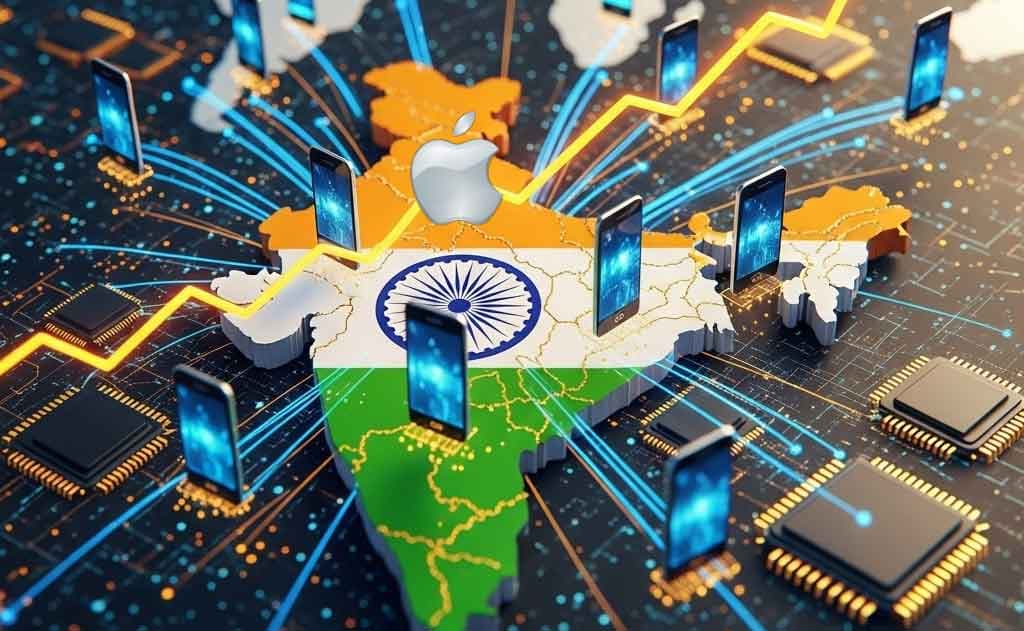
The export growth rate of India's smartphones reached an all-time high during the April-June quarter of 2023 (Q1FY26), with exports crossing $7.72 billion, a 58 percent increase from $4.9 billion in the prior year, as per the latest statistics. This milestone underscores India's rapid emergence as a critical player in global smartphone manufacturing and represents a watershed moment for the country's electronics sector, particularly for NRI investors and professionals tracking India's industrial transformation.
Apple's Dominant Role in India's Smartphone Export Boom
Reports reveal that during this quarter, Apple Inc. exported $6 billion worth of iPhones through contract manufacturers, which is an 82 percent growth from the previous year. This extraordinary surge reflects Apple's strategic decision to diversify its manufacturing footprint beyond China, leveraging India's competitive labor costs, improving infrastructure, and government incentives to build resilience into its global supply chain.
This quarter is not only notable as Apple's peak period, but also marks the highest quarterly export figure of smartphones from India. Apple alone contributed to almost 78 percent of the total smartphone exports during the quarter, demonstrating the company's outsized influence on India's export performance. While such concentration carries both opportunities and risks—Apple's continued investment signals confidence in India's manufacturing ecosystem, but over-reliance on a single company creates vulnerability to shifts in corporate strategy.
Contract Manufacturing Partners and Supply Chain Dynamics
Apple's iPhone production in India is executed through contract manufacturers, primarily Dixon Technologies and Padget Electronics, among others. These partnerships have become crucial to India's electronics export story. For NRI professionals in supply chain management, operations, or manufacturing engineering, this expansion has created career opportunities both within these contract manufacturers and in supporting logistics, quality assurance, and procurement roles. The visibility of Indian-made iPhones in global markets has also enhanced India's reputation in precision manufacturing, a sector historically dominated by East Asian competitors.
The Production-Linked Incentive Scheme: Policy Catalyst
The rise in smartphone exports is attributed to the increased local manufacturing from the Production-Linked Incentive (PLI) scheme introduced in 2020, as per the reports. The PLI scheme represents a deliberate government policy to shift India from a low-value assembly hub to a higher-value manufacturing destination. Under this scheme, manufacturers receive financial incentives based on incremental sales of goods manufactured domestically, effectively subsidizing the cost of production and making India competitive against established manufacturing hubs in Vietnam, Thailand, and Indonesia.
For NRI investors and entrepreneurs, the PLI scheme has opened pathways to establish or expand electronics manufacturing operations in India. The scheme covers not only smartphones but also components such as printed circuit boards (PCBs), battery packs, and camera modules, creating an ecosystem of ancillary manufacturing opportunities. NRIs with technical expertise or capital have increasingly returned to India or partnered with domestic manufacturers to capture these opportunities, though navigating regulatory compliance, tax implications (including Goods and Services Tax, or GST), and foreign investment rules requires specialized knowledge.
Historical Context: India's Smartphone Export Trajectory
India had only exported $3.1 billion worth of smartphones in FY21 (fiscal year ending March 2021), which increased to $24.1 billion by FY25 (fiscal year ending March 2025), with Apple responsible for $17.5 billion of that figure. This sevenfold increase over four years is extraordinary by any standard and reflects the compounding effect of policy support, corporate investment, and operational scaling.
Breaking down the timeline: in FY21, the PLI scheme was nascent, and manufacturers were still building production capacity. By FY22 and FY23, Apple began ramping up iPhone production in India in earnest, partly in response to geopolitical tensions affecting China-based supply chains and partly to hedge against potential tariffs or supply disruptions. By FY24 and FY25, the scheme had matured, with multiple manufacturers competing for Apple's orders and other smartphone brands (Samsung, Xiaomi, OnePlus) also establishing or expanding Indian production.
For NRI professionals working in India's tech hubs—Bangalore, Hyderabad, Pune, and Chennai—this growth has translated into increased demand for engineers, supply chain specialists, quality managers, and operations leaders. It has also attracted NRI-founded startups and service providers in logistics, warehousing, and export documentation.
Broader Electronics Export Growth and Sectoral Shift
India's total electronics exports in Q1FY26 also included $12.4 billion, a 48 percent year-on-year increase. This figure encompasses not only smartphones but also components, consumer electronics, and industrial electronics. As of the previous year's quarter, smartphone exports had contributed 58 percent of this figure, which has now grown to 62 percent, showcasing a shift from mere assembly to more sophisticated electronics manufacturing, as reported.
This shift is significant because it indicates that India is not simply assembling imported components but increasingly performing higher-value-added activities such as design integration, quality testing, and final assembly. Some manufacturers have also begun producing components domestically, reducing import dependency and increasing the value-add retained within India. For NRI investors in the electronics sector, this trend suggests growing opportunities in component manufacturing, specialized tooling, and precision engineering services.
Comparative Advantage and Competitive Positioning
India's rising share of global smartphone manufacturing comes at a time when Vietnam and Indonesia are also expanding capacity. However, India's advantages—a large domestic market for testing and validation, a growing pool of skilled labor, government support through the PLI scheme, and proximity to growing markets in South Asia and the Middle East—position it competitively. For NRI professionals considering relocation or investment, India's smartphone manufacturing ecosystem now rivals established hubs in terms of scale and sophistication, though labor costs remain a key competitive advantage.
From Rank 167 to Number One: A Symbolic Milestone
Remarkably, smartphones—ranked 167th in India's export list in FY15 (fiscal year ending March 2015)—have now become India's top export item by HS code in FY25, underscoring the country's rise as a global electronics manufacturing hub. This ascent from obscurity to the top position in just one decade is historically significant and reflects the success of targeted industrial policy.
In FY15, India's smartphone exports were negligible—the country was primarily known as a software and services exporter. Smartphones were not even tracked as a major export category. The transformation reflects both the success of the PLI scheme and the broader "Make in India" initiative launched in 2014, which aimed to position India as a global manufacturing destination across sectors.
Implications for NRI Professionals and Investors
For NRIs, this milestone carries several implications. First, it validates India's capability in capital-intensive, technology-driven manufacturing, potentially opening doors for NRI entrepreneurs to establish ventures in adjacent sectors such as semiconductor assembly, display manufacturing, or battery production. Second, it demonstrates the effectiveness of government policy in creating competitive advantage, suggesting that other sectors targeted by the government (semiconductors, medical devices, renewable energy) may offer similar opportunities. Third, it has created a talent pipeline—engineers and managers trained in smartphone manufacturing can transition to other electronics sectors, making India an attractive destination for NRI professionals seeking career growth in manufacturing and operations.
For NRI investors with exposure to India through mutual funds, stocks, or direct business interests, the smartphone export boom has contributed to India's overall export growth and foreign exchange earnings, strengthening the rupee and improving macroeconomic stability. However, investors should also note the concentration risk: Apple's dominance means that any shift in Apple's manufacturing strategy could significantly impact India's export figures.
Looking Ahead: Sustainability and Diversification
While the Q1FY26 figures are impressive, questions remain about sustainability. Apple's investment in India is partly a hedge against China-related risks and partly a response to cost pressures. If geopolitical tensions ease or if labor costs in India rise significantly, Apple's commitment could waver. Additionally, other smartphone manufacturers have not yet matched Apple's scale in India, suggesting that the sector's future growth depends on broadening the customer base beyond Apple.
The government has recognized this and is working to attract other global smartphone brands and component manufacturers through the PLI scheme and other initiatives. For NRI professionals and investors, this diversification effort presents opportunities to participate in India's continued electronics manufacturing growth across multiple brands and product categories.
Further reading: See NIST resources on manufacturing standards and FCC guidelines on electronics compliance for technical and regulatory frameworks relevant to electronics manufacturing.
Related NRI Globe Coverage
- iPhone 17 Pro and 17 Pro Max for NRIs 2026 — Complete Guide (US vs India Price, Warranty, Apple Intelligence, Sending as Gift)
- iPhone Duo Complete Review — Apple's First Foldable iPhone (2026) + India Price & NRI Buying Guide
- Google and Anthropic Reportedly Strike $2.17 Billion Monthly AI-Compute Deal with SpaceX: Opportunities for Indian Tech Talent
- Anthropic Report Confirms Israel Leads World in Per-Capita Claude Usage – "Start-Up Nation" Tops Global AI Adoption Charts
- Apple 2026 Product Blitz: Smarter Hardware & AI
- Why Elon Musk’s Grok AI Is Exploding in the US
- Leaked: Apple Book-Style Foldable iPhone Details Emerge
- Big Tech’s AI Power Shift: Apple, Google, OpenAI & Grok
Fresh from NRI Globe
- YouTuber Nandu's World (Rama Nandana) UK Visa & Job Fraud Case: Full Details + Key Lessons for NRIs (2026)
- Dussehra / Vijayadashami 2026 Events Country-Wise — Global NRI Directory (Ram Lila, Ravana Dahan, Durga Puja Pandals, Ayudha Puja Venues + Booking)
- Diwali 2026 Events Country-Wise — Global NRI Directory (White House, Leicester, London Trafalgar, Toronto, Auckland, Sydney Parramasala, Fiji, Mauritius, Trinidad, South Africa and More)
- Diwali / Deepavali 2026 Country-Wise NRI Celebrations — Complete Global Guide (USA, UK, Canada, Australia, Fiji, Mauritius, Trinidad, South Africa, UAE and 30+ Countries)