
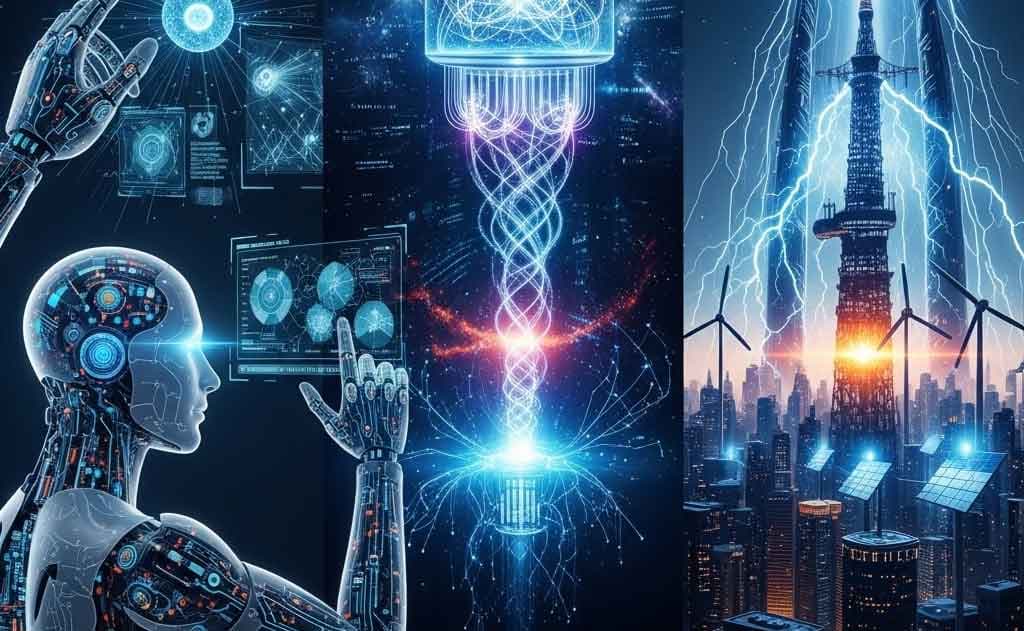
TL;DR
- Agentic AI systems are reshaping healthcare, finance, and customer service with autonomous decision-making capabilities.
- Quantum computing breakthroughs in error correction and cryptography are expected to accelerate in 2025.
- Nuclear energy and small modular reactors are becoming critical infrastructure to power AI data centers.
- Advanced semiconductors and AI accelerators from NVIDIA and AMD are driving the next wave of computing performance.
- Data centers and hyperscaler investments are surging to meet exponential AI and cloud computing demand.
Artificial Intelligence and Agentic Systems
Artificial intelligence remains the most transformative technology reshaping American industries. The distinction between traditional AI and Agentic AI is significant: traditional systems follow predefined rules and workflows, while Agentic AI operates autonomously, setting its own goals and executing complex tasks with minimal human oversight. These systems combine machine learning, natural language processing, and generative AI to perform work that previously required human judgment.
Healthcare organizations are deploying Agentic AI to generate personalized treatment recommendations by analyzing patient histories, genetic data, and clinical literature. Financial institutions use autonomous trading agents to execute investment strategies across multiple markets in real time. Customer service teams leverage AI agents that resolve inquiries without escalation in 70–80% of cases. A startup example: companies are now generating interactive business dashboards directly from written prompts, eliminating the need for manual data visualization work.
The market reflects this momentum. According to Statista's AI market analysis, the U.S. AI market is projected to reach substantial scale by 2025, driven by sustained investment from NVIDIA, Microsoft, Google, and emerging startups. Enterprise adoption is accelerating across sectors: companies report that AI-powered automation delivers measurable improvements in operational efficiency while enhancing output quality. Organizations implementing machine learning workflows for routine tasks have documented significant productivity gains, with some reporting cost reductions in the range of 20–40% depending on the use case and industry vertical. These gains reflect both labor efficiency and improved decision-making accuracy.
Quantum Computing: From Theory to Practical Application
Quantum computing harnesses quantum mechanics—superposition and entanglement—to process information exponentially faster than classical computers. While classical bits are either 0 or 1, quantum bits (qubits) exist in both states simultaneously, allowing quantum computers to explore multiple solutions in parallel.
Two major breakthroughs are expected in 2025. First, quantum error correction—a critical hurdle that has limited scalability—is approaching practical viability. IBM's quantum roadmap targets systems with thousands of logical qubits by mid-decade. Second, Google and other labs are demonstrating quantum advantage in specific domains: cryptography, molecular simulation, and optimization problems that would take classical computers millennia to solve.
Real-world applications are emerging. Pharmaceutical companies use quantum simulations to model protein folding and drug interactions, compressing research timelines from years to months. Financial firms are exploring quantum algorithms for portfolio optimization and risk analysis. Cybersecurity is both a beneficiary and a concern: quantum computers will eventually break current encryption, spurring a global shift to quantum-resistant cryptography. The U.S. National Institute of Standards and Technology (NIST) has already published post-quantum cryptography standards to prepare for this transition, with adoption timelines extending across government and enterprise sectors through the coming years.
Nuclear Energy and Advanced Power Infrastructure
The exponential energy demands of AI data centers and electric vehicle charging networks have made nuclear energy a centerpiece of U.S. infrastructure planning. Small modular reactors (SMRs) and advanced fusion designs offer a path to decarbonized, high-density power generation.
SMRs are factory-built reactors producing 50–300 megawatts, compared to 1,000+ megawatts for conventional plants. They require less capital upfront, can be deployed in remote locations, and operate with passive safety features. The U.S. Department of Energy is funding multiple SMR projects, with the first commercial units expected to come online in the latter half of this decade. Companies like NuScale Power and X-energy are leading development efforts.
Fusion energy, once purely experimental, is attracting serious commercial investment from venture capital firms and government agencies. Several fusion startups, including those backed by major institutional investors, are pursuing demonstrations of net-positive fusion in the mid-2020s. Success in fusion research would provide virtually limitless clean energy, though commercial deployment remains years away. The timeline and feasibility of commercial fusion remain subjects of active research and development across multiple companies and national laboratories.
The connection to AI is direct: a single large language model training run consumes as much electricity as thousands of homes in a year. Data center operators are actively partnering with nuclear utilities and SMR developers to secure long-term power contracts, making nuclear expansion a prerequisite for continued AI scaling.
Advanced Semiconductors and AI Accelerators
Semiconductors are the foundation of all computing, and specialized AI accelerators—chips optimized for machine learning workloads—are driving the next generation of performance gains. Traditional CPUs execute instructions sequentially; AI accelerators use parallel processing to train and run neural networks orders of magnitude faster.
NVIDIA's H100 and upcoming Blackwell GPUs dominate the market for AI training. AMD's MI300X and MI1950X accelerators offer competitive performance at lower cost, gaining traction in hyperscaler deployments. TSMC, the world's leading semiconductor manufacturer, is operating at near-maximum capacity to meet demand, with lead times extending into 2025 for advanced nodes.
The geopolitical dimension is significant. The U.S. government has restricted advanced chip exports to China and is investing in domestic semiconductor manufacturing through the CHIPS Act. The Commerce Department has allocated substantial federal funding to expand U.S. chip production capacity. Intel, Samsung, and TSMC are building new fabs in Arizona, Texas, and other states, reshoring critical supply chains and reducing dependence on overseas manufacturing.
Beyond AI, advanced semiconductors enable autonomous vehicles, IoT devices, and edge computing—processing data closer to the source rather than sending everything to centralized data centers. This distributed architecture reduces latency and bandwidth costs, unlocking new applications in healthcare, manufacturing, and smart cities.
Data Centers and Hyperscaler Infrastructure
Data centers are the physical backbone of cloud computing, hosting the servers, storage, and networking equipment that power AI, streaming, and enterprise applications. Hyperscalers—Amazon Web Services, Microsoft Azure, Google Cloud, and Meta—operate massive facilities consuming gigawatts of power and housing millions of GPUs.
The scale is staggering. A single hyperscaler data center campus may span 100+ acres and house 10,000+ servers. The largest AI data centers now operate 15+ gigawatts of IT load, with some facilities dedicated entirely to GPU clusters for training large language models. Cooling, power distribution, and network interconnect are engineering challenges that drive innovation in materials science and electrical systems.
Investment is accelerating. IDC forecasts that global data center spending is growing significantly, with the U.S. representing a substantial portion of worldwide investment. Public companies like Oracle, Vertiv, and Super Micro Computer are seeing record orders for data center infrastructure. Private equity is also active, acquiring smaller data center operators to consolidate capacity and improve operational efficiency.
A critical constraint is power availability. Many regions lack sufficient electrical capacity to support new hyperscaler builds, forcing companies to negotiate long-term contracts with utilities and invest in on-site power generation—including nuclear partnerships mentioned above. Real estate near fiber optic hubs and power plants commands premium valuations, reflecting the scarcity of suitable locations.
Robotics and Autonomous Systems
Robotics encompasses industrial automation, autonomous vehicles, surgical systems, and humanoid robots. AI advances are making robots more adaptive, capable of learning from experience rather than executing pre-programmed sequences.
In manufacturing and logistics, collaborative robots (cobots) work alongside humans, handling repetitive or hazardous tasks. Warehouse automation—robotic arms, autonomous mobile robots, and conveyor systems—is accelerating as e-commerce demand strains human labor markets. The U.S. Bureau of Labor Statistics reports that labor shortages in warehousing and manufacturing are driving automation adoption, with payback periods of 2–3 years in many cases.
Surgical robotics is transforming healthcare. Systems like the da Vinci platform enable minimally invasive procedures with precision and control beyond human capability. Hospitals report reduced patient recovery times and fewer complications. Robotic prosthetics powered by AI interpret neural signals, allowing users to control artificial limbs with natural movement patterns.
Autonomous vehicles remain in development but are progressing. Waymo, Cruise, and Tesla are operating robotaxi services in select U.S. cities. Regulatory approval is advancing: NHTSA has issued guidance for autonomous vehicle testing and deployment, clearing the path for scaled rollout in the coming years.
Battery Technology and Energy Storage
Battery technology is the enabling layer for electric vehicles, renewable energy integration, and portable electronics. Current lithium-ion batteries have reached a plateau in energy density; next-generation chemistries promise 2–3x improvements.
Solid-state batteries replace the liquid electrolyte in lithium-ion cells with a solid material, reducing flammability and increasing energy density. Toyota and QuantumScape are pursuing commercial production of solid-state cells in the coming years, with multiple companies targeting deployment timelines in the late 2020s. Early prototypes achieve 500+ watt-hours per kilogram, enabling electric vehicles with 600+ mile ranges on a single charge.
Sodium-ion batteries offer a lower-cost alternative to lithium, using abundant materials. CATL, the world's largest battery maker, has begun mass production of sodium-ion cells for electric vehicles and stationary storage. The trade-off is lower energy density, making sodium-ion better suited for grid storage and short-range vehicles.
Grid-scale battery storage is critical for renewable energy integration. When solar and wind generation exceeds demand, excess power charges batteries; during peak demand, batteries discharge. The U.S. Department of Energy reports that battery storage capacity is growing 50% annually, with costs declining 15% per year. By 2030, battery storage could represent 10% of total U.S. electricity capacity, fundamentally reshaping how the grid manages renewable energy.
Emerging Trends and Interconnections
These seven technology pillars do not exist in isolation. Agentic AI requires vast computational power from data centers, which demand energy from nuclear plants. Quantum computers will eventually break current encryption, necessitating quantum-resistant cryptography built into semiconductors and network protocols. Robotics and autonomous systems depend on batteries and semiconductors. The convergence creates a complex, interdependent ecosystem.
For professionals and investors, the implication is clear: companies positioned at the intersection of these trends—data center operators with nuclear partnerships, semiconductor firms supplying AI accelerators, battery makers serving EV and grid storage markets—are likely to capture disproportionate value. Conversely, technologies that do not align with this ecosystem (e.g., legacy fossil fuel infrastructure without a decarbonization pathway) face structural headwinds.
NRI professionals and diaspora entrepreneurs should monitor these trends closely. The U.S. tech sector is attracting global talent and capital; opportunities exist for those with expertise in AI, quantum computing, nuclear engineering, semiconductor design, and energy systems. Reverse brain drain—skilled Indians returning to India to apply these technologies—is also accelerating, as Indian companies and the government invest in AI, semiconductor fabs, and renewable energy.
Next Steps
To stay ahead of these trends, consider the following actions:
- Skill Development: Pursue certifications or courses in AI, quantum computing, semiconductor design, or energy systems. Platforms like Coursera, edX, and MIT OpenCourseWare offer free or affordable resources.
- Industry Monitoring: Follow announcements from NIST, the Department of Energy, and the SEC. Subscribe to tech news from Reuters, Bloomberg, and The Wall Street Journal for primary source reporting.
- Investment Research: If investing, focus on companies with clear exposure to these trends. Diversify across semiconductors, energy, data centers, and robotics rather than betting on single stocks.
- Networking: Engage with professional organizations like IEEE, the Semiconductor Industry Association, and the American Nuclear Society. Attend conferences and webinars to build knowledge and connections.
- Policy Awareness: Understand how government policies—CHIPS Act, Inflation Reduction Act, export controls—affect your industry or career path.
Sources
- Statista: AI Market Outlook – United States
- IBM Quantum: Quantum Computing Platform and Roadmap
- NIST: Post-Quantum Cryptography Standardization
- U.S. Department of Energy: Advanced Reactors
- TSMC: Taiwan Semiconductor Manufacturing Company
- U.S. Commerce Department: CHIPS Act Investments
- IDC: Global Datasphere and Data Center Spending
- U.S. Bureau of Labor Statistics: Industrial Production and Automation
- NHTSA: National Highway Traffic Safety Administration – Autonomous Vehicles
- U.S. Department of Energy: Energy Storage