
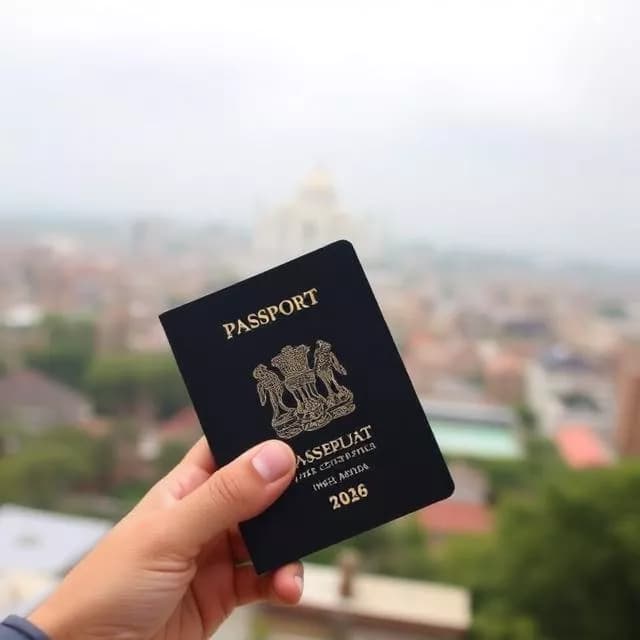
India's passport improved to the 75th position in the February 2026 Henley Passport Index. Holders now enjoy visa-free or visa-on-arrival entry to 56 destinations. While that number may appear modest against the top-ranked passports, the movement represents a meaningful shift in India's global mobility standing and carries practical consequences for the country's large diaspora.
TL;DR
- India moved up ten places to rank 75 with access to 56 destinations.
- Singapore leads the index with visa-free entry to 192 places.
- Recent bilateral agreements with countries in Asia, Africa and the Caribbean drove the gain.
- Key Western destinations still require prior visas for Indian citizens.
Henley Passport Index Methodology
The index scores 199 passports against 227 possible destinations using International Air Transport Association data. Scores reflect destinations reachable without a visa obtained in advance — meaning either complete visa-free entry, a visa issued on arrival at the port of entry, or an electronic travel authorization that can be secured online before departure. Monthly updates capture new agreements and policy shifts, making the index a relatively current snapshot of global mobility rather than a static annual report.
It is worth understanding what the index does not measure. It does not account for the ease of the visa-on-arrival process itself, queue times, fees, or the practical likelihood of being admitted. Two passports with identical scores can offer very different travel experiences depending on the destination's enforcement practices and the traveler's individual profile. For NRIs and frequent travelers, that distinction matters when translating a rank into real-world trip planning.
India's rise from 85th at the close of 2025 stems from fresh pacts that expanded options in several regions. The ranking places India level with Gabon and Madagascar, a pairing that reflects the index's purely numerical approach — countries at the same score share a rank regardless of the size or economic weight of their respective passport-holding populations.
India's Gains and Accessible Destinations
Diplomatic work produced new entry rules with partners across Asia, Africa and the Caribbean. Travelers report smoother trips to Thailand, Indonesia, Malaysia, Barbados and several African nations through visa-on-arrival or e-visa channels. Neighbors Bhutan, Nepal, Maldives and Sri Lanka remain among the easiest options, benefiting from longstanding regional frameworks that predate the Henley methodology itself.
The African continent represents a growing area of accessibility for Indian passport holders. Several nations there have moved toward broader visa-on-arrival policies as part of wider regional integration efforts, and India's bilateral diplomatic engagement on that continent has deepened over recent years. Caribbean destinations, while less frequently visited by Indian travelers, have similarly opened up, offering options for those combining business travel with leisure in the Atlantic region.
One NRI living in the United States described planning a family visit to Southeast Asia last year. With the updated access rules, the group avoided multiple embassy appointments and completed the journey on shorter notice. The experience highlighted how incremental changes in visa policy translate into concrete time savings for diaspora families who travel several times a year for weddings, business meetings and medical check-ups. Similar accounts from professionals in the Gulf and Europe note that the added destinations reduce overall planning friction, although long-haul trips to Europe and North America still demand full visa processes months ahead.
Travel and immigration specialists broadly observe that passport mobility gains of this kind matter most to frequent travelers — particularly NRIs who balance residency abroad with regular returns to India. Each additional visa-free destination can mean one fewer appointment at a foreign consulate, reduced document preparation time and greater flexibility when itineraries shift at short notice. For diaspora communities managing cross-border family obligations, those savings accumulate meaningfully over the course of a year. Analysts who track mobility indices also point out that a country's passport rank tends to reflect the depth of its diplomatic relationships as much as any single policy change, meaning sustained gains usually require continued engagement on multiple bilateral fronts.
For NRIs specifically, the passport they carry day-to-day may be that of their country of residence rather than India. However, the Indian passport remains relevant for travel back to India and for trips to third countries where the NRI's resident-country passport may not offer an advantage. Understanding which passport to present at which border — and whether dual-nationality rules apply — is a separate consideration that falls outside the Henley ranking but is practically intertwined with how diaspora travelers experience mobility.
Global Leaders in 2026
Singapore holds the top spot with visa-free access to 192 destinations. Japan and South Korea sit just behind. Several European Union countries occupy the next tier with scores between 185 and 186. The United Arab Emirates continues its strong showing among Gulf nations, a trajectory that reflects sustained diplomatic outreach by Abu Dhabi and Dubai over the past decade. The gap between the top-ranked passports and India's current position — roughly 130 to 136 additional destinations — illustrates how much of the world's geography remains behind a visa requirement for Indian citizens.
That gap also provides context for understanding why passport strength is sometimes discussed alongside broader economic and immigration policy debates. Countries at the top of the index tend to share characteristics such as high per-capita income, membership in multilateral trade and security frameworks, and long-established reciprocal visa arrangements with other wealthy nations. India's improving rank reflects progress on bilateral diplomacy, but closing the gap with top-tier passports would likely require shifts across several of those dimensions simultaneously.
| Rank | Passport | Destinations |
|---|---|---|
| 1 | Singapore | 192 |
| 2 | Japan / South Korea | 187-188 |
| 3-8 | Selected EU nations | 185-186 |
| 75 | India | 56 |
Remaining Barriers for Indian Passport Holders
Despite the improvement, holders still encounter strict requirements for most European and North American countries. These gaps reflect differences in economic indicators and reciprocal arrangements that top-ranked passports enjoy. Observers note that broader liberalization often tracks per-capita income levels and established bilateral ties. The Schengen area, which covers much of continental Europe, operates a unified short-stay visa system that applies a common set of criteria to applicants from countries outside its membership — criteria that currently place Indian citizens in a category requiring advance applications supported by financial documentation, travel history and purpose-of-visit evidence.
The United Kingdom, which operates its own visa regime separately from the EU following its departure from that bloc, similarly requires Indian nationals to apply in advance. The United States and Canada each have their own distinct processes, including biometric enrollment and consular interviews in some cases. For NRIs already holding residency or citizenship in those countries, onward travel to third destinations may be easier on the resident-country document, but travel to India itself still involves the Indian passport or an Overseas Citizen of India card, depending on the individual's status.
For NRIs, the practical implication is that a higher Henley rank does not automatically simplify travel to the destinations most relevant to their daily lives — such as the United States, Canada, the United Kingdom or Schengen-area countries. Those routes continue to require advance visa applications, supporting documentation and, in many cases, biometric appointments. Keeping track of destination-specific requirements through official government portals remains essential, as rules can shift independently of index rankings. A destination that appears accessible based on a passport's score may have introduced new conditions or temporary restrictions that the index has not yet captured in its most recent update.
Comparative context helps frame India's position. Among South Asian nations, India's rank is broadly in line with or ahead of several neighbors, though specific rankings shift with each monthly update. Among the BRICS grouping of major emerging economies, passport strength varies considerably, with some members holding significantly higher scores. That variation reflects the different diplomatic trajectories and bilateral agreement portfolios each country has built over decades.
Next steps
Check the official Henley site before booking travel. Review entry rules on destination government portals for the latest requirements. NRIs should keep passport validity well ahead of any planned international movement, as many destinations require a minimum of six months' validity beyond the intended stay and some airlines enforce that rule at check-in regardless of the destination's official policy. Travelers who hold both an Indian passport and a foreign residency document should verify which document is appropriate for each leg of a journey before departure.
Sources
Continue reading — NRI Globe pillar guide: H-1B Complete Guide for Indians 2026
Related NRI Globe Coverage
- India Passport Renewal for NRIs 2026 — Complete Guide (CGI, VFS, Application, Timeline)
- US NRI Documents & Travel Hub 2026 — Passport, OCI, e-Arrival, PIO Conversion, Minor Kids
- Indian Passport Renewal for NRIs in 2026: Complete VFS / Embassy Guide by Country
- Renewing the Indian Passport Abroad: The 2026 VFS Walkthrough
- Germany Allows Visa-Free Transit for Indian Passport Holders – Big Relief for Travelers
- NRI Passport Renewal Guide: Step-by-Step Process, Documents, and Tips for 2025
- Best Travel Insurance for NRIs 2026 — Complete Guide (IMG, Seven Corners, Allianz, SafetyWing & More)
- PAN Card + Aadhaar for NRIs 2026 — Linking, Application, Complete Guide (Tax + Financial Transactions)
Fresh from NRI Globe
- YouTuber Nandu's World (Rama Nandana) UK Visa & Job Fraud Case: Full Details + Key Lessons for NRIs (2026)
- Dussehra / Vijayadashami 2026 Events Country-Wise — Global NRI Directory (Ram Lila, Ravana Dahan, Durga Puja Pandals, Ayudha Puja Venues + Booking)
- Diwali 2026 Events Country-Wise — Global NRI Directory (White House, Leicester, London Trafalgar, Toronto, Auckland, Sydney Parramasala, Fiji, Mauritius, Trinidad, South Africa and More)
- Diwali / Deepavali 2026 Country-Wise NRI Celebrations — Complete Global Guide (USA, UK, Canada, Australia, Fiji, Mauritius, Trinidad, South Africa, UAE and 30+ Countries)