
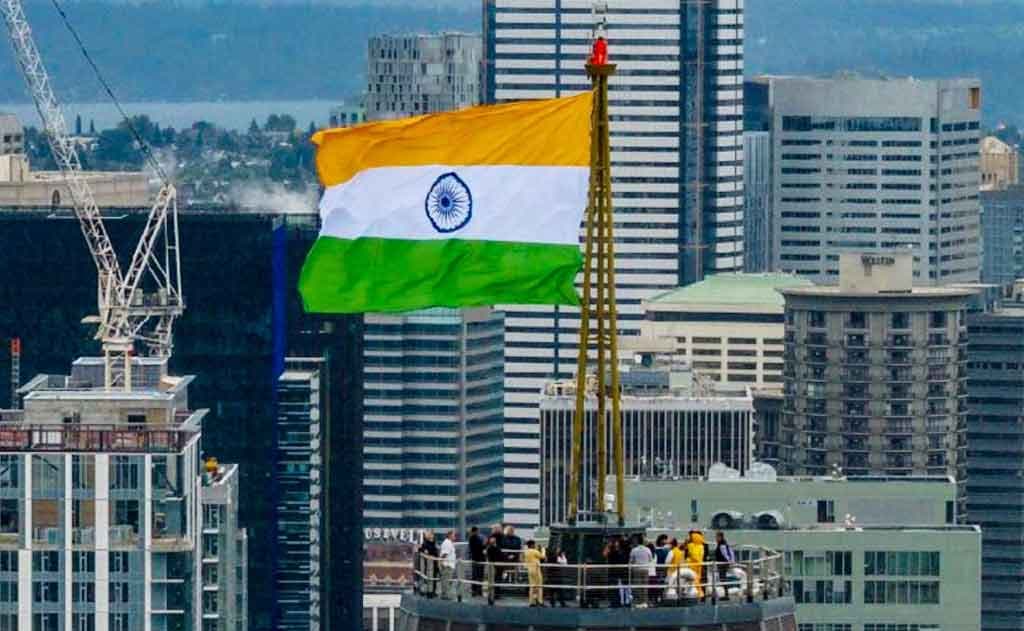
Har Ghar Tiranga is a public campaign led by the Ministry of Culture, Government of India, that invites citizens to fly the Tiranga (national flag) at their homes around Independence Day. Launched under the Azadi ka Amrit Mahotsav umbrella, it encourages ordinary people to display the flag, register participation, and download a certificate through an official portal.
What is Har Ghar Tiranga?
Har Ghar Tiranga, which translates roughly to "the Tricolour in every home," is a nationwide public-participation initiative coordinated by the Ministry of Culture. It began in 2022 as part of the wider Azadi ka Amrit Mahotsav programme marking 75 years of India's independence, and it has been repeated in subsequent years around the Independence Day period.
The central idea is simple: citizens are encouraged to hoist or display the national flag at their homes and workplaces as a personal act of participation. The campaign is presented by the Ministry as a way to deepen everyday engagement with the national flag rather than treating it as something displayed only at official venues.
Har Ghar Tiranga 2026: dates and portal
In past editions, the campaign has run for a short window in August, timed around Independence Day on 15 August. The specific 2026 dates, the campaign's official portal address, and any updated features are typically announced closer to the day through the Ministry of Culture's official channels, government press releases, and the dedicated campaign website. Readers should rely on those official sources for confirmed 2026 details rather than unofficial forwards on social media.
It is worth noting the milestone context: 15 August 2026 is the 80th Independence Day, marking 79 completed years of independence. If you have seen conflicting "79th" versus "80th" claims, our explainer on the 80th vs 79th Independence Day 2026 question sets out the counting logic clearly. For the full picture of the day, see our Independence Day 2026 guide.
How people generally participate
Participation in previous years has followed a broadly consistent pattern. While exact steps can change year to year, the general approach has looked like this:
- Display a flag at home: Citizens hoist or display the Tiranga at their residence, balcony, gate, or rooftop during the campaign window.
- Visit the official portal: A dedicated Har Ghar Tiranga website has been used for participation. Users typically pin their location and register their involvement.
- Upload a selfie with the flag: In earlier editions, participants uploaded a photo of themselves with the flag to the portal.
- Download a certificate: After registering, participants have been able to download a personalised certificate of participation as a digital keepsake.
- Share on social media: Many participants share their photos using the campaign hashtags, though this is optional and informal.
For 2026, assume the broad structure may be similar but confirm the exact certificate and selfie-portal mechanics from the official announcement, since the Ministry updates the process each cycle.
Participation at a glance
| Element | What it usually involves |
|---|---|
| Organiser | Ministry of Culture, Government of India |
| Umbrella programme | Azadi ka Amrit Mahotsav |
| Typical timing | A short window around 15 August (Independence Day) |
| Main action | Flying or displaying the Tiranga at home |
| Online step | Registering on the official portal; uploading a selfie in past years |
| Keepsake | Downloadable certificate of participation |
| Cost to join | Registering on the portal has been free; you supply your own flag |
Flag Code compliance when you display the Tiranga at home
Flying the national flag at home is a privilege that comes with clear rules. Home display must comply with the Flag Code of India, 2002, which was amended in 2021–2022 to permit display by members of the public in the open and on private homes. Correct handling is also protected by the Prevention of Insults to National Honour Act, 1971, which makes it an offence to disrespect the flag.
Some widely relevant points to keep in mind:
- Dignity first: The flag should always be displayed in a dignified position and never allowed to touch the ground or water.
- Correct orientation: The saffron band must be at the top when the flag is displayed horizontally, and the flag must never be displayed upside down.
- No damage: A damaged, torn, or soiled flag should not be flown.
- Not as clothing or drapery: The flag must not be worn as clothing, used as drapery, or turned into costume material. This is an important caution for fancy-dress and event ideas.
- Respectful disposal: When a flag is worn out, it must be disposed of respectfully and in private, in keeping with its dignity.
Because Independence Day involves hoisting the flag (raising it up the pole from the bottom), while Republic Day involves unfurling a flag already tied at the top, it helps to understand the difference before any ceremony. See our explainer on hoisting versus unfurling. For the full set of do's and don'ts, read our detailed guide to the Flag Code of India rules, and for end-of-life handling see how to dispose of a national flag correctly.
Choosing a flag for the campaign
The Flag Code specifies material and proportion standards. The flag should be rectangular with a length-to-height ratio of 3:2, and following the 2021 amendment, flags made of hand-spun, hand-woven, or machine-made cotton, polyester, wool, silk, or khadi bunting are permitted. Whatever material you choose, buy from a legitimate source and check that the proportions and colour bands are correct so your display remains respectful.
If you would like to understand what the colours and the Ashoka Chakra represent, our piece on the history and meaning of the Indian national flag gives helpful background.
A note on national symbols and neutrality
Har Ghar Tiranga is a government-organised civic campaign, and participation is a personal choice. When engaging with national symbols, remember that the State Emblem of India (Prohibition of Improper Use) Act, 2005 governs use of the State Emblem, and the national anthem should only be reproduced in its official, unaltered form and only where it genuinely aids understanding. For any specific question about permitted uses, timings, or the exact rules, consult the official text published by the Ministry of Home Affairs and the Ministry of Culture rather than relying on secondary summaries.
Har Ghar Tiranga for NRIs and the diaspora
Many Indians abroad follow the campaign and mark Independence Day at community events, consulates, and cultural associations. If you are outside India, note that the Flag Code of India applies within Indian jurisdiction; when displaying the Tiranga abroad, also respect the local laws and any guidance from your Indian mission. The spirit of the campaign — honouring the flag with dignity — travels well regardless of where you are.
Key takeaways
- Har Ghar Tiranga is a Ministry of Culture campaign under Azadi ka Amrit Mahotsav inviting citizens to fly the Tiranga at home.
- Participation has typically involved displaying a flag, registering on an official portal, uploading a selfie, and downloading a certificate.
- The confirmed 2026 dates and portal details are announced closer to the day via official channels.
- Home display must follow the Flag Code of India, 2002, backed by the Prevention of Insults to National Honour Act, 1971.
- 15 August 2026 is the 80th Independence Day, marking 79 completed years.
Related reading
- Independence Day 2026: complete guide
- 80th or 79th Independence Day 2026?
- Flag Code of India rules explained
- Hoisting vs unfurling the flag
- Indian national flag: history and meaning
- How to dispose of a national flag respectfully
Related NRI Globe Coverage
- YouTuber Nandu's World (Rama Nandana) UK Visa & Job Fraud Case: Full Details + Key Lessons for NRIs (2026)
- US Crime News 2026 — Top Trend Categories NRIs Are Watching (Organized Retail Theft, Auto Theft, Cybercrime, Hate Crimes, Fentanyl, AI-Enabled Fraud)
- US Crime & Safety This Week — September 17-21, 2026 (NRI Family Guide, FBI Alerts, H-1B/Immigration Scams, Tech Support Fraud, Emergency Resources)
- Japan's Centenarian Population Surpasses 100,000 for the First Time in History
- Major US News This Week (September 14-15, 2026): Supreme Court Blocks Trump Mail Voting Rules, AI Debate Explodes, Space Weapons Confirmed
- How AI Is Changing NRI Life 2026 — Visas, Jobs, Money, Family and the New Frauds
- $5,000 Trump Dividend Proposal — Complete Details, Feasibility & NRI Impact Analysis (Nov 2026 Midterms)
- Trump Urges Support for AI Data Centers on Fox News — US-China Race, Stocks, Local Opposition (NRI Perspective)
Fresh from NRI Globe
- Dussehra / Vijayadashami 2026 Events Country-Wise — Global NRI Directory (Ram Lila, Ravana Dahan, Durga Puja Pandals, Ayudha Puja Venues + Booking)
- Diwali 2026 Events Country-Wise — Global NRI Directory (White House, Leicester, London Trafalgar, Toronto, Auckland, Sydney Parramasala, Fiji, Mauritius, Trinidad, South Africa and More)
- Diwali / Deepavali 2026 Country-Wise NRI Celebrations — Complete Global Guide (USA, UK, Canada, Australia, Fiji, Mauritius, Trinidad, South Africa, UAE and 30+ Countries)
- Dussehra / Vijayadashami 2026 Country-Wise NRI Celebrations — USA, UK, Canada, Australia, New Zealand, UAE, Singapore, Germany, Netherlands and More