
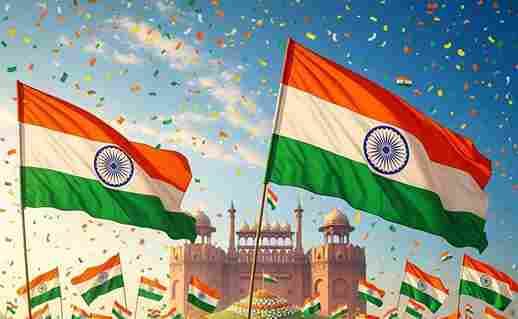
The difference is precise and physical. On Independence Day (15 August) the national flag is hoisted: it is tied in a bundle at the bottom of the pole and then pulled up to the top, echoing the raising of the flag in 1947. On Republic Day (26 January) the flag is unfurled: it already sits at the top of the pole and is simply unfolded. Both are ceremonial and both are governed by the Flag Code of India 2002.
Hoisting versus unfurling: the core distinction
The two words are often used interchangeably in everyday speech, but in the context of India's two national days they describe two different actions with two different symbolic meanings. The distinction is about where the flag starts and how it reaches the top of the pole.
When a flag is hoisted, it begins folded and secured near the base of the flagpole. An official pulls a rope, and the folded flag travels up the pole. At the top, the fold releases and the tricolour opens to the wind. The upward journey is the point: it visually re-enacts the moment the flag first went up on a free India.
When a flag is unfurled, it is already fixed at the top of the pole in a folded state. The official pulls a rope that releases the fold, and the flag opens where it is. There is no upward travel — only the unfolding. This is the form used on Republic Day, when India commemorates the day its Constitution came into effect in 1950, with the flag treated as already established at the summit.
Comparison table
| Aspect | Independence Day (15 August) | Republic Day (26 January) |
|---|---|---|
| Action | Hoisting (flag raised from bottom) | Unfurling (flag opened at top) |
| Starting position | Folded at the base of the pole | Already folded at the top of the pole |
| Movement | Flag travels up the pole, then opens | Flag stays in place and unfolds |
| Principal official at the national ceremony | Prime Minister | President |
| National venue | Ramparts of the Red Fort, Delhi | Kartavya Path (formerly Rajpath), Delhi |
| Commemorates | Independence from British rule in 1947 | The Constitution coming into force in 1950 |
| Symbolic idea | The raising of a free nation's flag | An established republic's flag opened anew |
Who performs each ceremony, and why
At the national level, the two ceremonies are led by two different constitutional office-holders, and the reasoning is commonly explained in terms of what each day marks.
- Independence Day — the Prime Minister. On 15 August, the Prime Minister hoists the flag from the ramparts of the Red Fort in Delhi and then addresses the nation. This day recalls the transfer of power in 1947 and the formation of a national government, so the head of government performs the ceremony.
- Republic Day — the President. On 26 January, the President unfurls the flag at Kartavya Path. This day marks the Constitution of India coming into effect in 1950, the point at which India became a republic with the President as head of state, so the head of state performs the ceremony.
These roles apply to the two principal national events in Delhi. Across states, Union Territories, schools, offices and other institutions, ceremonies are led by the relevant authority — a Governor, a Chief Minister, a head of institution or a designated official — following the same broad practice of hoisting on Independence Day and unfurling on Republic Day.
What the Flag Code of India 2002 governs
The display of the national flag in India is regulated primarily by the Flag Code of India 2002, together with the Prevention of Insults to National Honour Act 1971. The Flag Code is an administrative document that consolidates the rules, conventions and instructions relating to the display of the flag; the 1971 Act is a statute that addresses insults to national symbols.
The Flag Code has been amended over the years to widen public participation in flag display, including the flying of the flag by members of the public. Because the specific rules — on dimensions, materials, timings, positioning and conduct — are detailed and have changed over time, readers should rely on the authoritative text rather than summaries. You can review a plain-language overview on our Flag Code of India rules page, and you should always cross-check the official version published by the Ministry of Home Affairs (MHA).
A few general points that are commonly emphasised:
- The saffron band should be at the top when the flag is displayed flat or hoisted on a pole.
- The flag should be in a dignified condition and should not touch the ground or trail in water.
- When a flag is damaged or soiled, it should be disposed of respectfully and in private, in keeping with its dignity — our guide on how to dispose of the national flag explains the accepted methods.
- Nothing should be placed on, above or written on the flag except as specifically permitted.
Because enforcement and interpretation of these provisions can carry legal consequences under the 1971 Act, the safest course is to read the current MHA text before organising any flag ceremony.
Why the terminology matters legally and ceremonially
Using the correct term is more than a language preference. Official communications, event programmes and media coverage distinguish "flag hoisting" for Independence Day and "unfurling" for Republic Day, and organisers who follow the correct form align their events with established protocol. Getting the mechanics right — folded-at-the-base versus folded-at-the-top — also avoids the awkwardness of a ceremony that does not match the day it commemorates.
The 2026 dates and the anniversary count
15 August 2026 falls on a Saturday. It will be the 80th Independence Day and will mark 79 completed years since 1947. These two figures are frequently confused. The ordinal count of the event (the 80th time the day is observed, counting 1947 as the first) is one higher than the number of completed years (79). We explain the arithmetic in full on our dedicated 80th or 79th Independence Day 2026 page — worth reading if you want to state the count correctly in speeches or invitations.
Republic Day in 2026 was observed on 26 January; the flag was unfurled at the national ceremony in Delhi and at events across the country. For a broader picture of the 2026 observances, planning notes and coverage, see our Independence Day 2026 hub.
How the ceremony connects to the freedom movement
The act of hoisting the flag on Independence Day is rooted in the history of the freedom struggle, in which the tricolour became a rallying symbol over several decades. The movement spanned a wide spectrum — constitutional campaigners, mass civil-disobedience movements, revolutionary groups and figures associated with the Indian National Army among them — and historians present a range of assessments of the relative contribution of each strand. Rather than rank them, most accounts treat the movement as a broad, multi-stranded effort.
If you want to trace how events led to 1947, our India freedom struggle timeline lays out the sequence chronologically, and our overview of freedom fighters of India introduces figures from across that spectrum without adjudicating contested historical debates.
Common questions organisers ask
- Can we hoist on Republic Day? The established practice is to unfurl on Republic Day and hoist on Independence Day. Matching the action to the day keeps an event consistent with protocol.
- Does the same rule apply at schools and offices? The hoist-versus-unfurl distinction by day is generally followed at institutional ceremonies as well, with the presiding official leading it.
- What material should the flag be? The Flag Code addresses permissible materials; consult the current MHA text, as provisions have been updated over time.
- What if the flag is damaged during the event? Handle it with dignity and dispose of it respectfully afterwards — see the disposal guide linked above.
Related reading
- Independence Day 2026: complete guide
- 80th or 79th Independence Day 2026?
- Flag Code of India: display rules
- How to dispose of the national flag
- India freedom struggle timeline
- Freedom fighters of India
Related NRI Globe Coverage
- Can You Hoist the Indian Flag Abroad? Rules and Practical Guidance
- How to Hoist the National Flag at Home Correctly
- The Indian National Flag: History, Design and the Meaning of Every Element
- Pingali Venkayya: The Man Who Designed India's National Flag
- How to Dispose of a Damaged National Flag Respectfully
- Flag Code of India: Complete Rules for Displaying the Tiranga
- YouTuber Nandu's World (Rama Nandana) UK Visa & Job Fraud Case: Full Details + Key Lessons for NRIs (2026)
- US Crime News 2026 — Top Trend Categories NRIs Are Watching (Organized Retail Theft, Auto Theft, Cybercrime, Hate Crimes, Fentanyl, AI-Enabled Fraud)
Fresh from NRI Globe
- Dussehra / Vijayadashami 2026 Events Country-Wise — Global NRI Directory (Ram Lila, Ravana Dahan, Durga Puja Pandals, Ayudha Puja Venues + Booking)
- Diwali 2026 Events Country-Wise — Global NRI Directory (White House, Leicester, London Trafalgar, Toronto, Auckland, Sydney Parramasala, Fiji, Mauritius, Trinidad, South Africa and More)
- Diwali / Deepavali 2026 Country-Wise NRI Celebrations — Complete Global Guide (USA, UK, Canada, Australia, Fiji, Mauritius, Trinidad, South Africa, UAE and 30+ Countries)
- Dussehra / Vijayadashami 2026 Country-Wise NRI Celebrations — USA, UK, Canada, Australia, New Zealand, UAE, Singapore, Germany, Netherlands and More