
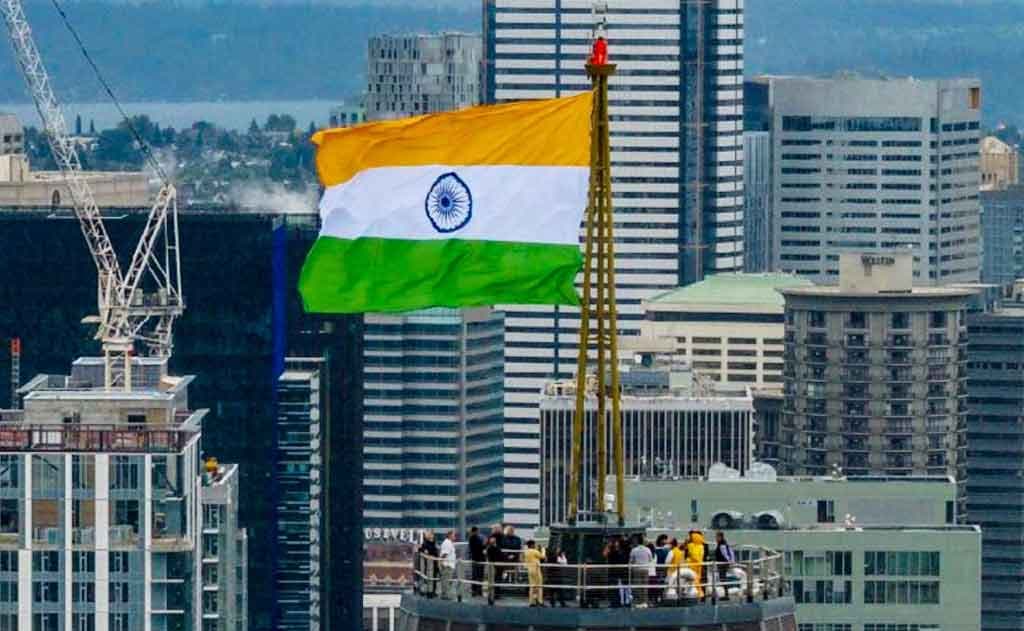
Yes, members of the Indian diaspora can generally display the Tiranga overseas at home or a community event, but two things matter: the Flag Code of India 2002 sets the standard for dignified handling, while abroad you must also respect local law and host-country flag protocol. Keep saffron on top, never let the flag touch the ground, and check your local rules before any public display.
The short answer for NRIs
For the global Indian community, Independence Day on 15 August 2026 — the 80th Independence Day, marking 79 completed years since 1947 — is a natural moment to raise the national flag. There is nothing inherently wrong with a family or community group hoisting the Tiranga abroad. What changes overseas is the legal framework: Indian flag law applies to conduct in India, and once you are on foreign soil, host-country rules and local protocol also apply. This guide explains how to display the flag respectfully anywhere in the world, and where you must pause to check local regulations.
| Quick Facts | Detail |
|---|---|
| Occasion | Independence Day 2026 — 15 August |
| Milestone | 80th Independence Day (79 completed years) |
| Day of week | Saturday (weekend advantage for diaspora events) |
| Governs conduct in India | Flag Code of India 2002; Prevention of Insults to National Honour Act 1971 |
| Governs conduct abroad | Also host-country law and local flag protocol — check locally |
| Correct orientation | Saffron at top; flag never touches the ground |
| Can NRIs display it? | Yes, respectfully — verify local public-display rules |
Which rules actually apply to you?
It helps to separate two distinct questions: how to handle the flag with dignity, and what a given country legally permits.
Indian flag law governs conduct in India
The Flag Code of India 2002 is a consolidated set of conventions and instructions on display of the national flag, and the Prevention of Insults to National Honour Act 1971 is the statute that penalises disrespect to national symbols. Both operate as Indian law within India. They express the correct manner of display — orientation, cleanliness, position of honour, dignified disposal — which is worth following anywhere as a matter of respect. But as legal instruments, their enforcement is territorial to India. You can read a plain-language explainer on our Flag Code of India rules page.
Abroad, local law and protocol also apply
When you are in the United States, Canada, the United Kingdom, the UAE, Australia, Singapore or anywhere else, you are subject to that country's laws and civic norms. Some jurisdictions regulate outdoor flag displays, flagpole permits, homeowners'-association rules, or the flying of foreign national flags on public or commercial premises. None of this is uniform, and it is not something an Indian source can state as fact for a foreign country. The safe, honest position is: check your local regulations before a public or permanent display. For a home or a private indoor community gathering, restrictions are typically minimal, but verifying beforehand is the responsible approach.
How to hoist the Tiranga respectfully anywhere
Whether you fly the flag on a balcony in Toronto, a driveway in New Jersey, a villa in Dubai or a community hall in London, the principles of dignified handling travel with you. These are drawn from the spirit of the Flag Code and are simply good practice worldwide.
- Saffron on top. When displayed flat or hoisted, the saffron band is always uppermost. On a horizontal wall mount, saffron sits at the top; if hung vertically, saffron should be to the observer's left.
- Never let it touch the ground or water. The flag should not trail on the floor, the pavement, or into water.
- Keep it clean and undamaged. A soiled, torn or faded flag should not be displayed. Use a flag in good condition.
- Position of honour. When shown with other flags, give the Tiranga a place of honour and do not fly it lower than another flag on the same pole in a way that implies subordination — but always reconcile this with any local protocol rules.
- Do not use it as drapery or clothing. Avoid using the flag as a tablecloth, seat cover, costume, or to carry objects.
- Handle with care. Hoist briskly, lower ceremoniously, and store it folded and clean.
- Dignified disposal. A flag that is damaged or no longer fit for display should be disposed of privately and respectfully, in keeping with its status as a national symbol.
Home display vs community event
The level of caution scales with visibility. A small flag inside your home, or on a table at a private family celebration, is straightforward. A large outdoor flag on a permanent pole, or a flag raised at a public park, school, hall or commercial venue, is where local permissions matter most.
| Setting | Typical consideration | Action |
|---|---|---|
| Indoor, private home | Usually unrestricted | Follow dignified-handling basics |
| Balcony / window | May involve tenancy or HOA rules | Check your lease or association |
| Permanent outdoor flagpole | May need a permit locally | Verify municipal / HOA rules |
| Public park or venue | Often needs booking or permission | Contact the venue/authority |
| Community / cultural event | May have event-permit conditions | Confirm with organisers and local authority |
Watching the Red Fort ceremony from abroad
Many families like to hoist their own flag while watching the Prime Minister's address and flag-hoisting from the Red Fort in Delhi. The official ceremony airs early morning IST on 15 August, so plan for a timezone shift — and note that in the Americas it lands on the evening of 14 August local time.
| Region (city) | Local day | Approx. local time to watch (early-morning IST event) |
|---|---|---|
| USA East (New York) | Thu 14 Aug | Late evening, 14 August |
| USA West (San Francisco) | Thu 14 Aug | Evening, 14 August |
| Canada (Toronto) | Thu 14 Aug | Late evening, 14 August |
| UK (London) | Fri 15 Aug | Early morning, 15 August |
| UAE (Dubai) | Fri 15 Aug | Early morning, 15 August |
| Singapore | Fri 15 Aug | Mid-morning, 15 August |
| Australia (Sydney) | Fri 15 Aug | Midday, 15 August |
Because these are approximate windows, confirm the exact broadcast start on the day. Our Red Fort ceremony timings worldwide page has city-by-city guidance so you can set an alarm and raise your own flag in sync.
The Saturday weekend advantage in 2026
One practical bonus this year: 15 August 2026 falls on a Saturday. For diaspora families juggling work and school schedules, a weekend date makes it far easier to gather, host a flag-hoisting at home, attend a community program, or organise a cultural evening without taking leave. If you are watching the Red Fort telecast in the Americas on Thursday evening (14 August local), you still have the full Saturday to celebrate locally.
Consulate and High-Commission events: the general pattern
Around Independence Day, Indian missions abroad — embassies, consulates and High Commissions — commonly host flag-hoisting ceremonies and cultural programs. These frequently include the reading of the President's address to the nation, patriotic performances, and community participation, and they are often held on the morning of 15 August at the mission premises or an associated venue. However, the exact events, timings, venues and organisers vary by city and are announced each year by the mission itself.
Do not rely on secondhand dates. Check your nearest Indian mission's official announcement — its website and verified social channels — for confirmed details in your city. Community associations also organise their own celebrations, so watch local diaspora networks too.
A note on the 80th vs 79th question
You will see both "80th" and "79th" used online, which causes confusion. The correct framing is that 15 August 2026 is the 80th Independence Day, and it marks 79 completed years of independence — not the "79th Independence Day," and not "80 years of independence." The count of anniversaries observed is one ahead of the number of full years elapsed, because the very first Independence Day in 1947 was itself an observance. We break the arithmetic down on our 80th or 79th Independence Day 2026 explainer.
Being a good guest and a proud citizen
For the diaspora, respectful flag display is really about holding two things together: honouring the Tiranga in the manner set out by the Flag Code, and honouring the laws and civic customs of your host country. There is no conflict between the two when you approach both with care — fly the flag cleanly and with dignity, verify local rules for anything public or permanent, and let your celebration reflect well on the community. For a broader planning checklist, see our Independence Day 2026 NRI guide, the main Independence Day 2026 hub, and the Independence Day 2026 USA resource for community events in the United States.
Related reading
- Independence Day 2026 — main hub
- 80th or 79th Independence Day 2026?
- Flag Code of India rules explained
- Independence Day 2026 NRI guide
- Red Fort ceremony timings worldwide
- Independence Day 2026 USA
Related NRI Globe Coverage
- Hoisting vs Unfurling: Independence Day and Republic Day Flag Ceremonies
- How to Hoist the National Flag at Home Correctly
- The Indian National Flag: History, Design and the Meaning of Every Element
- Pingali Venkayya: The Man Who Designed India's National Flag
- Teaching Your Children About Independence Day When They Were Born Abroad
- How to Dispose of a Damaged National Flag Respectfully
- Flag Code of India: Complete Rules for Displaying the Tiranga
- Indian Driving Rules vs International Driving Rules: 7 Common Mistakes Indian Drivers Make Abroad
Fresh from NRI Globe
- YouTuber Nandu's World (Rama Nandana) UK Visa & Job Fraud Case: Full Details + Key Lessons for NRIs (2026)
- Dussehra / Vijayadashami 2026 Events Country-Wise — Global NRI Directory (Ram Lila, Ravana Dahan, Durga Puja Pandals, Ayudha Puja Venues + Booking)
- Diwali 2026 Events Country-Wise — Global NRI Directory (White House, Leicester, London Trafalgar, Toronto, Auckland, Sydney Parramasala, Fiji, Mauritius, Trinidad, South Africa and More)
- Diwali / Deepavali 2026 Country-Wise NRI Celebrations — Complete Global Guide (USA, UK, Canada, Australia, Fiji, Mauritius, Trinidad, South Africa, UAE and 30+ Countries)