
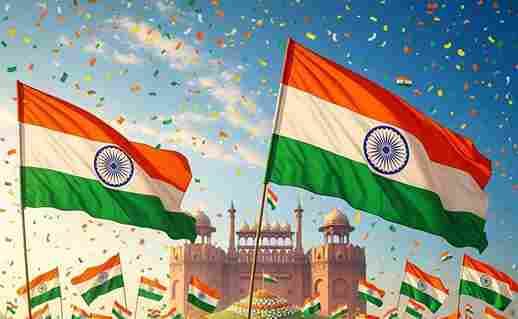
If your child was born outside India, you can teach them about Independence Day through simple stories, symbols and shared activities rather than dates alone. Explain that on 15 August 1947 India became free, watch the Red Fort ceremony together, learn what the flag's colours mean, and cook tricolour food — framing India as one of the two homes your family proudly belongs to.
Why this matters for children born abroad
For a child growing up in New Jersey, Toronto, London, Sydney or Dubai, India can feel like a place on a video call — grandparents' faces, a language half-understood, festivals that arrive when their classmates are at school. Independence Day is one of the clearest, most joyful entry points into that heritage. It has a story, colours, a song, and a shared moment the whole global family can watch at the same time.
The goal is not to make your child "more Indian" or "less" of wherever they were born. It is to give them a confident dual identity: proud of their Indian roots and at home in the country on their passport. Handled warmly, 15 August becomes a family tradition they will one day pass to their own children.
Quick facts for parents
| Detail | Information |
|---|---|
| Date in 2026 | Saturday, 15 August 2026 |
| What is being marked | The 80th Independence Day, completing 79 years of freedom |
| Original independence | 15 August 1947 |
| National flag | The Tiranga — saffron, white and green with the navy-blue Ashoka Chakra |
| Main ceremony | Flag-hoisting and address at the Red Fort, Delhi, early morning IST |
| Best age to start | From about age 3-4 with stories and colours; deeper history from age 9-10 |
| 2026 theme | Announced closer to the day; not confirmed yet |
Getting the number right — the 80th, not the 79th
This is a lovely teaching moment, because children love a puzzle. In 2026 India observes its 80th Independence Day, and this marks 79 completed years of freedom since 1947. It is easy to slip and say "79th" or "80 years of independence" — but neither is correct. Think of a birthday: on a child's first birthday they have completed one year and are entering their second. In the same way, the very first Independence Day was in 1947, so counting up to 2026 gives the 80th observance and 79 finished years.
If your child asks why the numbers differ, walk through it slowly with a birthday example — it turns a common confusion into a moment of understanding. For a fuller explanation you can read together, see our dedicated piece on whether it is the 80th or 79th Independence Day in 2026.
Age-appropriate ways to tell the story of 1947
Match the depth of the story to your child's age. You do not need to cover everything at once — the tradition grows with them year after year.
Ages 3-6: colours, flag and celebration
- Keep it simple and happy: "A long time ago, India became free to make its own choices, and every year we celebrate on 15 August."
- Focus on the flag's colours and let them wave a small paper flag.
- Sing along to the national anthem or a patriotic song — young children absorb melody and mood long before facts.
- Show them the Red Fort ceremony on screen: crowds, uniforms, the flag going up. Wonder is the lesson at this age.
Ages 7-10: the freedom struggle as a story
- Explain that India was once ruled by another country and that many people — of all faiths and regions — worked for many years so India could govern itself.
- Introduce a few figures gently and factually, keeping the focus on courage and non-violence rather than any single hero.
- Use a world map: show where India is, where you live now, and that both are "home."
- Read an age-appropriate picture book about 1947 together.
Ages 11 and up: history, symbols and questions
- Older children can handle real dates, names and the idea that freedom was hard-won over decades.
- Encourage questions — including hard ones about Partition (see below).
- Connect it to their own life: citizenship, identity, and what it means to belong to two cultures.
- Let them watch the full Red Fort address and discuss it afterwards, keeping the conversation neutral and non-political.
What the flag means — a family lesson
The Tiranga ("three colours") is the easiest symbol for children to grasp, and each part carries meaning worth explaining slowly.
| Part of the flag | Simple meaning for children |
|---|---|
| Saffron (top) | Courage and sacrifice — being brave and doing what is right |
| White (middle) | Peace and honesty |
| Green (bottom) | Growth, nature and hope for the future |
| Ashoka Chakra (navy-blue wheel) | A 24-spoke wheel meaning that we should keep moving forward and never stand still |
Let older children count the 24 spokes of the Chakra — it makes the symbol real and memorable. When you handle a flag at home, use it as a chance to teach respect: the flag is never used as a tablecloth, costume or wrapping, and it is treated with care. Because rules around the flag differ by country, this is also a good moment to explain that symbols deserve respect everywhere. You can read the details in our overview of the Flag Code of India rules.
Watch the Red Fort ceremony together — but mind the clock
The flag-hoisting and address at the Red Fort take place in the early morning in India on 15 August. Because of time-zone differences, that airs at very different local times around the world — and in the Americas it lands the evening before, on 14 August. Plan the viewing so the whole family can gather.
| Region | Approx. local time to watch (live) | Local date |
|---|---|---|
| India (IST) | Early morning | Sat 15 Aug 2026 |
| UAE / Gulf | Very early morning | Sat 15 Aug 2026 |
| UK (BST) | Early morning | Sat 15 Aug 2026 |
| US East Coast (EDT) | Late evening | Fri 14 Aug 2026 |
| US West Coast (PDT) | Late evening | Fri 14 Aug 2026 |
| Canada (Toronto, EDT) | Late evening | Fri 14 Aug 2026 |
| Australia (Sydney, AEST) | Mid-to-late morning | Sat 15 Aug 2026 |
Families in the USA and Canada should note that the live ceremony effectively becomes a Friday-evening event for them — an easy, kid-friendly time to gather. For exact local start times where you live, check our regularly updated guide to Red Fort ceremony timings worldwide. And there is good news for 2026: 15 August falls on a Saturday, so many families get a full weekend to celebrate without school or work getting in the way.
Simple activities the whole family can do
Children remember what they do far more than what they are told. Choose one or two of these each year and let them become your family's traditions.
- A small home flag-hoisting, done respectfully. A modest paper or cloth flag raised on the balcony or in the living room, with the anthem playing, gives children a sense of occasion. Teach them to handle it with care and to fold it neatly afterwards.
- Cook tricolour food together. Saffron, white and green are easy on a plate — think jalebi or carrot halwa, coconut or rice, and mint chutney or green fruit. Younger children love arranging a tricolour fruit platter or layered dessert.
- Craft the flag. Colouring sheets, paper-plate Ashoka Chakras, or a hand-drawn Tiranga are perfect for little ones.
- Video-call the grandparents. Let elders in India tell their own memories — this is priceless first-hand heritage your child cannot get anywhere else.
- Read a story or watch a child-friendly documentary. Choose age-appropriate, factual material about 1947.
- Learn a few words. "Jai Hind," the flag colours in your mother tongue, or a line of the anthem builds a small, joyful bridge to language.
These same ideas scale up beautifully for a group. If you are hosting or joining a larger gathering, our Independence Day 2026 NRI guide has more on organising family-friendly celebrations abroad.
Talking about Partition — gently, and only when they are ready
Older children will eventually learn that 1947 brought both freedom and the pain of Partition. This is a sensitive subject, and it deserves honesty without frightening detail.
- Wait until around ages 11-12, and follow your child's questions rather than front-loading the topic.
- Explain simply that when the country became free, it was also divided, and that many families had to leave their homes — a very hard and sad time for people on all sides.
- Keep the tone compassionate and neutral. This is a moment to teach empathy, not to assign blame to any community, region or faith.
- If your own family carries Partition stories, share them at an age-appropriate level — personal history makes it real and human.
- Reassure your child that Independence Day honours the freedom that was won, while also remembering the people who suffered.
Local celebrations and the events around you
Beyond the home, Indian diaspora communities abroad often mark 15 August with cultural programmes, and Indian diplomatic missions typically hold their own observances around the day. As a general pattern, embassies, consulates and High Commissions may host a flag-hoisting and community gathering, and local associations, temples and cultural groups sometimes organise events too. Details vary from city to city, so check your nearest Indian mission's official announcement and local community channels for confirmed dates, timings and venues rather than assuming a fixed schedule.
A word on respect and law: the Flag Code of India 2002 and the Prevention of Insults to National Honour Act, 1971 govern flag conduct within India. When celebrating abroad, families should also follow local laws and host-country protocol, which can differ from Indian rules. The simplest lesson to pass to children is universal — treat national symbols, both India's and your host country's, with dignity.
Celebrating dual belonging
The most valuable thing you can give a child born abroad is the message that they do not have to choose. They can love the country they were born in and cherish their Indian heritage at the same time. Independence Day, celebrated warmly each year, becomes proof of that — a day when the Tiranga and the flag of their home country can stand side by side on the table without contradiction.
For families in the United States, our Independence Day 2026 USA hub gathers viewing tips and community ideas in one place, and the full Independence Day 2026 pillar guide covers everything from history to celebrations worldwide.
Related reading
- Independence Day 2026: the complete guide
- Is it the 80th or 79th Independence Day in 2026?
- Independence Day 2026: the NRI guide
- Red Fort ceremony timings worldwide
- Flag Code of India rules explained
- Independence Day 2026 in the USA
Continue reading — NRI Globe pillar guide: UK Skilled Worker Visa for Indians
Related NRI Globe Coverage
- Independence Day vs Republic Day: 12 Differences Explained
- How to Explain Independence Day to Children (Age by Age)
- Independence Day 2026 for NRIs: USA, UK, Canada, Australia, UAE, Europe and Singapore Guide
- Independence Day Speech for Kids: Simple Speeches for Ages 4 to 10
- Independence Day Fancy Dress Ideas for Kids
- Short Independence Day Speech: 1-Minute and 2-Minute Versions
- Why Is India's Independence Day on 15 August? The Reason Behind the Date
- Celebrating Independence Day 8,000 Miles From Home
Fresh from NRI Globe
- YouTuber Nandu's World (Rama Nandana) UK Visa & Job Fraud Case: Full Details + Key Lessons for NRIs (2026)
- Dussehra / Vijayadashami 2026 Events Country-Wise — Global NRI Directory (Ram Lila, Ravana Dahan, Durga Puja Pandals, Ayudha Puja Venues + Booking)
- Diwali 2026 Events Country-Wise — Global NRI Directory (White House, Leicester, London Trafalgar, Toronto, Auckland, Sydney Parramasala, Fiji, Mauritius, Trinidad, South Africa and More)
- Diwali / Deepavali 2026 Country-Wise NRI Celebrations — Complete Global Guide (USA, UK, Canada, Australia, Fiji, Mauritius, Trinidad, South Africa, UAE and 30+ Countries)