
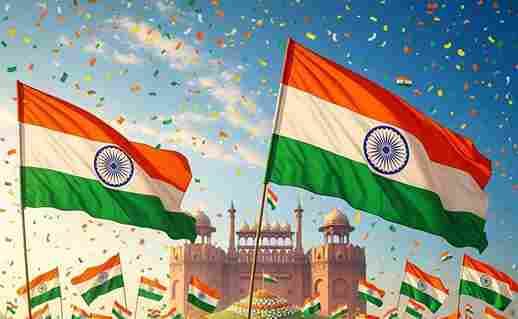
India's Independence Day falls on 15 August because that is the date on which the transfer of power from British rule took effect under the Indian Independence Act 1947. The date was selected by the last Viceroy, Lord Mountbatten, who is widely reported to have advanced the earlier plan for a transfer in June 1948 to August 1947.
Every year the question returns: why 15 August, and not some other day? The short answer lies in a single administrative decision made in the summer of 1947. The longer answer involves a wartime anniversary, a compressed political timetable, and a legal act of the British Parliament that fixed the date for two new nations at once. This article sets out what is documented, what is commonly attributed, and where historians differ.
The short answer: a date set by the Indian Independence Act 1947
The formal, legal reason is straightforward. The Indian Independence Act 1947, passed by the British Parliament in July 1947, provided for the creation of two independent dominions and named 15 August 1947 as the "appointed day" from which they would come into existence. From that date, British authority over the territory formally ended and the new dominions assumed responsibility for their own governance.
That is why India commemorates 15 August each year. In 2026 the country will observe Independence Day again on that date. For a full overview of the anniversary and its programme, see the Independence Day 2026 pillar guide.
Mountbatten and the advanced timetable
When Lord Mountbatten arrived in India as Viceroy in early 1947, the prevailing plan inherited from London envisaged a transfer of power by June 1948. Amid rising political tension, Mountbatten decided to bring the timetable forward substantially, settling on August 1947.
This compression of the schedule is one of the most discussed features of the period. Historians have noted that the accelerated timetable left little time to finalise administrative arrangements, including the drawing of the new boundaries, which was completed only shortly around the date of independence. Scholarly assessments of the decision range widely: some accounts describe the speed as a pragmatic response to deteriorating conditions, while others argue it added to the difficulties of the transition. These are matters of ongoing historical interpretation rather than settled fact, and readers should treat them as a range of views.
What is documented and what is attributed
- Documented: The plan for an early transfer was announced in mid-1947, and the Indian Independence Act named 15 August 1947 as the appointed day.
- Documented: The original working horizon had been June 1948, later advanced to August 1947.
- Popularly attributed: Mountbatten's personal reasoning for the specific choice of 15 August is often recounted in memoirs and later interviews; such recollections should be read as attributed accounts rather than contemporaneous record.
The Second World War association
One reason the 15 August date carries additional significance is its association with the end of the Second World War in Asia. 15 August 1945 is the date on which the Japanese surrender was announced (in some time zones), effectively ending the war in the Pacific. Mountbatten had served as Supreme Allied Commander of the South East Asia Command during the war, and 15 August 1945 marked a milestone in that theatre.
It has frequently been reported that the anniversary of that wartime date influenced the choice of 15 August for the transfer of power in India. This connection is popularly attributed and appears in numerous accounts of Mountbatten's reasoning. It is best presented as a widely cited explanation rather than as an independently verifiable cause, since the underlying decision was formalised through the legislative process described above.
Why does Pakistan observe 14 August?
A common point of confusion is that Pakistan marks its Independence Day on 14 August, while India marks it on 15 August, even though both emerged from the same Act on the same appointed day.
The facts here are administrative rather than a matter of dispute. Under the Indian Independence Act 1947, both dominions came into being on the appointed day of 15 August 1947. The transfer-of-power ceremonies, however, were staggered. Mountbatten attended the ceremony in Karachi first and then travelled to attend the ceremony in Delhi. Because the Karachi handover took place on 14 August 1947, Pakistan came to commemorate its Independence Day on that date, while India commemorates 15 August.
Several explanations are offered in different accounts for Pakistan's choice of the 14th, including the sequencing of the ceremonies and calendar considerations. These are reported here as a matter of record. The essential point is factual: the two commemorative dates differ by a day because of how and when the respective ceremonies were conducted, not because the countries became independent on different appointed days.
Timeline: how the date came to be fixed
| Date | Event |
|---|---|
| 15 August 1945 | Announcement of the Japanese surrender ending WWII in the Pacific (in some time zones); Mountbatten had led the South East Asia Command. |
| Early 1947 | Mountbatten takes office as Viceroy; the inherited plan envisages a transfer by June 1948. |
| Mid-1947 | Plan announced to advance the transfer of power to August 1947. |
| July 1947 | The Indian Independence Act 1947 is passed, naming 15 August 1947 as the appointed day. |
| 14 August 1947 | Transfer-of-power ceremony held in Karachi. |
| 15 August 1947 | Transfer-of-power ceremony held in Delhi; the appointed day takes effect. |
For a broader chronology of events leading up to 1947, see the India freedom-struggle timeline, which places the transfer of power within the longer arc of the independence movement, including the contributions of the women freedom fighters of India.
The midnight ceremony and the address to the nation
India's transfer of power is closely associated with the session of the Constituent Assembly held on the night of 14–15 August 1947. The address delivered on that occasion is remembered by the phrase "Tryst with Destiny," which is popularly attributed to that speech and is quoted here only briefly and with attribution. The moment of transition is conventionally placed at the stroke of midnight as 14 August turned into 15 August.
Because the appointed day was 15 August, the first official flag-hoisting and the formal ceremonies of the new dominion are dated to that day. If you are interested in the protocol of the ceremony itself, note the distinction between hoisting and unfurling explained in our guide to hoisting versus unfurling the national flag.
The 80th versus 79th question in 2026
A related point often raised alongside the "why 15 August" question is how to count the anniversary correctly. In 2026, 15 August marks the 80th Independence Day, because it is the eightieth time the day is being observed since 1947. At the same time, the country will have completed 79 years of independence, since 15 August 2026 falls one day short of the 80th full year.
In short: it is accurate to say the 80th Independence Day and to say 79 completed years of independence. It is not accurate to describe 2026 as the "79th Independence Day" or as marking "80 years of independence." The distinction is explained in detail on our dedicated page on whether 2026 is the 80th or 79th Independence Day. As for the 2026 official theme, it has not been confirmed at the time of writing; the 2025 theme "Naya Bharat" is mentioned here only as context and should not be assumed to carry over.
How the date is observed today
Regardless of the historical debates surrounding the choice of date, 15 August is a national holiday across India, marked by the flag-hoisting at the Red Fort, ceremonies in schools, offices and public institutions, and observances by the Indian diaspora abroad. Anyone displaying the national flag should follow the official protocol.
- Review the rules before hoisting: see the Flag Code of India for the do's and don'ts.
- Understand the correct method for the day, covered in hoisting versus unfurling.
- Dispose of any damaged or soiled flag respectfully, following the guide on how to dispose of the national flag.
Indians living overseas frequently organise their own observances; our Independence Day 2026 NRI guide covers participation from abroad, including timing across time zones and community events.
Summary
India's Independence Day is on 15 August because the Indian Independence Act 1947 named that date as the appointed day for the transfer of power, following Lord Mountbatten's decision to advance the earlier June 1948 plan. The date's association with the WWII wartime anniversary of 15 August 1945 is a widely cited but attributed explanation. Pakistan observes 14 August owing to the sequencing of the transfer-of-power ceremonies, with both nations having come into being under the same Act. In 2026, the day is correctly described as the 80th Independence Day, marking 79 completed years.
Related reading
- Independence Day 2026: the complete guide
- Is 2026 the 80th or 79th Independence Day?
- India's freedom-struggle timeline
- The Flag Code of India explained
- Independence Day 2026 NRI guide
Related NRI Globe Coverage
- Independence Day vs Republic Day: 12 Differences Explained
- Independence Day 2026 for NRIs: USA, UK, Canada, Australia, UAE, Europe and Singapore Guide
- Independence Day Speech for Kids: Simple Speeches for Ages 4 to 10
- Independence Day Fancy Dress Ideas for Kids
- Short Independence Day Speech: 1-Minute and 2-Minute Versions
- Celebrating Independence Day 8,000 Miles From Home
- Independence Day 2026 Theme, Red Fort Ceremony and What to Expect
- Independence Day 2026 Is on a Saturday: What That Means for Schools, Offices and Families
Fresh from NRI Globe
- YouTuber Nandu's World (Rama Nandana) UK Visa & Job Fraud Case: Full Details + Key Lessons for NRIs (2026)
- Dussehra / Vijayadashami 2026 Events Country-Wise — Global NRI Directory (Ram Lila, Ravana Dahan, Durga Puja Pandals, Ayudha Puja Venues + Booking)
- Diwali 2026 Events Country-Wise — Global NRI Directory (White House, Leicester, London Trafalgar, Toronto, Auckland, Sydney Parramasala, Fiji, Mauritius, Trinidad, South Africa and More)
- Diwali / Deepavali 2026 Country-Wise NRI Celebrations — Complete Global Guide (USA, UK, Canada, Australia, Fiji, Mauritius, Trinidad, South Africa, UAE and 30+ Countries)