
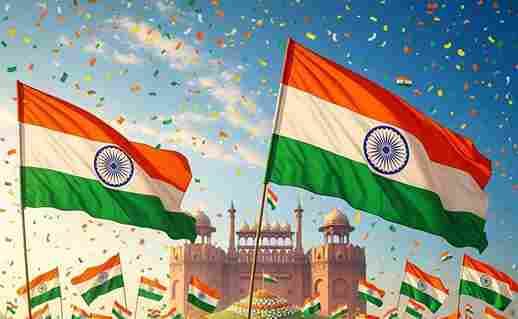
Independence Day 2026 falls on Saturday, 15 August 2026. It is a gazetted national holiday, so government and most private offices close, while schools and colleges generally hold their flag-hoisting function on the day itself. In India a Saturday often overlaps an existing weekend, so there is usually no long weekend; abroad, the weekend date is ideal for community events.
First, the number: it is the 80th Independence Day
Before planning anything, it helps to get the label right. 15 August 2026 marks the 80th Independence Day of India, which is the same as 79 completed years of independence since 15 August 1947. The two figures often get confused because both are correct in different senses: 2026 is the eightieth occasion the day is observed, while the country will have completed seventy-nine years since the transfer of power.
We explain the maths in detail on our dedicated page on the 80th vs 79th Independence Day question, and the broader context sits in our Independence Day 2026 guide. For families writing speeches, school notices or social posts, the safe phrasing is: "the 80th Independence Day, marking 79 years of freedom."
What a Saturday date means at a glance
Because 15 August is a fixed calendar date, the day of the week shifts each year. In 2026 it lands on a Saturday. Here is a quick summary of what that typically means for the main groups of people, followed by the details.
| Setting | What usually happens on Saturday 15 Aug 2026 |
|---|---|
| Schools and colleges | Flag-hoisting function and cultural programme usually held on the day, even though it is a holiday from regular classes |
| Government offices | Closed; official flag-hoisting ceremonies held at government buildings and public grounds |
| Private offices in India | Closed for the gazetted holiday; many already keep alternate or full Saturdays off, so little schedule change |
| Banks | Closed for the national holiday |
| Long weekend in India | Often none, because Saturday and Sunday are already non-working for many |
| NRI community abroad | Weekend date is convenient; consulate and association events cluster on the day or the surrounding weekend |
Schools: the function usually goes ahead
Independence Day is a holiday from normal teaching, but the flag-hoisting ceremony is a long-standing part of the school calendar and is typically conducted on 15 August itself, whichever day of the week it falls on. A Saturday date changes little here, since many schools that run a six-day week already treat the second Saturday or all Saturdays differently, and the ceremony is a special event rather than a class day.
What parents can generally expect:
- A short flag-hoisting ceremony, usually in the morning, followed by the national anthem.
- Cultural items such as patriotic songs, speeches, drills or skits by students.
- Distribution of sweets in many schools, and sometimes small paper flags for younger children.
- An early dismissal, with attendance for the function often expected even though it is a holiday.
Timings and whether attendance is compulsory vary by school and board, so the school's own circular is the authority. If your child is taking part in a speech or performance, our freedom-struggle timeline is a useful, neutral reference for dates and milestones, and our profiles of women freedom fighters of India add names that are often left out of standard scripts.
Offices and workplaces
15 August is a gazetted holiday under the national holidays observed across the country, so central and state government offices, courts, public-sector undertakings and banks are closed. Most private employers also observe it as a paid holiday. Because it is one of the three national holidays, it is commonly a mandatory closure rather than an optional restricted holiday.
The Saturday timing has a practical consequence in India: for the many employees who already have Saturday off, or an alternate-Saturday arrangement, the national holiday coincides with a non-working day, so it does not add an extra day away from work. Essential services such as hospitals, emergency response, transport and some retail continue to operate on rosters, as they do on any public holiday.
Is there a long weekend in India?
For a long weekend you generally need the holiday to sit next to a working day it can bridge. In 2026, 15 August is a Saturday and 16 August is a Sunday, so for most five-day-week workers the holiday is absorbed into the usual weekend rather than extending it. Those on a six-day week may effectively gain the Saturday. There is no automatic bridge day, so plans for travel or family gatherings are best made around the normal weekend rather than an official long break.
The diaspora angle: a Saturday is ideal abroad
For Indians living overseas, a weekend Independence Day is genuinely convenient, and this is where the 2026 date works in the community's favour. On a normal weekday, working professionals, students and families often cannot attend daytime flag-hoisting or cultural events. A Saturday removes that clash, so turnout at consulate ceremonies, temple and community-hall functions and cultural-association programmes tends to be higher.
What NRIs and Indian-origin communities can typically expect around 15 August 2026 abroad:
- Consulate and embassy ceremonies: Indian missions usually hold a flag-hoisting on the morning of 15 August, often open to the community. Check your local mission's notice for timing and any registration requirement.
- Community and association events: Regional and cultural associations schedule cultural evenings, food stalls and children's performances, frequently on the Saturday or across the weekend.
- Temple and gurudwara programmes: Many places of worship mark the day with a short observance that families can join after morning duties.
- School and youth activities: Weekend Indian-language and heritage schools abroad often run special sessions.
Because the day itself is free for most, it is also easier to organise a home celebration, a video call with family in India, or a small neighbourhood gathering. For a fuller planning checklist tailored to families overseas, see our Independence Day 2026 NRI guide.
A note on flag etiquette
Displaying the national flag at home or at a community event is welcomed, and the rules are the same wherever you are. The Flag Code of India sets out how the flag should be handled, and it is worth knowing the distinction between hoisting and unfurling the flag, since Independence Day involves hoisting a folded flag that is then released, unlike Republic Day. After the event, paper and cloth flags should not be discarded casually; our note on how to dispose of the national flag explains the dignified way to do it.
Planning tips for families
Whether you are in India or abroad, a weekend date makes it easier to build the day around both the ceremony and family time. A few practical pointers:
- Confirm timings early: School and consulate ceremonies are usually in the morning; check the exact time and whether attendance or registration is needed.
- Plan travel around the normal weekend: In India, do not assume an extra day off; book around Saturday and Sunday.
- Prepare speeches with sourced facts: Use the correct "80th Independence Day" label and verify dates from a reliable timeline.
- Handle flags with care: Follow the Flag Code and dispose of small flags respectfully afterwards.
- For NRIs, coordinate across time zones: A Saturday makes it simpler to join a live call with relatives in India during their evening.
Historical context, briefly and neutrally
India became independent at midnight on 15 August 1947, an event marked in Parliament by the "Tryst with Destiny" address (popularly attributed to Jawaharlal Nehru). The date also coincided with the Partition of the subcontinent, a period that caused large-scale displacement and hardship for millions of families across communities; historians continue to study its causes and consequences from a range of scholarly perspectives. Pakistan observes its own independence on 14 August, a difference tied to the sequence of the transfer-of-power ceremonies. In 2025 the official commemoration used the theme "Naya Bharat"; no theme for 2026 has been confirmed at the time of writing, so treat any circulating theme as unofficial until announced. For a factual sequence of events leading to 1947, see our freedom-struggle timeline.
Related reading
- Independence Day 2026: complete guide
- Is it the 80th or 79th Independence Day in 2026?
- Independence Day 2026 NRI guide
- Flag Code of India: rules explained
- Hoisting vs unfurling the flag
- Women freedom fighters of India
Related NRI Globe Coverage
- Independence Day vs Republic Day: 12 Differences Explained
- Independence Day 2026 for NRIs: USA, UK, Canada, Australia, UAE, Europe and Singapore Guide
- Independence Day Speech for Kids: Simple Speeches for Ages 4 to 10
- Independence Day Fancy Dress Ideas for Kids
- Short Independence Day Speech: 1-Minute and 2-Minute Versions
- Why Is India's Independence Day on 15 August? The Reason Behind the Date
- Celebrating Independence Day 8,000 Miles From Home
- Independence Day 2026 Theme, Red Fort Ceremony and What to Expect
Fresh from NRI Globe
- YouTuber Nandu's World (Rama Nandana) UK Visa & Job Fraud Case: Full Details + Key Lessons for NRIs (2026)
- Dussehra / Vijayadashami 2026 Events Country-Wise — Global NRI Directory (Ram Lila, Ravana Dahan, Durga Puja Pandals, Ayudha Puja Venues + Booking)
- Diwali 2026 Events Country-Wise — Global NRI Directory (White House, Leicester, London Trafalgar, Toronto, Auckland, Sydney Parramasala, Fiji, Mauritius, Trinidad, South Africa and More)
- Diwali / Deepavali 2026 Country-Wise NRI Celebrations — Complete Global Guide (USA, UK, Canada, Australia, Fiji, Mauritius, Trinidad, South Africa, UAE and 30+ Countries)