
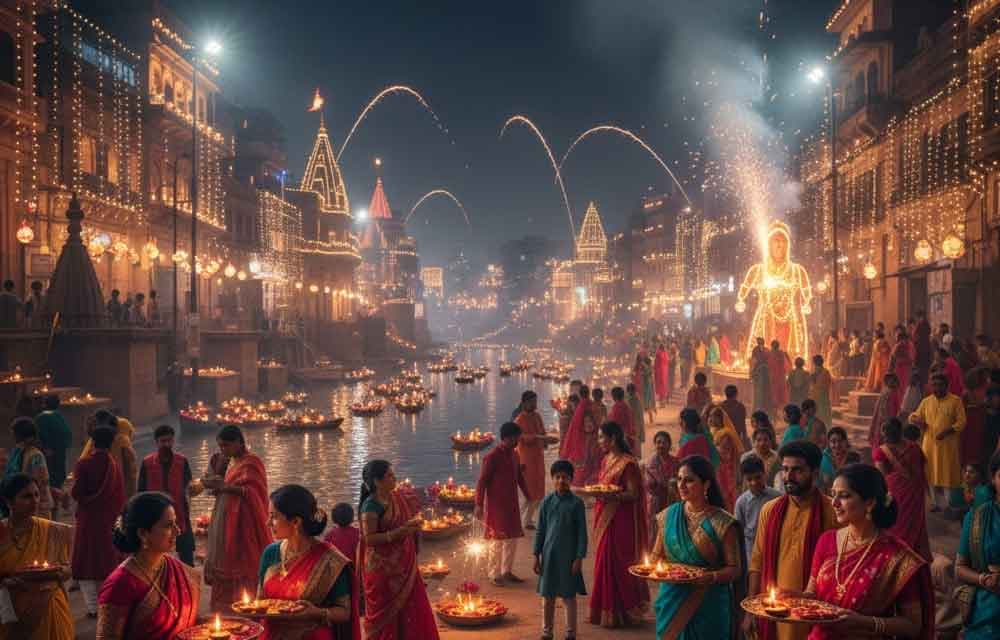
Celebrating Independence Day far from home means watching the Red Fort ceremony at dawn or midnight, hoisting a small flag on a balcony, and explaining to children why 15 August matters. In 2026 the day is India's 80th Independence Day, marking 79 completed years since 1947 — and for the diaspora, it is quietly celebrated across time zones worldwide.
The Odd Hour When 15 August Arrives
In India, Independence Day begins with the Prime Minister's address from the ramparts of the Red Fort, usually just after the flag is unfurled around 7:30 a.m. IST. For the diaspora, that same moment lands at very different points on the clock — and often on a very different date's edge.
A family in New Jersey might set an alarm for the small hours to stream the ceremony live. In London, it arrives before the workday. In Sydney or Auckland, it may already be afternoon. The physical distance — often 8,000 miles or more — becomes a felt thing precisely at this hour, when you are awake for something happening on the other side of the planet.
| Location | Approx. distance from Delhi | Local time when Red Fort ceremony begins (~7:30 a.m. IST) |
|---|---|---|
| London, UK | ~4,180 miles | Early morning (~3:00 a.m. BST) |
| Dubai, UAE | ~1,380 miles | Early morning (~6:00 a.m. GST) |
| New York, USA | ~7,300 miles | Late night before (~10:00 p.m. EDT) |
| San Francisco, USA | ~7,700 miles | Late evening before (~7:00 p.m. PDT) |
| Sydney, Australia | ~6,500 miles | Around noon (~12:00 p.m. AEST) |
Times are approximate and shift with daylight-saving changes; confirm your own local conversion before the day.
Two Homes, One Morning
For many Indians abroad, the day carries a dual identity. You may hold — or be building a life toward — the passport of one country while your earliest memories of the Tricolour belong to another. The morning of 15 August tends to hold both truths at once: gratitude for the place that now shapes your daily life, and a pull toward the country whose freedom the day commemorates.
This is not a contradiction so much as a layering. A child raised in Toronto or Singapore can sing the anthem of their birthplace and still feel their chest tighten when they hear Jana Gana Mana. Belonging, for the diaspora, is rarely a single address.
Small Celebrations, Real Meaning
Far from the parade grounds, celebrations tend to be intimate — and no less heartfelt for their scale. Common ways families mark the day include:
- A dawn or late-night stream of the Red Fort ceremony, sometimes with coffee and a few relatives on a video call from India.
- A small flag on the balcony, door or desk — displayed with care rather than as decoration.
- Cooking something from home: khichdi, biryani, or regional sweets that carry a grandmother's recipe across an ocean.
- A community gathering at a local Indian association, temple, gurudwara or cultural centre, often with a flag ceremony and children's performances.
- Wearing tricolour or traditional dress to work or a get-together, a quiet way of saying this is where I come from.
If you plan to display the national flag abroad, it is worth knowing that the Flag Code of India sets out how the Tricolour should be handled with dignity — and that the terms for the day itself have a specific meaning, as explained in our guide to hoisting versus unfurling the flag. When a paper or cloth flag has served its purpose, our note on how to dispose of the national flag respectfully is a useful reference.
Teaching Children Who Have Never Lived There
One of the tender challenges of the diaspora is passing on a story your children may know only through you. A child born abroad has never queued for a school flag-hoisting in India, never watched a neighbourhood parade, never been handed a paper flag at a bus stop on 15 August.
Parents bridge that gap in small ways: reading the story of the freedom struggle aloud, showing photographs, or walking through our India freedom struggle timeline together. Introducing the many people who shaped that struggle — including the often under-told stories of women freedom fighters of India — turns an abstract date into a set of human lives.
Historians hold a range of views on how independence was ultimately achieved — the relative weight of mass movements, negotiation, wartime pressures and global change is debated among scholars. Presenting it as a story with many contributors, rather than a single simple narrative, tends to help children hold it thoughtfully.
Getting the Number Right: 80th Day, 79 Years
A small point of accuracy travels well across borders. In 2026, India observes its 80th Independence Day, which marks 79 completed years of independence since 15 August 1947. It is not correct to call it the "79th Independence Day," and it is not "80 years of independence." Counting the first Independence Day in 1947 as number one, 2026 is the 80th observance. We explain the arithmetic in detail in our piece on whether it is the 80th or 79th Independence Day in 2026 — a handy link to share when the question comes up at a family gathering abroad.
| Question | Answer |
|---|---|
| Which Independence Day is 15 August 2026? | The 80th |
| How many years of freedom does it mark? | 79 completed years |
| First Independence Day | 15 August 1947 (counted as the 1st) |
A Word on Partition and Shared Dates
The 1947 transfer of power created two independent nations, and Pakistan observes its Independence Day on 14 August while India observes 15 August. Partition was, for millions of families on all sides, a period of upheaval, migration and loss. Among diaspora communities today — often living side by side in the same cities abroad — the date is frequently remembered with reflection as much as celebration. We treat it here as a matter of historical record, without any communal framing.
The Speech, the Symbols, the Feeling
Each year the Prime Minister addresses the nation from the Red Fort, and successive addresses have carried different emphases and slogans; the 2025 observance, for instance, was framed around a "Naya Bharat" (New India) theme. No official theme for 2026 has been confirmed at the time of writing, so it is best to wait for verified announcements rather than assume one.
Whatever the year's framing, the symbols endure: the Tricolour, the anthem, and the words spoken at the very first Independence Day. Jawaharlal Nehru's phrase from the eve of independence — "Tryst with Destiny," from a speech popularly attributed to him and delivered on 14–15 August 1947 — still surfaces in diaspora WhatsApp groups every August, a line small enough to carry across any distance.
Making the Day Your Own, Wherever You Are
There is no single correct way to mark Independence Day far from home. Some prefer the quiet of a solo dawn stream; others want the noise of a community hall full of children in tricolour. A few practical ideas that travel well:
- Plan the time zone. Convert the Red Fort ceremony to your local clock a day ahead so you don't miss the live broadcast.
- Involve the next generation. Give children a small task — reading a name, drawing the flag, learning one line of the anthem.
- Cook one thing from home. A single familiar dish can anchor the whole day.
- Connect across the ocean. A short video call to family in India, timed to their morning, closes the 8,000-mile gap for a few minutes.
- Share responsibly. If you post online, get the number right — the 80th day, 79 years — and keep the tone about heritage, not politics.
For a fuller checklist tailored to families abroad, our Independence Day 2026 NRI guide gathers timings, etiquette and celebration ideas in one place, and the main Independence Day 2026 hub keeps the season's coverage together.
Belonging to Two Countries
Distance does not dilute meaning; it changes its texture. For the diaspora, 15 August is less a public spectacle and more a private morning — a flag on a windowsill, a child's first attempt at the anthem, a parent's memory of school parades relayed across a kitchen table thousands of miles from where those parades once took place.
To belong to two countries is to keep two mornings in your chest at once. On Independence Day, far from home, that is not a burden but a kind of wealth — one that the diaspora carries, and passes on, wherever in the world it happens to wake up.
Related reading
- Independence Day 2026 — full coverage hub
- Is it the 80th or 79th Independence Day in 2026?
- Independence Day 2026: NRI guide
- Flag Code of India: rules for displaying the Tricolour
- India's freedom struggle timeline
- Women freedom fighters of India
Related NRI Globe Coverage
- Independence Day vs Republic Day: 12 Differences Explained
- Independence Day 2026 for NRIs: USA, UK, Canada, Australia, UAE, Europe and Singapore Guide
- Independence Day Speech for Kids: Simple Speeches for Ages 4 to 10
- Independence Day Fancy Dress Ideas for Kids
- Short Independence Day Speech: 1-Minute and 2-Minute Versions
- Why Is India's Independence Day on 15 August? The Reason Behind the Date
- Independence Day 2026 Theme, Red Fort Ceremony and What to Expect
- Independence Day 2026 Is on a Saturday: What That Means for Schools, Offices and Families
Fresh from NRI Globe
- YouTuber Nandu's World (Rama Nandana) UK Visa & Job Fraud Case: Full Details + Key Lessons for NRIs (2026)
- Dussehra / Vijayadashami 2026 Events Country-Wise — Global NRI Directory (Ram Lila, Ravana Dahan, Durga Puja Pandals, Ayudha Puja Venues + Booking)
- Diwali 2026 Events Country-Wise — Global NRI Directory (White House, Leicester, London Trafalgar, Toronto, Auckland, Sydney Parramasala, Fiji, Mauritius, Trinidad, South Africa and More)
- Diwali / Deepavali 2026 Country-Wise NRI Celebrations — Complete Global Guide (USA, UK, Canada, Australia, Fiji, Mauritius, Trinidad, South Africa, UAE and 30+ Countries)