
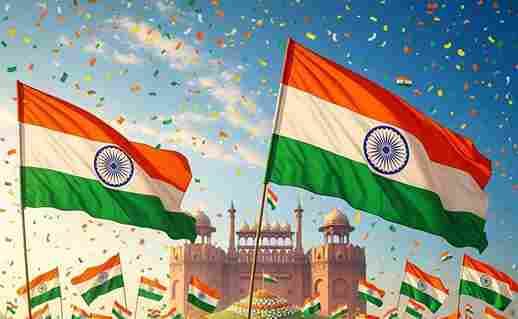
Independence Day and Republic Day are India's two most prominent national days, and they are often confused. In short: Independence Day (15 August) marks India's freedom from British rule in 1947, when the Prime Minister hoists the flag at the Red Fort. Republic Day (26 January) marks the Constitution coming into force in 1950, when the President unfurls the flag at Kartavya Path.
Both days feature the national flag, the national anthem and a public address, which is partly why they blur together in memory. But the events they commemorate are three years apart, the venues differ, the presiding figures differ, and even the flag ceremony itself is technically different. Below is a full comparison of the two occasions, followed by 12 differences explained one by one.
Independence Day vs Republic Day: comparison table
| Feature | Independence Day | Republic Day |
|---|---|---|
| Date | 15 August | 26 January |
| What it marks | End of British rule in 1947 | Constitution of India coming into force in 1950 |
| Year commemorated | 1947 | 1950 |
| Main venue | Red Fort (Lal Qila), Delhi | Kartavya Path, Delhi |
| Who presides | Prime Minister | President of India |
| Flag ceremony | Flag is hoisted (raised from the bottom) | Flag is unfurled (already at the top, then opened) |
| Main event | Address to the nation from the ramparts | Ceremonial parade |
| Chief guest | No foreign chief guest by convention | A foreign head of state or government is typically invited |
| Nature of the day | Attaining freedom | Becoming a sovereign republic |
| Head of state's role | President addresses the nation the evening before | President presides and takes the salute |
| Symbolism | Freedom from external rule | Adoption of self-governance and the rule of law |
| 2026 milestone | 80th Independence Day (79 completed years) | 77th Republic Day |
The 12 differences explained
1. The date
Independence Day falls on 15 August every year; Republic Day falls on 26 January. The dates are not arbitrary. 15 August 1947 is when the Indian Independence Act took effect. 26 January was chosen deliberately because it echoed the "Purna Swaraj" (complete independence) declaration observed on that date in 1930, well before independence was won.
2. What each day marks
Independence Day commemorates the transfer of power and the end of British colonial rule in 1947. Republic Day commemorates a distinct constitutional event: the coming into force of the Constitution of India on 26 January 1950, the moment India became a sovereign democratic republic rather than a dominion. You can trace the long path to both milestones in our India freedom struggle timeline.
3. The three-year gap
India was independent from 1947 but did not yet have its own constitution. Between 1947 and 1950 the country operated under adapted colonial-era law while the Constituent Assembly drafted a new constitution. That drafting process is what Republic Day ultimately honours, which is why the two days are three years apart rather than the same event.
4. Who presides
On Independence Day, the Prime Minister is the central figure, addressing the nation from the Red Fort. On Republic Day, the President of India, as head of state, presides over the ceremony and takes the salute at the parade. This reflects the different character of each occasion — one political-executive, one constitutional.
5. Hoisting versus unfurling the flag
This is the most commonly missed distinction. On Independence Day the flag is hoisted: it starts folded at the bottom of the pole and is pulled up, symbolising a nation rising into freedom. On Republic Day the flag is unfurled: it is already tied at the top of the pole and is opened out, reflecting a nation already established. We explain the ceremony in detail in hoisting vs unfurling the flag.
6. The venue
Independence Day is centred on the Red Fort in Delhi, from whose ramparts the Prime Minister speaks. Republic Day is centred on Kartavya Path (formerly Rajpath), the ceremonial avenue running from Rashtrapati Bhavan toward India Gate, which forms the route of the parade.
7. Parade versus address
The signature of Republic Day is the grand ceremonial parade — military contingents, cultural tableaux from states and ministries, and a fly-past. The signature of Independence Day is the Prime Minister's address to the nation from the Red Fort, which sets out priorities and reflects on the year. Republic Day is a display; Independence Day is a speech.
8. The chief guest
Republic Day, by long convention, features a foreign chief guest — a visiting head of state or government invited as the guest of honour. Independence Day has no comparable foreign-guest convention; it is an internally focused occasion. This diplomatic dimension is unique to Republic Day.
9. What is being celebrated
Independence Day celebrates the attainment of freedom — the removal of external rule. Republic Day celebrates the framework of self-governance — the adoption of a constitution, fundamental rights and the rule of law. One is about becoming free; the other is about how a free nation chose to govern itself.
10. The role of the head of state
On Independence Day, the President traditionally addresses the nation on the evening before (14 August), while the Prime Minister leads the 15 August ceremony. On Republic Day, the President is the presiding figure of the day itself. So the two national days effectively give the head of state and head of government different lead roles.
11. The tone and format
Independence Day tends to be reflective and forward-looking, organised around a national address, flag-hoisting at government offices, schools and homes, and cultural programmes. Republic Day is more formal and ceremonial, built around the parade, the presidential salute and the awarding of gallantry and civilian honours announced around that period.
12. The 2026 numbering
In 2026, 15 August 2026 is the 80th Independence Day, marking 79 completed years since 1947 — not the "79th" Independence Day, a common error. Republic Day on 26 January 2026 is the 77th Republic Day. If the counting confuses you, our explainer on whether it is the 80th or 79th Independence Day resolves it clearly.
Why the two days are so easily confused
Both national days share the same visible elements: the tricolour, the national anthem, patriotic programmes in schools and workplaces, and a public ceremony in Delhi covered live nationwide. Because both are gazetted holidays and both centre on the flag, casual observers often merge them. The clearest way to keep them apart is a simple pair of anchors: 15 August = freedom (1947), flag hoisted by the PM at the Red Fort; 26 January = Constitution (1950), flag unfurled by the President at Kartavya Path.
A quick memory aid
- August, Prime Minister, Red Fort, hoist, freedom — Independence Day.
- January, President, Kartavya Path, unfurl, Constitution — Republic Day.
- Independence Day has a speech; Republic Day has a parade.
- Republic Day has a foreign chief guest; Independence Day does not.
Flag etiquette applies to both
Whichever day you are marking, the national flag must be displayed with dignity. The Flag Code of India rules govern size, position, timing and handling, and there is a proper process for retiring a damaged tricolour, covered in how to dispose of the national flag. These rules apply equally on 15 August and 26 January.
Marking the days from abroad
Indians overseas observe both occasions through community flag ceremonies, cultural evenings and embassy events. If you are planning a celebration, our Independence Day 2026 NRI guide covers timings across time zones and etiquette, and you can find broader coverage on our Independence Day 2026 hub. For context on the people behind the freedom that 15 August marks, see our feature on women freedom fighters of India.
Related reading
- Independence Day 2026: full coverage hub
- 80th or 79th Independence Day 2026? The numbering explained
- Hoisting vs unfurling the flag: the difference
- Flag Code of India: rules for displaying the tricolour
- India's freedom struggle: a timeline
- Independence Day 2026: an NRI guide
Related NRI Globe Coverage
- Independence Day 2026 for NRIs: USA, UK, Canada, Australia, UAE, Europe and Singapore Guide
- Independence Day Speech for Kids: Simple Speeches for Ages 4 to 10
- Independence Day Fancy Dress Ideas for Kids
- Short Independence Day Speech: 1-Minute and 2-Minute Versions
- Why Is India's Independence Day on 15 August? The Reason Behind the Date
- Celebrating Independence Day 8,000 Miles From Home
- Independence Day 2026 Theme, Red Fort Ceremony and What to Expect
- Independence Day 2026 Is on a Saturday: What That Means for Schools, Offices and Families
Fresh from NRI Globe
- YouTuber Nandu's World (Rama Nandana) UK Visa & Job Fraud Case: Full Details + Key Lessons for NRIs (2026)
- Dussehra / Vijayadashami 2026 Events Country-Wise — Global NRI Directory (Ram Lila, Ravana Dahan, Durga Puja Pandals, Ayudha Puja Venues + Booking)
- Diwali 2026 Events Country-Wise — Global NRI Directory (White House, Leicester, London Trafalgar, Toronto, Auckland, Sydney Parramasala, Fiji, Mauritius, Trinidad, South Africa and More)
- Diwali / Deepavali 2026 Country-Wise NRI Celebrations — Complete Global Guide (USA, UK, Canada, Australia, Fiji, Mauritius, Trinidad, South Africa, UAE and 30+ Countries)