
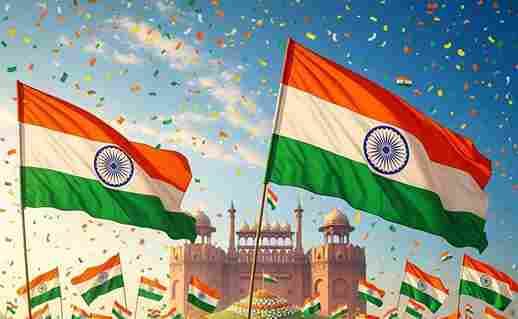
India celebrates Independence Day 2026 on Saturday, 15 August 2026. This is the 80th Independence Day, marking 79 completed years of freedom since the transfer of power at midnight on 15 August 1947. Because the count starts at the first anniversary in 1948, the ordinal number is always one ahead of the years elapsed — a point we explain in detail below.
Quick Facts: Independence Day 2026
| Detail | Information |
|---|---|
| Date | Saturday, 15 August 2026 |
| Which anniversary | 80th Independence Day |
| Years of freedom completed | 79 years |
| Original event | Transfer of power, midnight 14–15 August 1947 |
| Main ceremony | Flag hoisting at the Red Fort, New Delhi |
| Who hoists the flag | The Prime Minister of India |
| Flag action | Hoisting (flag raised from the bottom) |
| Nationwide campaign | Har Ghar Tiranga |
| 2026 theme | Not yet confirmed; expected from PIB closer to 15 August |
Is it the 80th or 79th Independence Day?
The correct term is the 80th Independence Day. India became independent on 15 August 1947. The first Independence Day celebration took place on 15 August 1948 — that was anniversary number one. Counting forward, 15 August 2026 is therefore the 80th such observance, even though only 79 full years of independence have elapsed. Calling it the "79th Independence Day" is a common error, and it is equally wrong to say India completes "80 years of independence" in 2026. We break the arithmetic down step by step on our dedicated explainer, 80th or 79th Independence Day 2026.
What happened on 15 August 1947
At the stroke of midnight between 14 and 15 August 1947, British colonial rule over India formally ended and power was transferred to the new Dominion of India. The Constituent Assembly held a special session in Delhi through the night. The tricolour was raised, and India began its journey as a sovereign nation. The same act of independence also created the separate state of Pakistan, and the subcontinent was reshaped by the drawing of new borders.
Independence was not the achievement of a single person or movement. It emerged from decades of effort across many streams — constitutional campaigners, mass non-violent movements, revolutionary groups, the contributions of soldiers and the wider public, and negotiations in the final years. Historians continue to weigh the relative importance of these strands, and readers will find a range of scholarly interpretations rather than one settled verdict.
Timeline: The Road to Freedom, 1857–1947
| Year | Milestone |
|---|---|
| 1857 | The Revolt of 1857, a major uprising against East India Company rule |
| 1858 | The British Crown assumes direct control of India |
| 1885 | The Indian National Congress is founded |
| 1905 | Partition of Bengal spurs the Swadeshi movement |
| 1919 | Jallianwala Bagh tragedy; the Rowlatt Act protests |
| 1920–22 | Non-Cooperation Movement |
| 1930 | Salt March and the Civil Disobedience Movement |
| 1942 | Quit India Movement |
| 1945–46 | Post-war negotiations; INA trials draw wide public attention |
| 1947 | Indian Independence Act passed; power transferred on 15 August |
Partition: Remembering with Dignity
Independence arrived alongside Partition. Millions of people crossed newly drawn borders in one of the largest human migrations in recorded history, and enormous numbers of families were uprooted, separated or lost. On 14 August India observes Partition Horrors Remembrance Day to honour those who suffered and were displaced.
The responsibility for Partition and the precise sequence of decisions that led to it remain subjects of serious historical debate, with scholars offering differing assessments. We treat this history as a shared human experience of loss and resilience rather than through any communal lens, and we encourage readers to approach the period with the empathy it deserves.
The Red Fort Ceremony: Order of Events
The national ceremony takes place at the Red Fort (Lal Qila) in Delhi. The sequence is broadly as follows each year:
- The Prime Minister is received and inspects a Guard of Honour.
- The Prime Minister hoists the National Flag from the ramparts of the Red Fort.
- A 21-gun salute is fired as the flag is hoisted.
- The National Anthem, Jana Gana Mana, is played.
- The Prime Minister addresses the nation.
- The event closes with patriotic displays; in many years flower petals are showered and balloons or doves released.
Why the Prime Minister Hoists the Flag — Not the President
On Independence Day the Prime Minister hoists the flag at the Red Fort, while on Republic Day (26 January) the President unfurls it at the ceremonial parade. The distinction reflects history: in 1947 India did not yet have a President — the office was created only when the Constitution came into force in 1950. The head of the elected government, the Prime Minister, therefore leads the Independence Day observance, a convention that has continued ever since.
Hoisting vs Unfurling: Know the Difference
These two terms are not interchangeable, and knowing the difference is a mark of respect for the flag:
- Hoisting (Independence Day): The folded flag is tied at the bottom of the pole and pulled up, then released to fly. This symbolises the nation rising to freedom in 1947.
- Unfurling (Republic Day): The flag is already tied at the top of the pole and is simply opened out, marking the adoption of the Constitution.
The National Flag: Respect and the Flag Code
Display of the Tiranga is governed by the Flag Code of India, 2002 and by the Prevention of Insults to National Honour Act, 1971. These set out how the flag may be displayed, the prohibited uses, and how a damaged flag must be disposed of respectfully in private. A quick checklist for a respectful display:
- Ensure the saffron band is at the top when the flag is displayed horizontally.
- Never let the flag touch the ground, water or the floor.
- Do not use the flag as drapery, clothing, or to cover objects, tables or platforms.
- Do not display a torn, soiled or faded flag.
- Dispose of a worn flag privately and with dignity, in keeping with the rules.
For the full rules and permitted uses, see our detailed guide to the Flag Code of India rules and our step-by-step explainer on how to dispose of a national flag respectfully. Always confirm the current position against the official Ministry of Home Affairs text before acting on any specific use.
The National Anthem
Jana Gana Mana, composed by Rabindranath Tagore, was adopted as India's National Anthem by the Constituent Assembly on 24 January 1950. It is sung in its official, unaltered form during the flag hoisting. Standing respectfully while the anthem is played is itself an expression of national honour protected under law.
Har Ghar Tiranga
In recent years the government's Har Ghar Tiranga ("A Flag in Every Home") campaign has invited citizens to display the tricolour at their homes and workplaces around 15 August. The campaign encourages participation through flag displays, selfies and community events, and typically runs in the days leading up to Independence Day. If you take part, follow the same flag-etiquette checklist above so that the display remains respectful.
How India Celebrates
Beyond the Red Fort, flag-hoisting ceremonies take place at state capitals led by Governors and Chief Ministers, and at schools, offices, housing societies and government buildings across the country. Cultural programmes, patriotic songs, essay and quiz competitions, and community gatherings are common. Because 15 August 2026 falls on a Saturday, many families in India enjoy a weekend around the holiday, boosting community events and travel.
How the Diaspora Celebrates
For the global Indian community, Independence Day is a moment of connection with home. Indian missions abroad — embassies, high commissions and consulates — customarily hold flag-hoisting ceremonies and cultural events. Community associations and temples also organise gatherings. Because event details, timings and venues vary by location and change each year, please check the announcement from your nearest Indian mission rather than relying on last year's schedule.
One practical point for viewers in different time zones: the Red Fort ceremony airs in the early morning IST. For much of the United States, that corresponds to the evening of 14 August local time, so American viewers watching a live broadcast will do so the night before their own calendar date. Our Red Fort ceremony timings worldwide guide maps the broadcast to major diaspora cities, and our Independence Day 2026 NRI guide covers celebrating abroad, from flag etiquette in your host country to family-friendly ideas.
The 2026 Theme
The official theme for Independence Day 2026 has not been confirmed. The 2025 observance used the theme "Naya Bharat," which we mention only as context. Each year's theme is announced by the Press Information Bureau (PIB) closer to the day, so treat any theme circulating in advance as unconfirmed until it is officially released.
Explore the Full Independence Day 2026 Cluster
This is the master guide. For deeper dives on specific questions, use the directory below.
Related reading
- Independence Day 2026: complete pillar guide
- Is it the 80th or 79th Independence Day 2026?
- Flag Code of India: rules for displaying the Tiranga
- How to dispose of a national flag respectfully
- Independence Day 2026 NRI guide
- Red Fort ceremony timings worldwide
Related NRI Globe Coverage
- Independence Day vs Republic Day: 12 Differences Explained
- Independence Day 2026 for NRIs: USA, UK, Canada, Australia, UAE, Europe and Singapore Guide
- Independence Day Speech for Kids: Simple Speeches for Ages 4 to 10
- Independence Day Fancy Dress Ideas for Kids
- Short Independence Day Speech: 1-Minute and 2-Minute Versions
- Why Is India's Independence Day on 15 August? The Reason Behind the Date
- Celebrating Independence Day 8,000 Miles From Home
- Independence Day 2026 Theme, Red Fort Ceremony and What to Expect
Fresh from NRI Globe
- YouTuber Nandu's World (Rama Nandana) UK Visa & Job Fraud Case: Full Details + Key Lessons for NRIs (2026)
- Dussehra / Vijayadashami 2026 Events Country-Wise — Global NRI Directory (Ram Lila, Ravana Dahan, Durga Puja Pandals, Ayudha Puja Venues + Booking)
- Diwali 2026 Events Country-Wise — Global NRI Directory (White House, Leicester, London Trafalgar, Toronto, Auckland, Sydney Parramasala, Fiji, Mauritius, Trinidad, South Africa and More)
- Diwali / Deepavali 2026 Country-Wise NRI Celebrations — Complete Global Guide (USA, UK, Canada, Australia, Fiji, Mauritius, Trinidad, South Africa, UAE and 30+ Countries)