
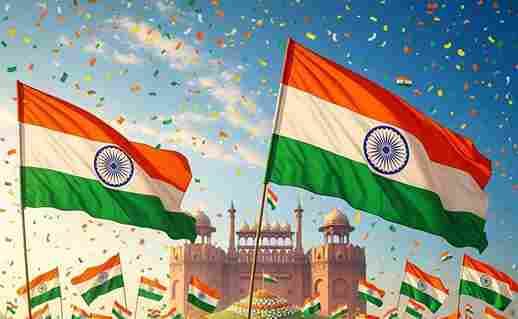
Explaining Independence Day to children works best when you match the story to their age. For ages 4-6, keep it to a simple idea of freedom and the flag. For 7-10, add the year 1947 and why people celebrate. For 11 and older, you can introduce Partition honestly but gently, without frightening detail. In 2026 India marks its 80th Independence Day, completing 79 years of freedom.
Why an age-by-age approach helps
Children understand big ideas in stages. A four-year-old cannot picture a country the way a twelve-year-old can, and a curious eleven-year-old will feel talked down to if you stop at "we got freedom." The goal is to give each child a true story sized to what they can hold, so that the picture deepens naturally as they grow.
This matters even more for children born abroad. For many diaspora families, Independence Day is one of the few fixed points on the calendar when a child can ask, in plain words, "Where are we from, and what happened there?" A confident, warm answer at home helps a child feel rooted in two places at once rather than caught between them.
Before we go age by age, one fact worth getting right so you can pass it on correctly. India became independent on 15 August 1947. In 2026 we observe the 80th Independence Day, which marks 79 completed years of freedom. It is a common slip to call it the "79th" day or "80 years of independence"; you can read the simple explanation on our 80th vs 79th Independence Day guide.
Ages 4-6: the short, gentle version
At this age, keep it to feelings and pictures. You might say:
"A long time ago, people from far away came to our country, India, and were in charge of it. They made the rules, and Indians could not decide things for themselves. Many kind and brave people worked for a long, long time so that India could be free and make its own choices. They did not want fighting; they wanted fairness. On a special day, 15 August, India became free. Now every year we say thank you to those brave people. We raise our flag high into the sky. It has three colours: saffron on top, white in the middle with a blue wheel, and green at the bottom. When we see the flag go up and hear our national anthem, we stand quietly and feel proud. That is Independence Day, our country's happy birthday of freedom."
That is roughly all a young child needs. Let them ask questions, answer simply, and stop when they are satisfied. Colouring a paper flag or watching a flag being raised is more memorable at this age than any date or name.
Ages 7-10: adding the year and the "why"
Now children can hold a date, a few names, and a sense of cause and effect. You can say something like this:
"For almost 200 years, Britain ruled over India. That means British leaders, not Indians, controlled the government, the money, and the laws. Many Indians felt this was unfair, because a country should be run by its own people. So people across India joined together to ask for freedom. One of the most famous leaders was Mahatma Gandhi, who believed in fighting unfairness without violence, through peaceful protest and truth. Millions of ordinary people, women and men, from every region and religion, took part over many years. Finally, on 15 August 1947, India became an independent country. That is why we celebrate Independence Day every year on 15 August."
At this age it helps to explain a few things they will notice at a celebration:
- Hoisting the flag: On Independence Day the flag is raised from the bottom of the pole to the top. This is called hoisting. On Republic Day (26 January) the flag is already at the top and is simply unfurled. You can explain the difference using our hoisting vs unfurling guide.
- The national anthem: We stand still and quiet when "Jana Gana Mana" is played, as a mark of respect.
- The three colours: Saffron, white and green, with a navy-blue 24-spoke wheel called the Ashoka Chakra in the centre.
Curious children often ask what the colours "mean." It is honest to say the flag was carefully designed and that the wheel stands for movement and progress, while pointing them to our flag history and meaning page for the full story rather than inventing tidy one-word answers.
A simple age-by-age summary
| Age group | Core idea | What to include | What to hold back |
|---|---|---|---|
| 4-6 | India is free and it is our special day | The flag, standing for the anthem, "happy" tone | Dates, Partition, any violence |
| 7-10 | India was ruled by Britain and became free in 1947 | 15 August 1947, peaceful movement, flag rules | Detailed Partition, communal framing |
| 11+ | Freedom came in 1947, and it came with hard costs too | Partition explained gently, why it still matters | Graphic detail, blame, one-sided history |
Ages 11 and older: the fuller story, including Partition
Older children can handle complexity and will notice if you leave things out. This is the age to explain that independence was a huge achievement and that it came with a painful event called Partition. You do not need frightening detail; you need honesty and a calm tone.
You might explain it in stages:
- The struggle: India's freedom movement lasted decades and involved many leaders and millions of ordinary people across all regions and faiths. It used many methods, but the peaceful, non-violent path led by figures such as Mahatma Gandhi became world-famous.
- Independence and Partition together: When the British left in 1947, British India was divided into two countries, India and Pakistan (East Pakistan later became Bangladesh in 1971). This division is called Partition.
- What Partition meant for people: Millions of families had to leave their homes and move across the new borders. It was a time of great upheaval and sadness for very many people. You can say this truthfully without describing violence in detail, especially with a sensitive child.
- Why it still matters: Many families today, including in the diaspora, can trace their story to those years. Knowing this helps children understand relatives' stories and headlines they may see later.
A gentle way to frame it: "Getting freedom was a wonderful thing that people had worked toward for a very long time. But the way the country was divided also caused a lot of hardship for ordinary families. Both things are true at the same time. That is why Independence Day is joyful, but people also remember it with some seriousness."
Keep the tone factual and balanced. Avoid blaming any one community, and if your child asks a hard question you cannot answer, it is fine to say "That is a big question historians still discuss, let's read about it together." For a wider overview you can point them to our Independence Day 2026 pillar page.
The flag: what to teach children about respect
Children love the flag, so this is a natural moment to teach that it is treated with care under law. The way the flag is used is governed by the Flag Code of India, 2002, and disrespect to it can be an offence under the Prevention of Insults to National Honour Act, 1971. A few simple, correct points for children:
- The flag should never touch the ground or water, and should be kept clean and whole.
- The flag is not to be worn as clothing or used as drapery or costume. This is worth stressing before school "fancy-dress" events, where children sometimes want to wear the flag as a cape or sari.
- A paper flag should not be thrown on the ground after the celebration; damaged flags should be disposed of respectfully, as explained in our flag disposal guide.
- When in doubt about any use, treat the flag with dignity and check the rules rather than guessing.
For the full set of do's and don'ts to share with older children or a school group, use our Flag Code of India rules explainer, and always defer to the official Ministry of Home Affairs text for specifics.
A note on the anthem, the national song and the emblem
Teach children to stand respectfully for the national anthem, "Jana Gana Mana," and explain that it is always sung in its official, unaltered form; it is not something to change or perform casually. If your child hears about the debate over "Vande Mataram" as India's national song, you can explain factually that different songs have held different official roles and that the topic has been discussed for a long time, without turning it into an argument about any community. The State Emblem (the Ashoka lion capital seen on official documents) is protected by the State Emblem of India (Prohibition of Improper Use) Act, 2005, so it is not for decoration or craft projects. For patriotic songs at home, choose them by title and theme and enjoy them together, rather than relying on any single "meaning."
Making it real for children born abroad
Diaspora children may never have set foot in India, so the day can feel abstract. A few ideas that work well:
- Connect it to family: Ask grandparents to share, on a call, where they were on past Independence Days. A real family memory beats any textbook.
- Watch a flag-hoisting together: Many Indian associations abroad host morning ceremonies on or near 15 August.
- Cook and craft: Make tricolour snacks or paper flags, using the moment to name the colours and the wheel correctly.
- Two homes, not a contest: Reassure children that being proud of India and belonging fully to the country they live in are not in conflict.
Above all, keep the tone warm and let the child lead with questions. You are not delivering a lecture; you are handing down a story that will grow with them.
Related reading
- Independence Day 2026: full guide
- Is 2026 the 80th or 79th Independence Day?
- Flag Code of India: rules explained
- Hoisting vs unfurling the flag
- The Indian flag: history and meaning
- How to dispose of a national flag respectfully
Related NRI Globe Coverage
- Independence Day vs Republic Day: 12 Differences Explained
- Teaching Your Children About Independence Day When They Were Born Abroad
- Independence Day 2026 for NRIs: USA, UK, Canada, Australia, UAE, Europe and Singapore Guide
- Independence Day Speech for Kids: Simple Speeches for Ages 4 to 10
- Independence Day Fancy Dress Ideas for Kids
- Short Independence Day Speech: 1-Minute and 2-Minute Versions
- Why Is India's Independence Day on 15 August? The Reason Behind the Date
- Celebrating Independence Day 8,000 Miles From Home
Fresh from NRI Globe
- YouTuber Nandu's World (Rama Nandana) UK Visa & Job Fraud Case: Full Details + Key Lessons for NRIs (2026)
- Dussehra / Vijayadashami 2026 Events Country-Wise — Global NRI Directory (Ram Lila, Ravana Dahan, Durga Puja Pandals, Ayudha Puja Venues + Booking)
- Diwali 2026 Events Country-Wise — Global NRI Directory (White House, Leicester, London Trafalgar, Toronto, Auckland, Sydney Parramasala, Fiji, Mauritius, Trinidad, South Africa and More)
- Diwali / Deepavali 2026 Country-Wise NRI Celebrations — Complete Global Guide (USA, UK, Canada, Australia, Fiji, Mauritius, Trinidad, South Africa, UAE and 30+ Countries)