
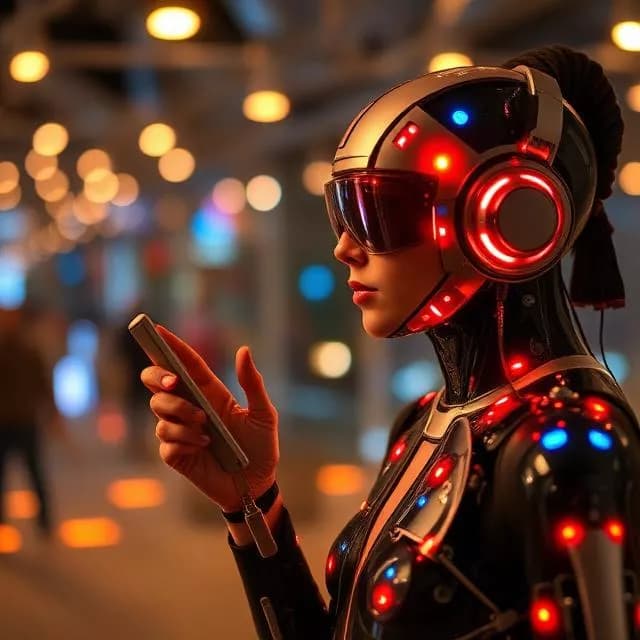
The Convergence of 6G and Human Augmentation: Implications
As the world hurtles toward the full deployment of 6G networks by 2030, a transformative era of human-machine integration is on the horizon. Nokia's CEO, Pekka Lundmark, has envisioned a future where traditional smartphones become obsolete, with advanced interfaces "built directly into our bodies." This prediction, shared in global forums, aligns with accelerating policy actions, including the recent Presidential Memorandum signed by President Donald Trump on December 19, 2025, aimed at securing U.S. leadership in 6G. The memorandum explicitly positions 6G as the foundational infrastructure for emerging technologies, including artificial intelligence, robotics, and implantable devices.
For Non-Resident Indians (NRIs) and the broader global Indian community, this technological shift presents both unprecedented opportunities and profound challenges. With millions of Indians living abroad—in the United States, Canada, the UK, Australia, the Middle East, and beyond—many are at the forefront of tech innovation, healthcare, finance, and entrepreneurship. 6G-enabled implantable technologies could revolutionize remote work, telemedicine connecting families across continents, personalized education, and financial inclusion. Yet, concerns over privacy, data security, cultural values, and ethical boundaries demand vigilant discussion within our diaspora.
This evolution is not speculative fiction but rooted in current research and policy. Nokia Bell Labs and other leaders foresee 6G delivering terahertz speeds, ultra-low latency, and integrated sensing that blend the digital and physical worlds seamlessly. The U.S. memorandum's emphasis on "implantable technologies" signals a strategic push, freeing spectrum bands to enable real-time applications like neural interfaces and biosensors.
Nokia's Vision: From Handheld Devices to Embodied Connectivity
Pekka Lundmark's insights, highlighted in discussions at the World Economic Forum and other platforms, paint a picture of radical change. By 2030, he anticipates that "the smartphone as we know it today will not be the most common interface," with many functions integrated directly into the body. This builds on transitions from phones to wearables like smart glasses, evolving further into biocompatible implants.
Nokia's 2030 Tech Vision emphasizes human augmentation and digital-physical fusion. Human augmentation involves enhancing cognition, senses, and health through embedded tech—think neural links for instant language translation, vital monitors alerting doctors in real-time, or augmented reality overlays for navigation and learning. For NRIs juggling multiple cultures and time zones, such tools could ease communication barriers, enable seamless collaboration with teams in India, or provide proactive health insights tailored to genetic predispositions common in South Asian populations.
Digital-physical fusion creates "digital twins"—virtual replicas of people, cities, or systems—for optimization. In healthcare, a digital twin of your body could predict diseases; in education, personalized learning paths could bridge gaps for children in diaspora families preserving Indian heritage while excelling globally.
U.S. Policy Acceleration: The 6G Memorandum and Its Global Ripple Effects
On December 19, 2025, President Trump signed the "Winning the 6G Race" memorandum, directing spectrum reallocation and diplomatic efforts to dominate this space. The fact sheet underscores that "6G networks will provide the foundation to operate cutting-edge technologies of the next decade, including AI, robotics, implantable technologies and many other advancements."
Key actions include clearing the 7.125-7.4 GHz band for commercial 6G use and studying additional frequencies. This prioritizes ultra-reliable connections vital for implants requiring zero-latency data transfer.
For the Indian diaspora, particularly the large NRI community in the U.S. (over 4 million strong), this policy could boost job opportunities in tech hubs like Silicon Valley, where many Indians lead in AI and telecom. Collaborations between U.S. firms and Indian giants like Reliance Jio or Tata could accelerate 6G rollout in India, benefiting remittances, family businesses, and cross-border investments.
However, the explicit focus on implantables raises questions. As 6G enables body area networks—nano-sensors communicating via terahertz waves through human tissue—adoption could become tied to visa requirements, employment, or healthcare access in host countries.
Technical Enablers: Why 6G Makes Implantables Feasible
6G's innovations make bodily integration practical:
- Terahertz Frequencies: Enabling terabit speeds and energy harvesting from the body itself, powering implants without batteries.
- Integrated Sensing and Communication (ISAC): Networks that "sense" biometrics and environments, feeding data directly to implants for augmented perception.
- AI-Native Networks: Processing sensitive data on-device or at the edge, potentially addressing privacy concerns.
- Body-Centric Communication: Using the human body as a medium for secure, low-power data transfer.
Applications relevant to NRIs include:
- Healthcare: Continuous monitoring for diabetes or heart conditions prevalent in Indian communities, with alerts to family doctors in India or abroad.
- Education and Skills: Neural enhancements for faster learning of new languages or professional skills, aiding career mobility.
- Cultural Preservation: Immersive VR experiences connecting diaspora youth to Indian festivals, languages, and history in sensory-rich ways.
- Financial Inclusion: Secure, thought-based transactions for remittances, reducing fees and fraud.
Opportunities for the Global Indian Community
NRIs are uniquely positioned to thrive:
- Innovation Leadership: Indian-origin executives at Google, Microsoft, and Nokia influence these technologies.
- Entrepreneurship: Startups in Bengaluru or Hyderabad could develop 6G apps tailored for diaspora needs, like multilingual neural translators.
- Economic Growth: Faster networks boost e-commerce, remote consulting, and edtech platforms serving NRIs.
- Family Connectivity: Holographic calls and shared virtual realities strengthen ties across oceans.
Risks and Ethical Concerns: A Call for Diaspora Vigilance
This path is not without dangers:
- Privacy and Surveillance: Implants generating neural data could be vulnerable to breaches, especially in authoritarian regimes or corporate overreach.
- Digital Divide: High costs may exclude lower-income NRIs or families in rural India.
- Cultural and Ethical Clash: Concepts of bodily integrity in Indian philosophy (e.g., ahimsa, sanctity of the body) may conflict with invasive tech.
- Health Unknowns: Long-term effects of terahertz exposure or implants need more study.
- Autonomy Loss: Mandatory adoption for jobs or travel could erode personal freedom.
The diaspora must advocate for ethical frameworks—perhaps through organizations like TiE or GOPIO—ensuring regulations protect individual rights and cultural values.
Toward a Balanced Future: Empowerment Rooted in Choice
As 6G approaches, the global Indian community stands at a pivotal moment. Implantable technologies promise enhanced capabilities, bridging distances and amplifying potential. Yet, we must ensure this augmentation empowers rather than controls.
NRIs, with our blend of Eastern wisdom and Western innovation, can lead in shaping ethical 6G deployment. Demand transparency, inclusive access, and safeguards. Embrace the promise while preserving our humanity.
Stay connected with NRIGlobe.com for ongoing coverage of how these advancements impact our worldwide family—one globe, one root, infinite connections.
Related NRI Globe Coverage
- AI Impact on Indian IT Services and NRI Tech Professionals 2026: The Augmentation-Not-Replacement Framework
- TCS to Have as Many AI Agents as Human Employees by 2028-30: N Chandrasekaran
- AI Data Center Cooling Methods Explained — Air vs Direct-to-Chip Liquid vs Immersion (2026 Rack Density Guide)
- Generative AI Terminology 2026 — Complete Glossary From Beginner to Advanced (LLM, RAG, Agents, LangGraph, MCP, Enterprise AI)
- How Much Electricity Does AI Use for One Prompt? The Real 2026 Numbers (ChatGPT, Gemini, Agentic AI)
- How Much Water Does AI Use for One Prompt? The Real 2026 Numbers Explained
- Best AI Tools for NRIs in 2026 — ChatGPT, Claude, Gemini, Perplexity, Notion AI and Practical Uses for Immigration, Family and Productivity
- iPhone 17 Pro and 17 Pro Max for NRIs 2026 — Complete Guide (US vs India Price, Warranty, Apple Intelligence, Sending as Gift)
Fresh from NRI Globe
- YouTuber Nandu's World (Rama Nandana) UK Visa & Job Fraud Case: Full Details + Key Lessons for NRIs (2026)
- Dussehra / Vijayadashami 2026 Events Country-Wise — Global NRI Directory (Ram Lila, Ravana Dahan, Durga Puja Pandals, Ayudha Puja Venues + Booking)
- Diwali 2026 Events Country-Wise — Global NRI Directory (White House, Leicester, London Trafalgar, Toronto, Auckland, Sydney Parramasala, Fiji, Mauritius, Trinidad, South Africa and More)
- Diwali / Deepavali 2026 Country-Wise NRI Celebrations — Complete Global Guide (USA, UK, Canada, Australia, Fiji, Mauritius, Trinidad, South Africa, UAE and 30+ Countries)