
TL;DR
- Isaac 0 folds everyday garments in 30-90 minutes per load.
- Priced at $7,999 with monthly subscription and deposit options.
- Hybrid AI plus remote human oversight handles tricky folds.
- Limited to Bay Area shipments in the near term.
- Useful for dual-income NRI families seeking time savings.
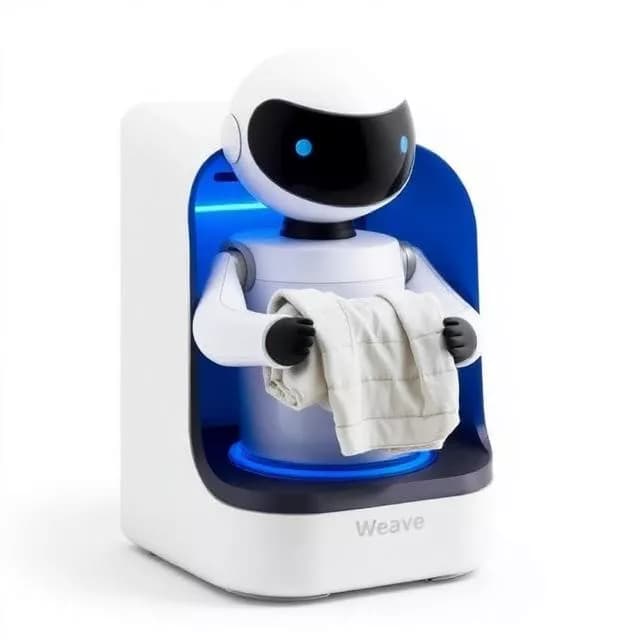
Weave Robotics launched Isaac 0 as a stationary unit built for one task. The machine accepts most common clothing items and returns them folded. Early users report consistent output on standard loads.
Core Capabilities of Isaac 0
The unit processes T-shirts, long-sleeve shirts, hoodies, sweaters, pants, towels, pillowcases, undergarments, and paired socks. Cycle times range from 30 to 90 minutes depending on volume and fabric mix. Sensors detect edges and adjust grip force to avoid tears.
Users load items into a bin at the base. The robot then sequences folds without further intervention in most cases. Output stacks appear on an adjacent tray.
Current Constraints and Known Gaps
Large items such as bed sheets remain outside current scope. Inside-out garments sometimes require manual correction before loading. Minor creases appear on occasion with thicker fabrics. The company logs these events and pushes model updates based on aggregated session data.
Hybrid Control System
Autonomous routines manage routine folds. When confidence scores drop, the system routes camera feeds to remote operators. Those operators issue corrective commands that also feed the training set. This loop has already processed thousands of pounds of test laundry.
The method reduces full autonomy risk while accelerating improvement. Each human correction refines the next autonomous attempt.
Safety Measures in Home Settings
Design choices include a low center of gravity, limited joint travel, and enclosed motors. These reduce pinch points and tip-over risk near children. The unit stays in one location, removing navigation hazards common in mobile platforms.
Pricing Structure and Rollout
Three paths exist: outright purchase at 7999 USD, a 250 USD reservation deposit, or 450 USD monthly subscription. Shipments remain restricted to the Bay Area for support reasons.
| Model | Task Focus | Mobility | Price Range | Availability |
|---|---|---|---|---|
| Isaac 0 | Laundry fold only | Stationary | 7999 USD | Bay Area 2026 |
| Competitor A | General assistance | Mobile | 20000+ USD | Prototype |
| Competitor B | Vacuum only | Mobile | 400-1200 USD | Wide retail |
NRI Household Perspective
Many Indian families living in the United States balance demanding careers with household duties. Domestic help costs often exceed several hundred dollars weekly in major metros. A device that consistently handles one recurring chore frees evening hours for family time or rest. Early adopters note that the fixed cost becomes easier to justify when both partners work full schedules and weekend chores accumulate quickly. The subscription path lowers the entry barrier for households that prefer to test performance before committing to ownership. Over a three-year horizon the machine may offset paid help or reduce reliance on weekend laundry marathons. Cultural expectations around neat clothing storage remain high, and the robot delivers uniform folds that meet those standards without daily oversight.
Why Laundry Folding Serves as an Effective Starting Task
The chore repeats on predictable schedules. Success metrics are easy to measure. The workspace stays bounded. These traits allow rapid iteration without the complexity of whole-home navigation. Weave Robotics therefore ships a narrow product first and expands capability through software updates.
Planned Successor Model
A mobile follow-on unit is slated for later 2026. It would retain folding ability while adding tidying and basic organization functions. First deliveries target existing Isaac 0 customers.
Next steps
Visit the official site to reserve a unit or request a demo. Compare total cost of ownership against local laundry services. Track firmware release notes for expanded garment support.
Sources
Related NRI Globe Coverage
- Top Trends from CES 2026: Physical AI, Robotics, and Foldables Define the Future
- Beijing’s First-Ever World Humanoid Robot Games: A Showcase of AI-Powered Innovation
- NVIDIA CEO Jensen Huang Urges Students to Study Physics for the Future of AI and Robotics
- AI Data Center Cooling Methods Explained — Air vs Direct-to-Chip Liquid vs Immersion (2026 Rack Density Guide)
- Generative AI Terminology 2026 — Complete Glossary From Beginner to Advanced (LLM, RAG, Agents, LangGraph, MCP, Enterprise AI)
- How Much Electricity Does AI Use for One Prompt? The Real 2026 Numbers (ChatGPT, Gemini, Agentic AI)
- How Much Water Does AI Use for One Prompt? The Real 2026 Numbers Explained
- Best AI Tools for NRIs in 2026 — ChatGPT, Claude, Gemini, Perplexity, Notion AI and Practical Uses for Immigration, Family and Productivity
Fresh from NRI Globe
- YouTuber Nandu's World (Rama Nandana) UK Visa & Job Fraud Case: Full Details + Key Lessons for NRIs (2026)
- Dussehra / Vijayadashami 2026 Events Country-Wise — Global NRI Directory (Ram Lila, Ravana Dahan, Durga Puja Pandals, Ayudha Puja Venues + Booking)
- Diwali 2026 Events Country-Wise — Global NRI Directory (White House, Leicester, London Trafalgar, Toronto, Auckland, Sydney Parramasala, Fiji, Mauritius, Trinidad, South Africa and More)
- Diwali / Deepavali 2026 Country-Wise NRI Celebrations — Complete Global Guide (USA, UK, Canada, Australia, Fiji, Mauritius, Trinidad, South Africa, UAE and 30+ Countries)