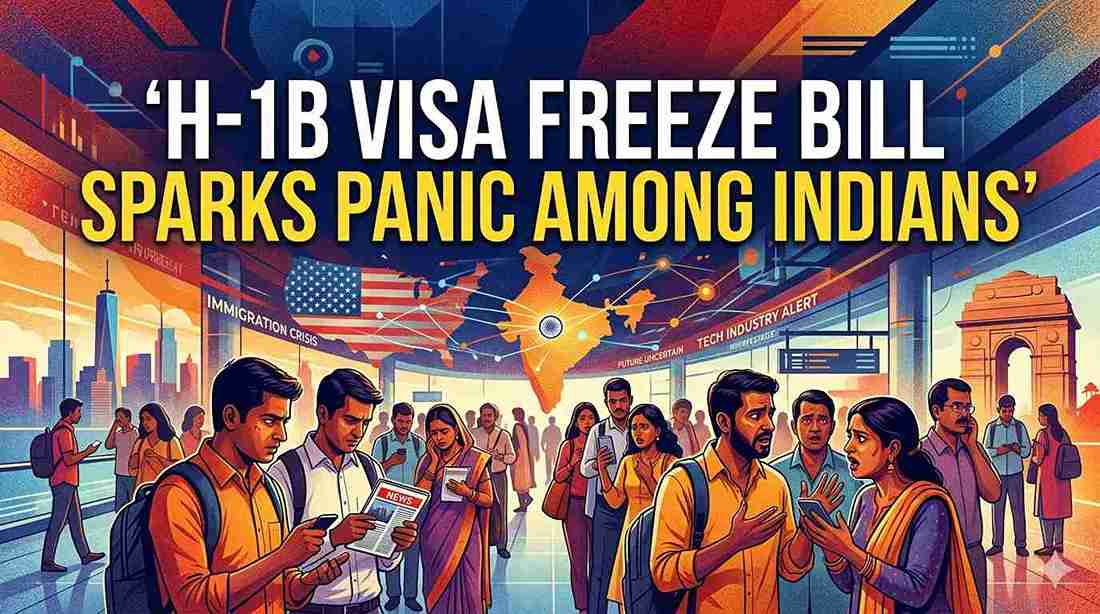
Imagine this: Arjun, a 28-year-old software engineer from Bengaluru, lands his dream job at a Silicon Valley startup. His H-1B visa application is ready, his hopes sky-high. But then, a seismic shift rocks his plans. The White House, under President Donald Trump, has just approved a radical overhaul of the H-1B visa program, replacing the random lottery with a wage-based system. For Arjun, and millions of Indian professionals like him, the American Dream just got a lot more complicated—or, for some, a golden opportunity. Here’s the story of how Trump’s latest immigration move is reshaping the future for Indian tech talent, spiced with fiery debates and bold statements from the corridors of power.
The H-1B Visa: A Lifeline for Indian Talent
The H-1B visa is the golden ticket for skilled foreign workers, especially from India, where 72.3% of the 386,000 visas issued in 2023 went to Indian nationals. With an annual cap of 85,000 visas—65,000 general and 20,000 for advanced-degree holders—the program fuels America’s tech engine, powering companies like Microsoft, Amazon, and Google. But the random lottery system, where luck trumps skill, has long been a sore point. Enter Trump’s new plan: a wage-based selection process that prioritizes high earners and senior professionals, approved by the White House on August 8, 2025.
This isn’t just policy jargon—it’s a plot twist in the lives of countless Indian workers. For someone like Arjun, earning $90,000 as an entry-level coder, the odds of securing a visa could plummet. Meanwhile, Priya, a senior AI specialist commanding $180,000, might find herself at the front of the line. The stakes are high, and the reactions are electric.
Trump’s Vision: “America First” Meets Global Talent
Trump has never been shy about his stance on H-1B visas. During his first term, he called the program a “theft” of American prosperity, arguing it allowed companies to hire cheaper foreign labor over U.S. workers. His latest move revives a 2021 proposal from his “Buy American, Hire American” playbook, which aimed to prioritize high-paid, highly skilled workers. “I need smart people,” Trump recently declared, hinting at a merit-based system that rewards talent but with a catch: higher wages mean higher chances.
The policy shift has sparked a firestorm. U.S. Citizenship and Immigration Services (USCIS) Director Joseph Edlow, appointed in July 2025, defends the change, saying it ensures “immigration is a net positive” for the U.S. economy. But critics like Doug Rand, a former Biden official, warn it could gut the program’s purpose of attracting the “best and brightest” graduates, many of whom are Indian. On X, voices like @USTechWorkers amplify the tension, claiming Indian workers dominate tech hiring while American jobs vanish, urging Trump to “suspend the H-1B program” entirely.
The Indian Perspective: Dreams on the Line
For Indian professionals, the stakes are personal. India accounts for 62% of the employment-based green card backlog, with over a million petitions pending. The new wage-based system could tilt the scales toward senior professionals, leaving younger workers like Arjun scrambling. “This could crush my plans,” Arjun says, echoing fears shared on X, where users like @sheela2010 claim Trump aims to “hit India hardest” with a transformed visa system.
The ripple effects extend beyond visas. The Trump administration also rolled back a Biden-era policy protecting children of H-1B holders from “aging out” at 21, potentially forcing thousands of Indian-American kids to leave the U.S. if their parents’ green card applications remain stuck. Neha Mahajan of Skilled Immigrants in America calls this “a devastating blow” for Indian families, who face decades-long green card waits.
Sparks Fly: Controversy and Contradictions
The debate is heating up, with heavyweights weighing in. Congresswoman Marjorie Taylor Greene has called for ending Indian H-1B visas altogether, while Trump aide Stephen Miller accuses India of undermining U.S. interests. Yet, Trump’s pro-India rhetoric, bolstered by his rapport with Prime Minister Narendra Modi, suggests a more nuanced stance. Experts like Ramesh Alluri Reddy of TeamLease predict stronger U.S.-India trade ties could boost demand for Indian talent in tech hubs.
On the flip side, immigration advocates argue the wage-based system could backfire. A 2021 study by the Institute for Progress estimated it would raise average H-1B salaries from $106,000 to $172,000, pricing out startups and nonprofits. “This isn’t about merit—it’s about who can pay the most,” says Priya, the AI specialist, who worries smaller firms will lose out.
A New Chapter for Indian Techies
As the rule heads to the Federal Register for public comment, the future remains uncertain. Legal challenges, like those that blocked Trump’s 2021 attempt, loom large. For now, Indian professionals are left navigating a high-stakes game of chance turned into a high-stakes game of pay. Will Arjun pivot to Canada’s more welcoming tech scene? Will Priya’s expertise secure her a spot? And will the U.S. retain its edge as a magnet for global talent?
This is more than a policy change—it’s a saga of ambition, uncertainty, and resilience. Share your thoughts on how Trump’s H-1B overhaul will shape the Indian tech diaspora in the comments below.