
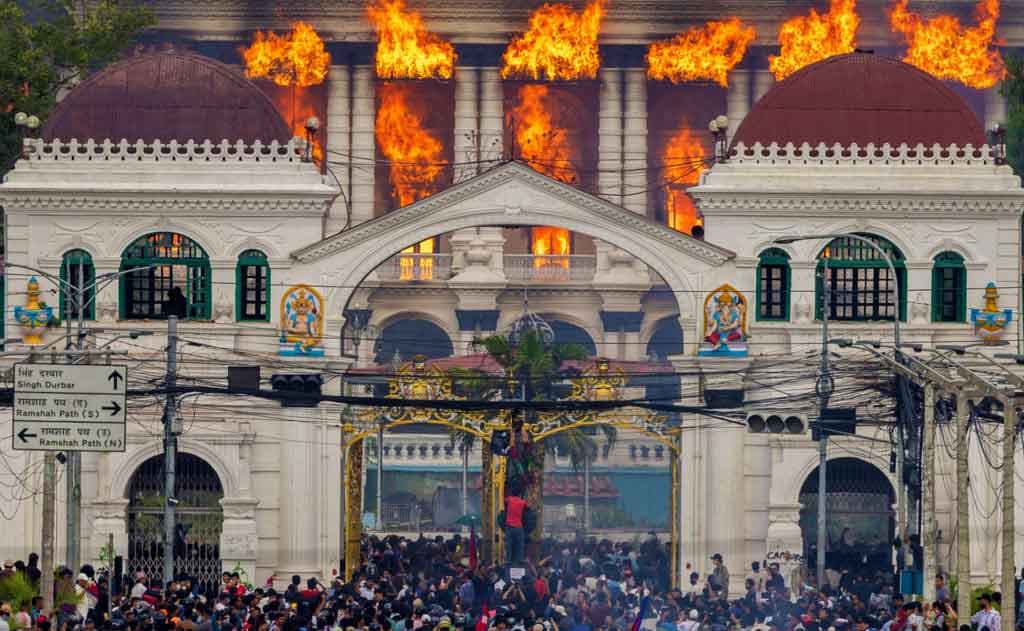
Nepal is witnessing one of its most volatile and distressing political crises in recent years. The situation spiraled out of control after protesters set fire to the private residence of Prime Minister Sharma Oli, ultimately forcing him to resign. Soon after, large groups of angry youth stormed the streets, torching the Nepal Parliament building. Dramatic visuals of the Parliament engulfed in smoke have gone viral across social media, capturing the scale of public outrage.
Roots of the Crisis
For weeks, Nepal has been in flames — both literally and figuratively. The current upheaval did not emerge overnight; rather, it represents the culmination of mounting grievances that have festered within Nepali society for an extended period. Understanding the structural causes of this crisis is essential for observers, particularly NRI readers with family or business ties to Nepal, as the instability carries implications for remittances, investment, and cross-border movement.
The immediate trigger for mass mobilization centers on a constellation of economic and governance failures:
- Rising unemployment and deepening financial distress have pushed people to the brink. Nepal's economy, heavily dependent on remittances from the diaspora and tourism, has struggled to generate sufficient formal employment for its youth population. Young Nepalis, many of whom have completed secondary or tertiary education, face limited opportunities within the country and increasingly resort to migration or informal work.
- Public anger has been fueled further by allegations of corruption and weak governance. Successive governments have faced accusations of embezzlement, nepotism in public appointments, and misallocation of development funds. The lack of transparent accountability mechanisms has eroded public confidence in state institutions.
- The government's harsh response — including a social media ban and violent crackdowns on protesters — only intensified the unrest instead of quelling it. Rather than addressing underlying grievances, authorities attempted to suppress dissent through digital censorship and police action, a strategy that typically backfires by validating protester claims of authoritarian governance.
For NRI observers, this pattern is particularly significant. Nepal's diaspora remittances constitute roughly 20–25% of the country's GDP, yet political instability and governance failures have consistently undermined productive investment of these funds. When young Nepalis perceive limited opportunity at home despite family contributions from abroad, frustration intensifies, potentially accelerating emigration and brain drain.
The Escalation: From Protest to Arson
The decision by protesters to target Prime Minister Sharma Oli's private residence represents a dramatic escalation from conventional street demonstrations. Setting fire to a government leader's home signals not merely political disagreement but a breakdown in the social contract and institutional channels for grievance redressal. This action forced Oli's resignation, removing him from office but not resolving the underlying tensions that mobilized protesters in the first place.
The subsequent assault on the Parliament building itself — one of Nepal's most symbolically significant structures — underscores the depth of alienation from democratic institutions. When citizens resort to burning legislative buildings, it reflects a conviction that representative democracy has failed to serve their interests. This is particularly troubling in Nepal's context, where the country transitioned to democracy only in 1990 and adopted its current constitution in 2015 following a devastating earthquake.
The Parliament fire also carries practical consequences. Damage to the building disrupts legislative functioning, complicates the formation of a new government, and signals to international investors and development partners that Nepal's political system is fragile. For NRIs considering repatriation of savings, business establishment, or long-term relocation, such instability raises questions about property rights, contract enforcement, and the security of financial assets.
Violence on the Streets
In a shocking development, Nepal's Finance Minister was chased, beaten, and manhandled by enraged protestors in broad daylight. Videos of the incident are circulating widely, underscoring the depth of public resentment against the ruling leadership. The attack on a senior cabinet minister represents a critical threshold in civil unrest — the moment when state officials become targets of direct physical violence.
This incident carries several implications. First, it demonstrates that anger is not merely directed at abstract policies but at identifiable individuals perceived as architects of economic mismanagement. The Finance Minister, as custodian of the national budget, becomes a focal point for grievances about fiscal misallocation and austerity measures. Second, the assault indicates that security forces either could not or would not protect a senior official, raising questions about state capacity and the loyalty of security apparatus during periods of civil unrest. Third, the circulation of such videos on social media amplifies the symbolic power of the act, potentially encouraging further direct action against other officials.
For NRI communities, particularly those in finance, business, or government sectors, the targeting of the Finance Minister carries a cautionary message: political upheaval in Nepal can rapidly escalate to personal danger for officials and their families. This may influence decisions about whether to accept postings in Nepal or encourage family members to relocate.
Governance Breakdown and State Capacity
The sequence of events — resignation of the Prime Minister, burning of Parliament, assault on the Finance Minister — reveals a state struggling to maintain basic order and institutional continuity. Nepal's security forces, already stretched thin by geographic challenges and limited resources, appear unable or unwilling to suppress the unrest decisively. This suggests either that the police and military lack sufficient personnel and equipment, or that they are reluctant to employ lethal force against civilians, or both.
The social media ban, while intended to prevent coordination of protests and spread of inflammatory content, instead likely deepened grievances by appearing censorious and heavy-handed. In the modern information environment, such bans are difficult to enforce completely and often generate sympathy for protesters framed as victims of authoritarian suppression.
Nepal's political system has experienced considerable turbulence since 1990. The country has cycled through multiple constitutions, numerous governments, and periods of armed conflict (notably the Maoist insurgency from 1996 to 2006). This history of instability means that institutional memory of crisis management is limited, and political actors may lack experience in de-escalation and negotiated settlement.
Economic Context and Diaspora Implications
Nepal's economy faces structural vulnerabilities that underpin the current crisis. The country's industrial base remains underdeveloped, and the service sector — particularly tourism and remittances — dominates. The COVID-19 pandemic disrupted both tourism and migration patterns, reducing remittance inflows and exacerbating unemployment. As economic conditions deteriorated, government revenues declined, limiting the state's capacity to fund public services or create employment programs.
For the NRI diaspora, these economic conditions carry direct relevance. Remittances sent to family members in Nepal become less valuable if inflation erodes purchasing power, and political instability deters investment in businesses or property. Additionally, if civil unrest continues, banking systems may experience disruptions, complicating the transfer and withdrawal of funds. NRIs with elderly parents or dependents in Nepal face heightened anxiety about their safety and access to essential services.
The crisis also affects Nepali workers abroad. If international media coverage portrays Nepal as dangerously unstable, it may reinforce negative stereotypes and complicate visa applications or employment sponsorships for Nepali nationals seeking work in the US, UK, Canada, UAE, Australia, Singapore, and other major NRI destinations. Conversely, if the crisis resolves quickly and governance improves, it could enhance Nepal's international standing and facilitate labor migration.
A Nation on Edge
With Parliament in flames, its Prime Minister gone, and senior leaders under attack, Nepal is at a political tipping point. Whether the country will find a path to stability or descend further into unrest remains uncertain. The immediate challenge is forming a new government capable of commanding legitimacy and addressing the grievances that mobilized protesters. This requires not merely replacing one leader with another, but undertaking substantive reforms in fiscal management, anti-corruption enforcement, and job creation.
International actors, including India, China, and multilateral institutions such as the World Bank and IMF, will likely attempt to influence Nepal's trajectory. India, as Nepal's largest neighbor and primary trade partner, has particular interest in stability. China's Belt and Road investments in Nepal also create incentives for Beijing to support order restoration. However, external pressure alone cannot resolve internal political divisions.
For the NRI community, the coming weeks and months will be critical. If Nepal's political leadership can negotiate a settlement that includes genuine economic reform and anti-corruption measures, confidence may gradually return. If, conversely, the cycle of protest and repression continues, further deterioration is likely. NRI readers with family, business, or property interests in Nepal should monitor developments closely, maintain communication with trusted local contacts, and consider contingency plans for protecting assets and ensuring family safety.
Related Stories on NRI Globe
- Sachin Tendulkar Celebrates 53rd Birthday with Family and Fans in Mumbai
- Telugu-Origin Men Sampath Rajidi and Sreedhar Mada Plead Guilty in Major H-1B Visa Fraud Case in California – "Dollar Dream" Turns Sour
- FBI Internet Crime Report 2025: NRIs in USA Lost Record $20.877 Billion to Crypto, AI & Tech Scams in 2025 – Key Lessons for 2026
- IIT Bombay Director Slams Coaching Culture
- Monalisa Case: POCSO FIR Filed in MP Marriage Row
Related NRI Globe Coverage
- Iran 1979 vs 2026: From Islamic Revolution to a Nation in Turmoil – The Complete Story
- India's IT Minister Challenges IMF's 'Second-Tier' AI Label at Davos
- Mother of All Deals: India's Historic EU Free Trade Agreement — January 2026 Updates
- PM Modi Meets Chinese Foreign Minister Wang Yi, Signals Progress in India-China Ties Ahead of SCO Summit
- Trump-Putin Summit Set for Next Week: Can They End the Ukraine War
- Haiti in Turmoil: U.S. Embassy on Lockdown Amid Gunfire Chaos
- Pokémon TCG Mega Evolution Set Revealed: Release Date, Elite Trainer Boxes, and Exclusive Promo Cards
- Iranian Foreign Minister Heads to Moscow After U.S. Strikes
Fresh from NRI Globe
- YouTuber Nandu's World (Rama Nandana) UK Visa & Job Fraud Case: Full Details + Key Lessons for NRIs (2026)
- Dussehra / Vijayadashami 2026 Events Country-Wise — Global NRI Directory (Ram Lila, Ravana Dahan, Durga Puja Pandals, Ayudha Puja Venues + Booking)
- Diwali 2026 Events Country-Wise — Global NRI Directory (White House, Leicester, London Trafalgar, Toronto, Auckland, Sydney Parramasala, Fiji, Mauritius, Trinidad, South Africa and More)
- Diwali / Deepavali 2026 Country-Wise NRI Celebrations — Complete Global Guide (USA, UK, Canada, Australia, Fiji, Mauritius, Trinidad, South Africa, UAE and 30+ Countries)