
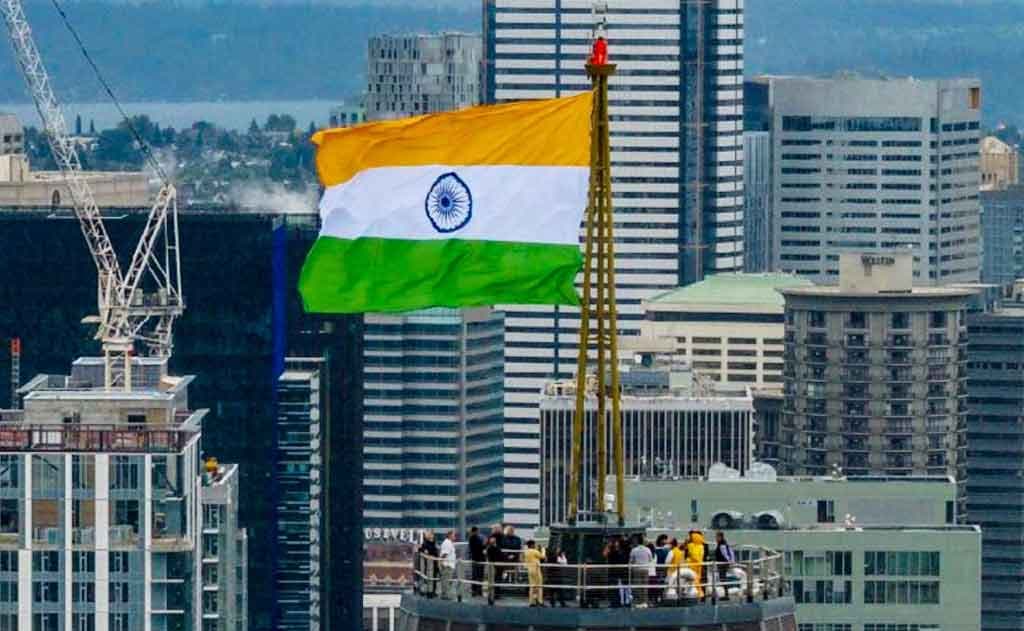
For Indians across continental Europe, Independence Day 2026 falls on Saturday, 15 August — India's 80th Independence Day, marking 79 completed years since 1947. Because Central European Summer Time (CEST) runs 3.5 hours behind India, the Red Fort ceremony in Delhi airs in the early morning, from around 4 AM CEST. This guide covers viewing times, embassy and consulate event patterns, and where to find a flag.
Quick Facts: Independence Day 2026 in Europe
| Detail | Information |
|---|---|
| Date | Saturday, 15 August 2026 |
| Occasion | 80th Independence Day (79 completed years) |
| Red Fort ceremony (IST) | Flag-hoisting from ~7:30 AM IST |
| Local viewing (CEST) | From ~4:00 AM CEST, early morning 15 Aug |
| Time difference | CEST is 3.5 hours behind IST |
| Day of week | Saturday — a weekend advantage |
| Key missions | Berlin, Frankfurt, Munich, Paris, The Hague, Bern, Geneva and more |
When to watch the Red Fort ceremony from Europe
The Prime Minister's address and flag-hoisting at the Red Fort begin in the morning India time. Since most of continental Europe observes CEST during August — 3.5 hours behind India — the live broadcast reaches European screens in the small hours of Saturday morning. If you want to catch the flag going up live, plan for an early start; if you would rather sleep in, the ceremony is easily viewed later on demand via national broadcaster streams and official social channels.
| Location | Time zone | Ceremony airs (approx.) | Local date |
|---|---|---|---|
| Berlin, Frankfurt, Munich (Germany) | CEST (UTC+2) | ~4:00 AM | Sat 15 Aug |
| Paris (France) | CEST (UTC+2) | ~4:00 AM | Sat 15 Aug |
| Amsterdam / The Hague (Netherlands) | CEST (UTC+2) | ~4:00 AM | Sat 15 Aug |
| Zurich, Bern, Geneva (Switzerland) | CEST (UTC+2) | ~4:00 AM | Sat 15 Aug |
| Rome, Milan (Italy) | CEST (UTC+2) | ~4:00 AM | Sat 15 Aug |
| Lisbon (Portugal) | WEST (UTC+1) | ~3:00 AM | Sat 15 Aug |
Unlike the Indian diaspora in the Americas — where the broadcast lands on the evening of 14 August local time — Europeans get the ceremony on the correct calendar date, 15 August, just very early in the day. For a full worldwide breakdown of exact airing times across time zones, see our Red Fort ceremony timings worldwide guide.
The Saturday weekend advantage
In 2026, 15 August falls on a Saturday, which is a genuine bonus for the European diaspora. There is no clash with the working week, so families can gather in the morning, attend a community programme through the day, and enjoy a relaxed evening without rushing back to office or school. Weekend timing also makes it easier for Indian associations, student groups and cultural societies to organise picnics, potlucks and flag-hoisting gatherings that people can actually attend.
Embassy and consulate events: the general pattern
Indian missions across Europe traditionally observe Independence Day with a formal flag-hoisting ceremony, typically held on the morning of 15 August at the embassy or consulate premises. The customary format includes the unfurling of the National Flag, the singing of the national anthem, and a reading of the President of India's address to the nation. Many missions follow this with light refreshments and, in some cases, cultural performances by local community groups.
Because dates, times, venues, registration requirements and any security or capacity limits vary from one mission to another — and can change year to year — you should always check the official announcement from your nearest Indian mission. Missions publish details on their websites and verified social media handles in the days before 15 August. Some events are open to the community, while others require prior registration; a few may be held at an external venue rather than the chancery. Confirm before you travel.
- Check the official website of your nearest embassy or consulate a week or two ahead.
- Follow verified social media handles for last-minute timing or venue updates.
- Note whether registration is required — several missions request advance sign-up.
- Arrive early if the flag-hoisting is timed for the morning; entry and security checks take time.
- Carry photo ID, as missions may ask for identification at the gate.
Germany
Germany is home to one of Europe's largest Indian communities, concentrated around IT, engineering, research and student hubs. The Embassy of India in Berlin is the principal mission, with the Consulates General in Frankfurt and Munich serving the west and south. Each typically holds its own Independence Day observance. Frankfurt's large tech and finance workforce and Munich's engineering and student community usually mean well-attended gatherings. Watch the Berlin embassy and the Frankfurt and Munich consulate channels for their specific programmes.
France
The Embassy of India in Paris anchors observances for France. The Indian community there spans professionals, students, restaurateurs and long-settled families of Indian origin. Expect the customary morning flag-hoisting and national anthem, with community participation. As always, confirm timing and whether the event is open or by registration through the embassy's official announcement.
Netherlands
The Embassy of India in The Hague serves a growing Indian diaspora clustered around Amsterdam, Rotterdam, Eindhoven and the wider Randstad — many working in technology, logistics and the sciences. The Netherlands also has a large, long-established Hindustani (Indo-Surinamese) community with deep cultural ties to India. Independence Day programmes tend to draw both newer arrivals and heritage communities. Check the embassy's notice for exact details.
Switzerland
The Embassy of India in Bern is the main mission for Switzerland, with the Consulate General in Geneva also active given the city's international organisations and Indian professional presence. Zurich hosts a substantial community linked to banking, pharma and technology. Swiss observances follow the same flag-hoisting-and-anthem pattern; verify the specific location and time with the Bern embassy or Geneva consulate before attending.
Other European countries
Across the rest of the continent — Italy (Rome, Milan), Belgium (Brussels), Spain (Madrid), Portugal (Lisbon), Austria (Vienna), Poland (Warsaw) and the Nordic and Baltic states — Indian embassies and consulates hold comparable Independence Day observances. Brussels also hosts India's mission to the European Union. If you live outside the major hubs, your consular jurisdiction may cover several countries, so identify the mission responsible for your region and follow its announcement. Community associations frequently organise separate cultural events on the same weekend.
Where to buy the Indian flag in Europe
If you want to display the Tiranga at home or carry one to a community event, you have several sourcing options across Europe:
- Online marketplaces — major European e-commerce sites list flags in various sizes; order a week or two ahead to allow for delivery.
- Indian grocery and specialty stores — shops in cities like Frankfurt, Berlin, Paris, The Hague and Zurich often stock flags around mid-August.
- Community associations — many Indian societies distribute small hand flags at their events.
- Print-on-demand services — for larger flags or banners, local print shops can produce them, but ensure the proportions and colours are correct.
Respecting the flag: rules in India and abroad
The manner of displaying the National Flag in India is governed by the Flag Code of India, 2002 and the Prevention of Insults to National Honour Act, 1971. These lay down how the Tiranga should be handled — correct orientation with the saffron band up, keeping it clean and undamaged, and never letting it touch the ground. Our detailed Flag Code of India rules explainer walks through the essentials.
Importantly, these are Indian statutes and apply within India. When you are in Germany, France, Switzerland or any other host country, you should also respect local law and host-country protocol regarding flags, public gatherings and displays. Rules on flying foreign flags, using public spaces and holding events differ from country to country, so treat the Flag Code as a mark of respect while following the regulations of the place where you live. When in doubt, community organisers and your mission can advise on what is appropriate locally.
Community context across Europe
The Indian and Indian-origin diaspora in Europe is diverse — spanning tech professionals in Germany's cities, students across the continent's universities, researchers, healthcare workers, entrepreneurs and heritage communities like the Indo-Surinamese Dutch. Independence Day is one of the moments when this scattered community comes together: at embassy lawns, in rented halls, in parks for potluck picnics, and increasingly in online watch-parties for the Red Fort broadcast. For a broader look at how NRIs everywhere can plan the day, see our Independence Day 2026 NRI guide.
Understanding the 80th vs 79th question
A common point of confusion each year: is 2026 the 79th or the 80th Independence Day? The answer is that 15 August 2026 is the 80th Independence Day, marking 79 completed years of independence. The first Independence Day was 15 August 1947 (the 1st), so counting each observance since then makes 2026 the 80th. Because the count of celebrations is always one ahead of the number of full years elapsed, it is incorrect to call it the "79th Independence Day" or to say India completes "80 years." Our dedicated 80th or 79th Independence Day 2026 explainer settles the maths in full.
Planning your Independence Day in Europe
To make the most of Saturday, 15 August 2026: decide whether you will wake early for the ~4 AM CEST live Red Fort broadcast or watch it later on demand; check your nearest Indian mission's official announcement for its flag-hoisting timing and whether registration is needed; source a flag in advance; and consider a community picnic or potluck to use the weekend. Whether you are in Berlin, Paris, Amsterdam, Zurich or a smaller town, the day is a chance to connect with home and with the wider diaspora. For the full campaign, our Independence Day 2026 pillar brings all our coverage together, and our Independence Day 2026 USA hub compares how the day plays out across the Atlantic.