
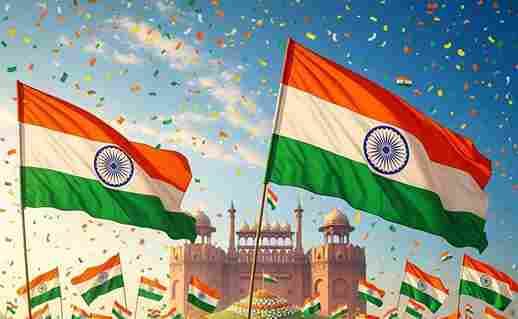
For a school celebrating Independence Day on 15 August 2026, a strong programme blends a correct flag-hoisting ceremony, the national anthem, short speeches, patriotic group songs, dance and skits on the freedom struggle, competitions, tricolour decorations and a values or cleanliness pledge. Below are around 25 practical, inclusive ideas you can adapt for any grade, with a note on getting the flag and the banner wording right.
Get the date and banner wording right first
Before you design a single banner, fix the wording. 15 August 2026 is the 80th Independence Day of India, marking 79 completed years of freedom since 1947. It is not the "79th Independence Day," and it is not "80 years of independence." Because banners, certificates and stage backdrops are printed weeks in advance, brief your art teacher and printer clearly, and read our explainer on the 80th vs 79th Independence Day 2026 so the whole school communicates the same, accurate figure.
For the full context of the day — its history, significance and how communities mark it — link students and parents to our Independence Day 2026 pillar guide.
The flag-hoisting ceremony, done correctly
The flag ceremony is the heart of the function, so it must be done by the book. On Independence Day the flag is hoisted — it is tied to the bottom of the pole in a bundle and raised, then unfurled at the top. This differs from Republic Day, where the flag is already at the top and only unfurled. If your teachers are unsure which term and action applies, share our guide on hoisting vs unfurling the flag.
All handling must follow the Flag Code of India, 2002, and treat the flag with the dignity the Prevention of Insults to National Honour Act, 1971 requires. Practical points for a school:
- The saffron band must always be at the top; the flag must never touch the ground, water or floor.
- Only a clean, undamaged flag in the correct proportions (3:2) should be used.
- Rehearse the hoist so the flag opens cleanly at the top without snagging.
- Assign responsible staff to raise, guard and, at the end of the day, lower and store the flag respectfully.
- Never drape the flag over furniture, vehicles or people, and never use it as a table cloth, bunting or costume.
For the complete rules on display, size, timing and respectful handling, keep the Flag Code of India rules open while you plan, and always consult the official Ministry of Home Affairs text for anything you are unsure about.
National anthem and patriotic music
After the flag is hoisted, the assembly sings the national anthem, Jana Gana Mana. It must be sung in its official, unaltered form and at the correct point in the ceremony — never as background music or decoration. Keep a music teacher or senior student to lead so the tune, words and timing (about 52 seconds) are correct, and ask everyone to stand at attention.
You can then include a short set of patriotic group songs performed by class choirs. Describe and select these by title and theme — songs about unity, sacrifice, the tricolour, the land and the freedom movement — and avoid reproducing copyrighted film-song lyrics on screens, printed sheets or banners. Choose age-appropriate, well-known compositions and rehearse for clear diction rather than volume.
Speeches, and handling historical topics with balance
Short speeches keep the audience engaged. Ideas that work well:
- A two-minute welcome by the head or head student.
- Student speeches (English and regional languages) on themes like "What freedom means to me," unity in diversity, or the duties of a citizen.
- A brief address on a freedom-struggle theme delivered factually, without praise or criticism of any political party, leader or government.
If students research historical debates — for example the history of Vande Mataram as the national song — encourage a balanced, factual treatment based on documented history, with no communal framing. When in doubt about the status of the anthem, national song or emblem, point students to official Ministry of Culture and MHA sources.
Dance, skits and cultural performances
Cultural items let more students take part and make the freedom story vivid:
- A group dance choreographed to a patriotic instrumental or a song chosen by theme (not by reproduced lyrics).
- A short skit dramatising a milestone of the freedom struggle — keep it factual, inclusive and respectful of every community.
- A "unity in diversity" segment where students present the languages, dress and folk arts of different states.
- A silent tableau (living picture) representing farmers, soldiers, teachers, doctors and workers who build the nation.
Important: in any skit or fancy-dress item, students must never wear the national flag as clothing, a cape, a sash or drapery — this is prohibited. If a costume needs a tricolour theme, use separate saffron, white and green fabric arranged as ordinary clothing, without reproducing the flag or the Ashoka Chakra. The State Emblem is separately protected under the State Emblem of India (Prohibition of Improper Use) Act, 2005, so it should not be copied onto costumes or props.
Competitions and academic activities
Competitions can run in the days before the function, with prizes given on stage on 15 August:
| Activity | Best for | Theme ideas |
|---|---|---|
| Essay writing | Middle and senior classes | "79 years of freedom," citizen duties, unity |
| Poster / drawing | All ages | Freedom fighters, the tricolour, a clean India |
| Quiz | Middle and senior | History, geography, the Constitution, national symbols |
| Elocution / debate | Senior classes | What freedom means today |
| Handwriting / slogan | Primary classes | Simple patriotic slogans and pledges |
| Photo / collage | Senior classes | Everyday heroes in the community |
For the quiz, include a question on the correct wording — "Is 2026 the 79th or 80th Independence Day?" — as a memorable way to reinforce the accurate figure. To understand the meaning behind the colours and the chakra for poster and quiz rounds, read our guide to the Indian national flag history and meaning.
Tricolour decorations without single-use plastic
Decorations set the mood, but plan them to be respectful and eco-friendly:
- Avoid single-use plastic flags. They are quickly discarded and often trampled, which insults the flag and adds to litter.
- Use cloth or paper buntings in saffron, white and green — but note that decorative bunting is a colour scheme, not the national flag itself, and must not carry the chakra unless it is a proper flag displayed under the Flag Code.
- Decorate with marigolds, potted plants, rangoli and reusable fabric drapes in tricolour shades.
- Set up a themed photo corner with a slogan board — again, without turning the actual flag into a prop.
- Plan in advance how any paper flags will be collected and stored respectfully rather than thrown away.
If your school does use small cloth flags and some become soiled or damaged, dispose of them with dignity as explained in our guide on how to dispose of the national flag — never in ordinary rubbish.
A values and cleanliness pledge
Close the programme with a collective pledge that turns celebration into commitment. Options include the National Pledge, a citizen-duties pledge, or a short school-written promise to keep the campus and neighbourhood clean, respect every classmate regardless of background, and use resources responsibly. A brief Swachhata (cleanliness) drive — students tidying a corner of the campus or a nearby public space after the function — makes the values tangible and inclusive.
A simple running order
- Assembly and welcome
- Flag hoisting (Flag Code compliant)
- National anthem, Jana Gana Mana, in official form
- Head's short address
- Patriotic group songs (by theme)
- Student speeches in multiple languages
- Dance, skit or tableau
- Prize distribution for competitions
- Values and cleanliness pledge
- Vote of thanks and refreshments
Keep the total under about 90 minutes, rehearse the flag ceremony and anthem thoroughly, and make sure every activity is inclusive of all students. Done well, the function is both a joyful celebration and a genuine civics lesson.
Related reading
- Independence Day 2026: complete guide
- Is 2026 the 80th or 79th Independence Day?
- Flag Code of India rules explained
- Hoisting vs unfurling the flag
- Indian national flag: history and meaning
- How to dispose of the national flag respectfully
Related NRI Globe Coverage
- Independence Day Fancy Dress Ideas for Kids
- Independence Day vs Republic Day: 12 Differences Explained
- Independence Day 2026 for NRIs: USA, UK, Canada, Australia, UAE, Europe and Singapore Guide
- Independence Day Speech for Kids: Simple Speeches for Ages 4 to 10
- Short Independence Day Speech: 1-Minute and 2-Minute Versions
- Why Is India's Independence Day on 15 August? The Reason Behind the Date
- Celebrating Independence Day 8,000 Miles From Home
- Independence Day 2026 Theme, Red Fort Ceremony and What to Expect
Fresh from NRI Globe
- YouTuber Nandu's World (Rama Nandana) UK Visa & Job Fraud Case: Full Details + Key Lessons for NRIs (2026)
- Dussehra / Vijayadashami 2026 Events Country-Wise — Global NRI Directory (Ram Lila, Ravana Dahan, Durga Puja Pandals, Ayudha Puja Venues + Booking)
- Diwali 2026 Events Country-Wise — Global NRI Directory (White House, Leicester, London Trafalgar, Toronto, Auckland, Sydney Parramasala, Fiji, Mauritius, Trinidad, South Africa and More)
- Diwali / Deepavali 2026 Country-Wise NRI Celebrations — Complete Global Guide (USA, UK, Canada, Australia, Fiji, Mauritius, Trinidad, South Africa, UAE and 30+ Countries)