
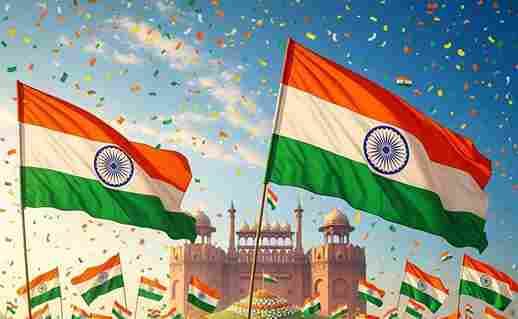
Looking for 10 lines on Independence Day for a school essay, speech or classroom recitation? Below are three ready-to-use sets graded by level — very simple (Classes 1-3), moderate (Classes 4-6) and advanced (Classes 7-10). Each set correctly states that 15 August 2026 is the 80th Independence Day, marking 79 completed years of freedom.
| Quick Facts | Detail |
|---|---|
| Date in 2026 | Saturday, 15 August 2026 |
| Which Independence Day | 80th Independence Day |
| Years completed | 79 completed years of independence |
| Year of independence | 1947 (freedom from British rule) |
| Main national ceremony | Flag hoisting at the Red Fort, Delhi |
| Flag action on this day | Hoisting (flag raised from the bottom) |
| Best sets for | Classes 1-3, 4-6 and 7-10 |
Before you begin: get the number right
Many worksheets circulating online wrongly say "79th Independence Day". That is incorrect for 2026. Because India became free on 15 August 1947, the day in 2026 is the 80th Independence Day and it marks 79 completed years of independence. Teaching children the accurate figure early avoids a very common mistake — you can read the full explanation on our 80th vs 79th Independence Day guide. For the wider background and history, see our Independence Day 2026 pillar page.
Set 1 — Very simple 10 lines (Classes 1 to 3)
Short words and one idea per line, easy for young learners to memorise.
- Independence Day is celebrated on 15 August every year.
- India became free on 15 August 1947.
- In 2026, we celebrate the 80th Independence Day.
- It marks 79 completed years of freedom.
- The national flag is hoisted on this day.
- Our flag has three colours — saffron, white and green.
- There is a blue Ashoka Chakra in the middle of the flag.
- Many freedom fighters worked hard to make India free.
- We sing the national anthem, "Jana Gana Mana".
- I feel very proud to be an Indian. Jai Hind!
Set 2 — Moderate 10 lines (Classes 4 to 6)
Slightly longer sentences with a few extra facts for middle-primary students.
- Independence Day is one of India's most important national festivals.
- It is observed on 15 August, the day India won freedom in 1947.
- In 2026 the nation celebrates its 80th Independence Day, marking 79 completed years of independence.
- India gained freedom from British rule after a long struggle.
- The Prime Minister hoists the national flag at the Red Fort in Delhi.
- On Independence Day the flag is hoisted, meaning it is raised from the bottom of the pole.
- A ceremonial 21-gun salute and the national anthem follow the flag hoisting.
- Schools and offices hold flag ceremonies, cultural programmes and patriotic songs.
- We remember leaders and freedom fighters who sacrificed for the country.
- It is a proud reminder to serve the nation and respect the tricolour.
Set 3 — Advanced 10 lines (Classes 7 to 10)
Richer vocabulary and context for higher classes, essays and speeches.
- Independence Day, celebrated on 15 August, commemorates India's freedom from nearly two centuries of colonial rule.
- India achieved independence on 15 August 1947, after decades of struggle and sacrifice.
- In 2026, India observes its 80th Independence Day, marking 79 completed years as a free and sovereign nation.
- The freedom movement drew on many streams of thought, from mass non-violent campaigns to revolutionary action.
- The transfer of power in 1947 was also accompanied by the Partition, a moment of both freedom and great human hardship.
- The main national ceremony is held at the Red Fort, where the Prime Minister hoists the flag and addresses the nation.
- On Independence Day the flag is hoisted — raised from the bottom — which differs from the unfurling of an already-raised flag on Republic Day.
- Displaying the national flag follows the Flag Code of India, 2002 and the Prevention of Insults to National Honour Act, 1971.
- The day honours the values of liberty, unity, equality and constitutional democracy on which the Republic stands.
- It inspires every citizen to contribute responsibly to the nation's progress and to protect its hard-won freedoms.
A quick word on the flag (for teachers and older students)
If your lines mention the flag, keep them accurate. On Independence Day the flag is hoisted — folded and tied at the bottom, then raised. On Republic Day it is unfurled — already at the top of the pole and simply opened. Public display and handling of the national flag are governed by the Flag Code of India, 2002 and the Prevention of Insults to National Honour Act, 1971; teachers should refer students to the official Ministry of Home Affairs text for the exact rules. When a paper flag becomes soiled or damaged, it must be disposed of respectfully — our guide on how to dispose of a national flag explains the correct method for classrooms.
How teachers can help children present these lines
Ten short lines are ideal for building early public-speaking confidence. Here is a simple approach that works from Class 1 upward.
- Match the set to the child's level — Set 1 for Classes 1-3, Set 2 for 4-6, Set 3 for 7-10.
- Have students underline the two key facts — "80th Independence Day" and "79 completed years" — so the numbers stay correct.
- Ask children to read each line aloud twice before memorising, pausing at the end of every line.
- Encourage a clear, slow delivery with eye contact rather than fast recitation.
- Let younger children hold a small paper tricolour, handled respectfully, as a prop.
- End the recitation with "Jai Hind!" to give a confident, familiar close.
Presentation checklist
- Correct year figure used (80th Independence Day, 79 completed years)
- Set chosen matches the student's class level
- Lines rehearsed aloud at least twice
- Flag references are accurate (hoisting, not unfurling)
- Any flag prop is handled respectfully
- Speech ends clearly with a confident "Jai Hind!"
Which set should you use?
| Class level | Recommended set | Best for |
|---|---|---|
| Classes 1-3 | Set 1 (very simple) | Recitation, first speech, memory practice |
| Classes 4-6 | Set 2 (moderate) | Short essay, assembly speech |
| Classes 7-10 | Set 3 (advanced) | Essay, debate, detailed speech |
A note on the 2026 celebrations
Because 15 August 2026 falls on a Saturday, many families and schools will have a relaxed weekend around the holiday. Each year a theme is associated with the celebrations — in 2025 it was "Naya Bharat" — and the 2026 theme is expected to be announced by the Press Information Bureau closer to 15 August, so children should not state a 2026 theme as confirmed. Families abroad can follow the Red Fort ceremony too; note that it airs early-morning IST, which for the United States is the evening of 14 August local time. See our Red Fort ceremony timings worldwide and the Independence Day 2026 NRI guide for details.
Related reading
- Independence Day 2026: history, significance and celebrations
- Is it the 80th or 79th Independence Day in 2026?
- Flag Code of India: rules for displaying the tricolour
- How to dispose of a national flag respectfully
- Independence Day 2026 NRI guide
- Red Fort ceremony timings worldwide
Related NRI Globe Coverage
- Independence Day vs Republic Day: 12 Differences Explained
- Independence Day 2026 for NRIs: USA, UK, Canada, Australia, UAE, Europe and Singapore Guide
- Independence Day Speech for Kids: Simple Speeches for Ages 4 to 10
- Independence Day Fancy Dress Ideas for Kids
- Short Independence Day Speech: 1-Minute and 2-Minute Versions
- Why Is India's Independence Day on 15 August? The Reason Behind the Date
- Celebrating Independence Day 8,000 Miles From Home
- Independence Day 2026 Theme, Red Fort Ceremony and What to Expect
Fresh from NRI Globe
- YouTuber Nandu's World (Rama Nandana) UK Visa & Job Fraud Case: Full Details + Key Lessons for NRIs (2026)
- Dussehra / Vijayadashami 2026 Events Country-Wise — Global NRI Directory (Ram Lila, Ravana Dahan, Durga Puja Pandals, Ayudha Puja Venues + Booking)
- Diwali 2026 Events Country-Wise — Global NRI Directory (White House, Leicester, London Trafalgar, Toronto, Auckland, Sydney Parramasala, Fiji, Mauritius, Trinidad, South Africa and More)
- Diwali / Deepavali 2026 Country-Wise NRI Celebrations — Complete Global Guide (USA, UK, Canada, Australia, Fiji, Mauritius, Trinidad, South Africa, UAE and 30+ Countries)