
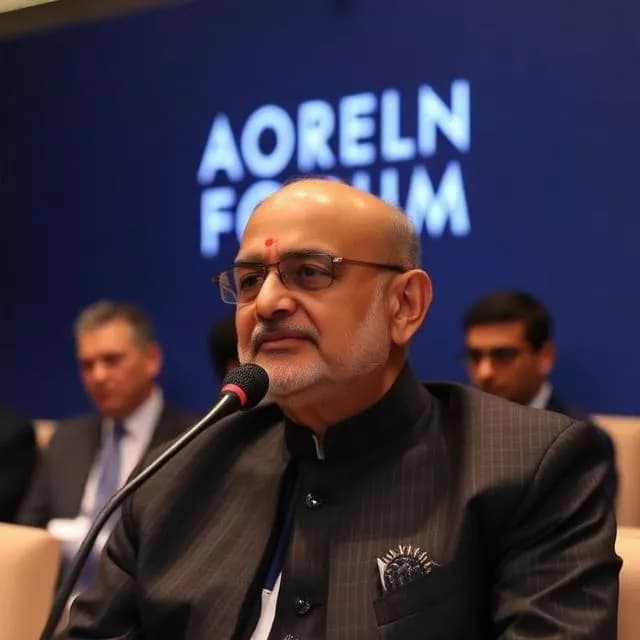
India's IT Minister Challenges IMF's 'Second-Tier' AI Label at Davos
India's IT Minister Ashwini Vaishnaw boldly challenged the International Monetary Fund (IMF)'s classification of India as a "second-tier" AI power during a high-profile panel at the World Economic Forum (WEF) in Davos 2026. In a direct rebuttal to IMF Managing Director Kristalina Georgieva, Vaishnaw asserted that India firmly belongs in the first group of global AI leaders, backed by credible international benchmarks like Stanford University's assessments.
This exchange has ignited widespread discussion on India's true standing in the global AI race, highlighting strengths in talent, applications, and preparedness while acknowledging ongoing challenges in foundational models and hardware.
What Sparked the Debate at Davos?
During the WEF panel on the global impact of AI, Kristalina Georgieva suggested that India falls into a "second grouping" or second-tier category of AI economies—behind frontrunners like the US and China. She pointed to potential gaps in preparedness for widespread AI adoption.
Vaishnaw responded firmly and factually:
- "I don't know what the IMF criteria have been, but Stanford places India as third in terms of AI penetration, in terms of AI preparedness, and in terms of AI talent."
- He added that on AI talent specifically, India ranks second globally.
- "I don't think your classification in the second book is right. It's actually in the first!"
Vaishnaw emphasized India's holistic progress across the five layers of AI architecture:
- Applications — Where 95% of real-world ROI occurs, and India excels in deployment across sectors.
- Models — Building toward stronger foundational capabilities.
- Chips — Addressing dependencies through strategic initiatives.
- Infrastructure — Including high-performance computing resources.
- Energy — Supporting sustainable scaling.
He projected India as the future largest supplier of AI services worldwide, driven by widespread diffusion rather than just scale.
Stanford's 2025 Report: India's Impressive Rankings
Vaishnaw's arguments drew heavily from Stanford University's Global AI Vibrancy Tool and related 2025 assessments (covering data through 2024). Key highlights for India include:
- Ranked third globally in AI Vibrancy (behind only the US and China), with a notable leap from seventh place in prior years.
- Score of 21.59 in the 2024 Global Vibrancy Index, surpassing countries like South Korea (17.24) and the UK (16.64).
- Third in AI penetration and preparedness.
- Second in AI talent.
- A massive 252% surge in AI-related job postings, reflecting booming demand and a vibrant ecosystem in talent and applications.
The vibrancy framework evaluates seven pillars: research and development, responsible AI, economy, talent, policy and governance, public opinion, and infrastructure. India's gains stem from strong policy pushes, growing R&D output, patent filings, investments, and digital infrastructure expansion.
Key Government Initiatives Powering India's AI Rise
Vaishnaw spotlighted flagship programs demonstrating India's commitment:
- IndiaAI Mission — A major national effort providing affordable access to GPUs and compute resources for startups, researchers, and developers. It aims to democratize AI tools and foster innovation.
- AIRAWAT Supercomputer — Developed under the National Programme on AI and installed at C-DAC Pune, AIRAWAT achieved a global ranking of 75th in the Top 500 Supercomputing List (as of earlier updates). It delivers high AI petaflops capacity, positioning India among top AI supercomputing nations and supporting research, analytics, and knowledge dissemination.
These initiatives address compute bottlenecks, enable cost-effective scaling, and align with the vision of "AI for All" to drive socioeconomic progress.
The Broader Debate: Strengths vs. Gaps
While Vaishnaw's rebuttal earned praise for its confidence and data-backed approach, the discussion also revealed nuanced views:
Strengths Praised:
- World-class talent pool and rapid job growth.
- Leadership in AI applications and real-world deployment.
- Policy momentum through missions like IndiaAI.
Criticisms and Challenges:
- Lags in developing indigenous foundational models and advanced chips (heavy reliance on global suppliers).
- Infrastructure and energy constraints for massive-scale training.
- Need for continued investment to close gaps with US/China in core innovation.
The exchange underscores that AI leadership definitions vary—whether by foundational tech, talent/application vibrancy, or economic impact. Vaishnaw's focus on applications (where most value is created) positions India uniquely for global influence.
Why This Matters for NRIs and Global Indians
For the NRI community and Indians worldwide, this moment signals exciting opportunities:
- India's AI ecosystem is creating high-value jobs in tech, data science, and AI services—many remote-friendly or open to global talent.
- Returning or collaborating with Indian startups/institutions becomes more attractive amid government-backed compute access.
- As India aims to export AI services massively, NRIs in tech hubs can bridge partnerships, investments, and knowledge transfer.
This Davos exchange reinforces India's trajectory as a formidable AI player, not just catching up but redefining leadership through talent, applications, and inclusive growth.
India's rise in AI is unstoppable—fueled by vision, talent, and bold rebuttals on the global stage. Stay tuned to NRIGlobe.com for more updates on AI developments, NRI impacts, tech policy, and opportunities shaping the future.
Latest NRI News & Global Updates:
Health, Wellness & Lifestyle for NRIs
https://nriglobe.com/lifestyle/
Latest NRI News & Global Updates
https://nriglobe.com/news/
Business & Finance News for NRIs
https://nriglobe.com/business/
Investment Guides for NRIs
https://nriglobe.com/investment/
Jobs & Career Opportunities for NRIs
https://nriglobe.com/jobs/
Related NRI Globe Coverage
- Davos 2026 Day 1 Highlights: India's Historic Presence & What It Means for NRIs Worldwide
- Davos 2026: $26B AI-Green Deals – MMRDA’s Sustainable Tech Boom
- How to Create an AWS Free Tier Account in the USA: Complete Step-by-Step Guide for 2026
- WEF Davos 2026 Day 2: Key Highlights & Global Takeaways
- Why NRIs Celebrate January 1: The Colonial History Behind India's New Year
- ISRO HOPE Mission: Ladakh Analogue Site for Moon and Mars Tests
- From Vegas Lights to India’s Data Centers: AWS
- From Dubai to New Jersey: Will NRI Votes Shape India’s
Fresh from NRI Globe
- YouTuber Nandu's World (Rama Nandana) UK Visa & Job Fraud Case: Full Details + Key Lessons for NRIs (2026)
- Dussehra / Vijayadashami 2026 Events Country-Wise — Global NRI Directory (Ram Lila, Ravana Dahan, Durga Puja Pandals, Ayudha Puja Venues + Booking)
- Diwali 2026 Events Country-Wise — Global NRI Directory (White House, Leicester, London Trafalgar, Toronto, Auckland, Sydney Parramasala, Fiji, Mauritius, Trinidad, South Africa and More)
- Diwali / Deepavali 2026 Country-Wise NRI Celebrations — Complete Global Guide (USA, UK, Canada, Australia, Fiji, Mauritius, Trinidad, South Africa, UAE and 30+ Countries)